
Why the US Is Buying Foreign Currency for the First Time in 28 Years: The Yen Intervention as Defense of the US Debt Market
For the first time in 28 years, the United States is spending money to rescue someone else's currency. The most interesting part of this story is not the intervention itself, but how the world found out about it. A Reuters photographer captured US Treasury Secretary Scott Bessent's handwritten note: "To do by: Japanese yen 5–10 billion." A $5–10 billion note in a market with a daily turnover of $9.6 trillion (BIS estimate, 2025 triennial survey) moves nothing — but it changed market psychology. And that, as we will show, was exactly what was needed.
The Facts: What Happened
| Date | Event |
|---|---|
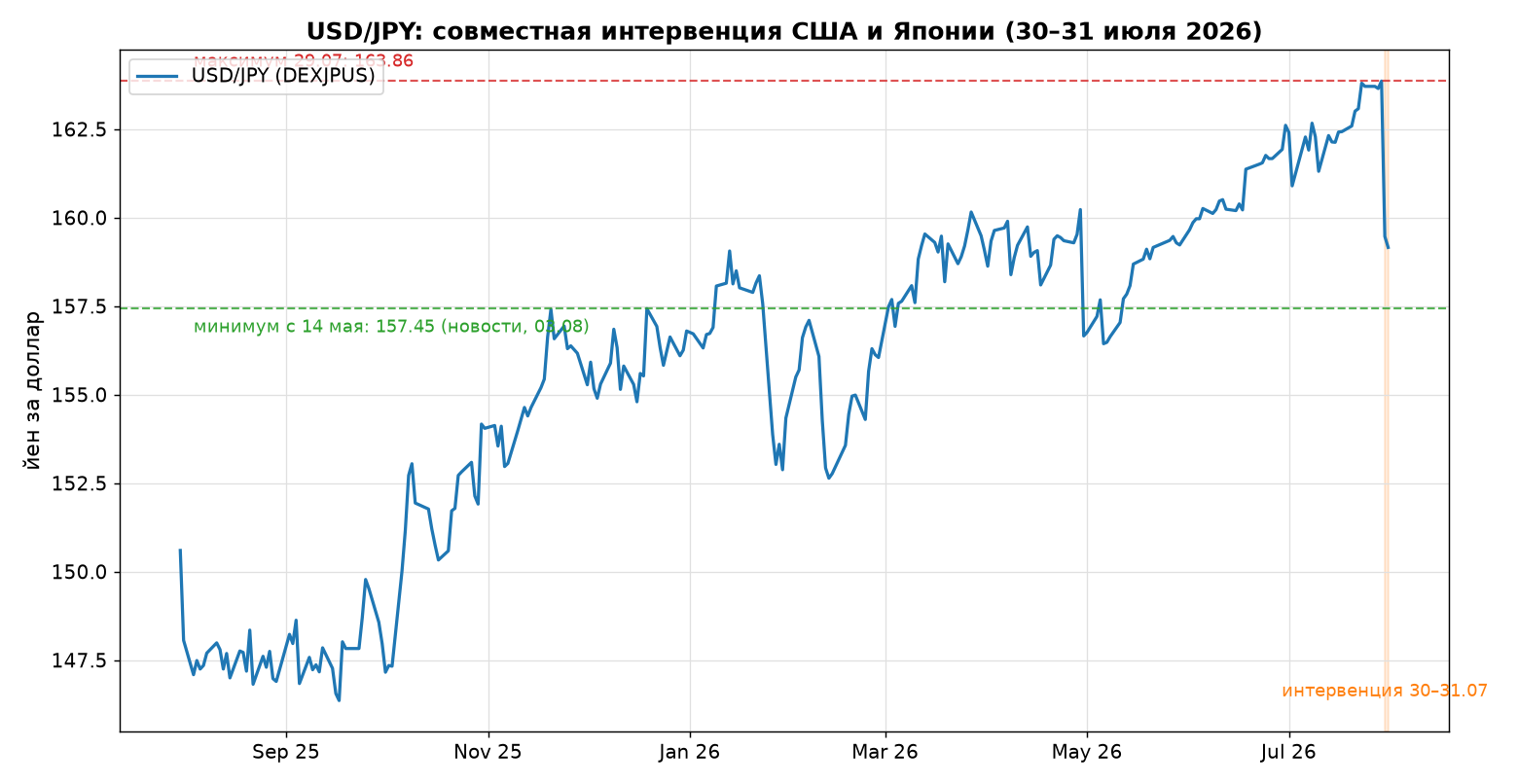
| ~Jul 25–31 | Yen falls to a 40-year low; USD/JPY reaches 163.86 (Jul 29) |
| Jul 30–31 | Joint US-Japan intervention; ING estimates up to $80 billion over two days |
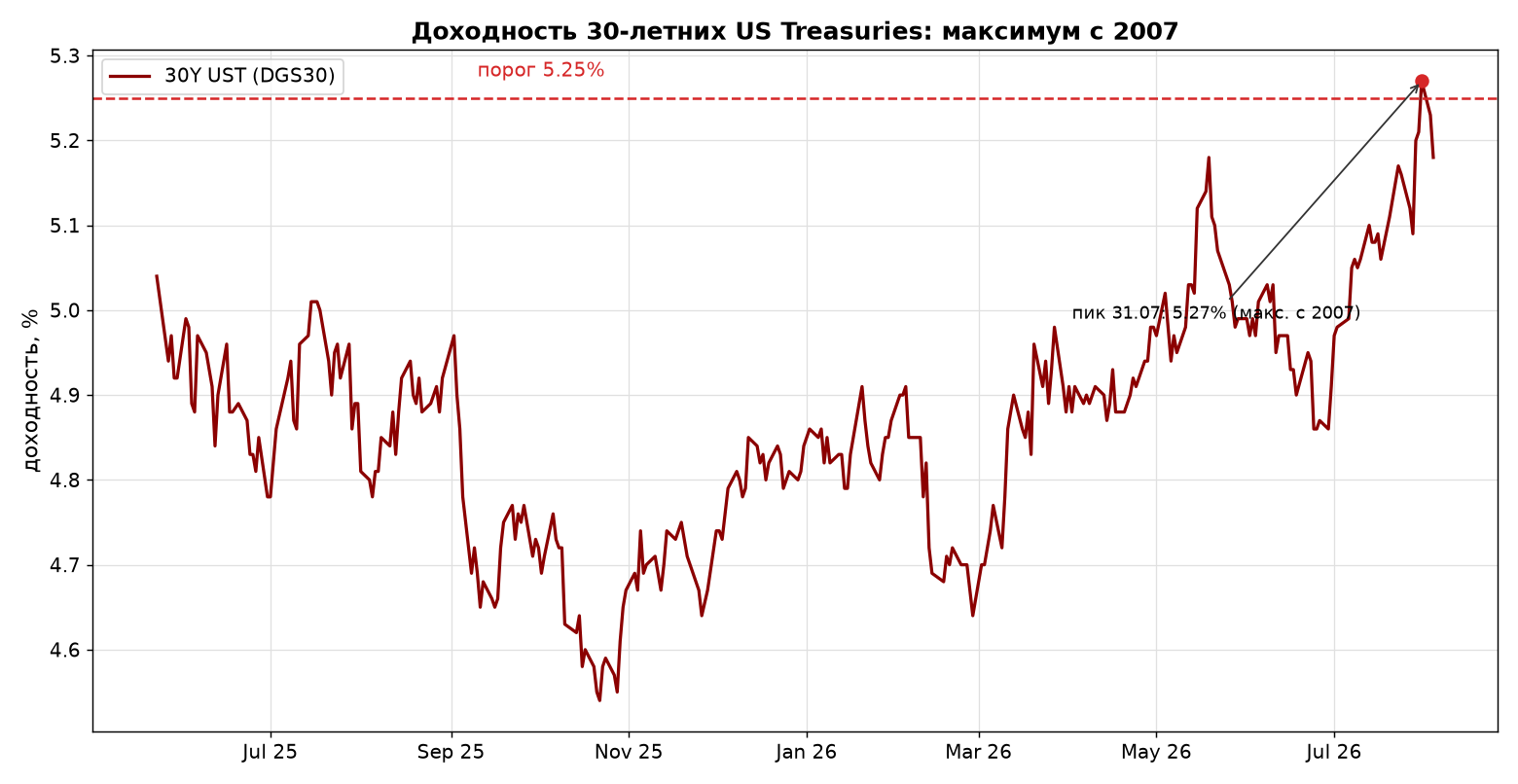
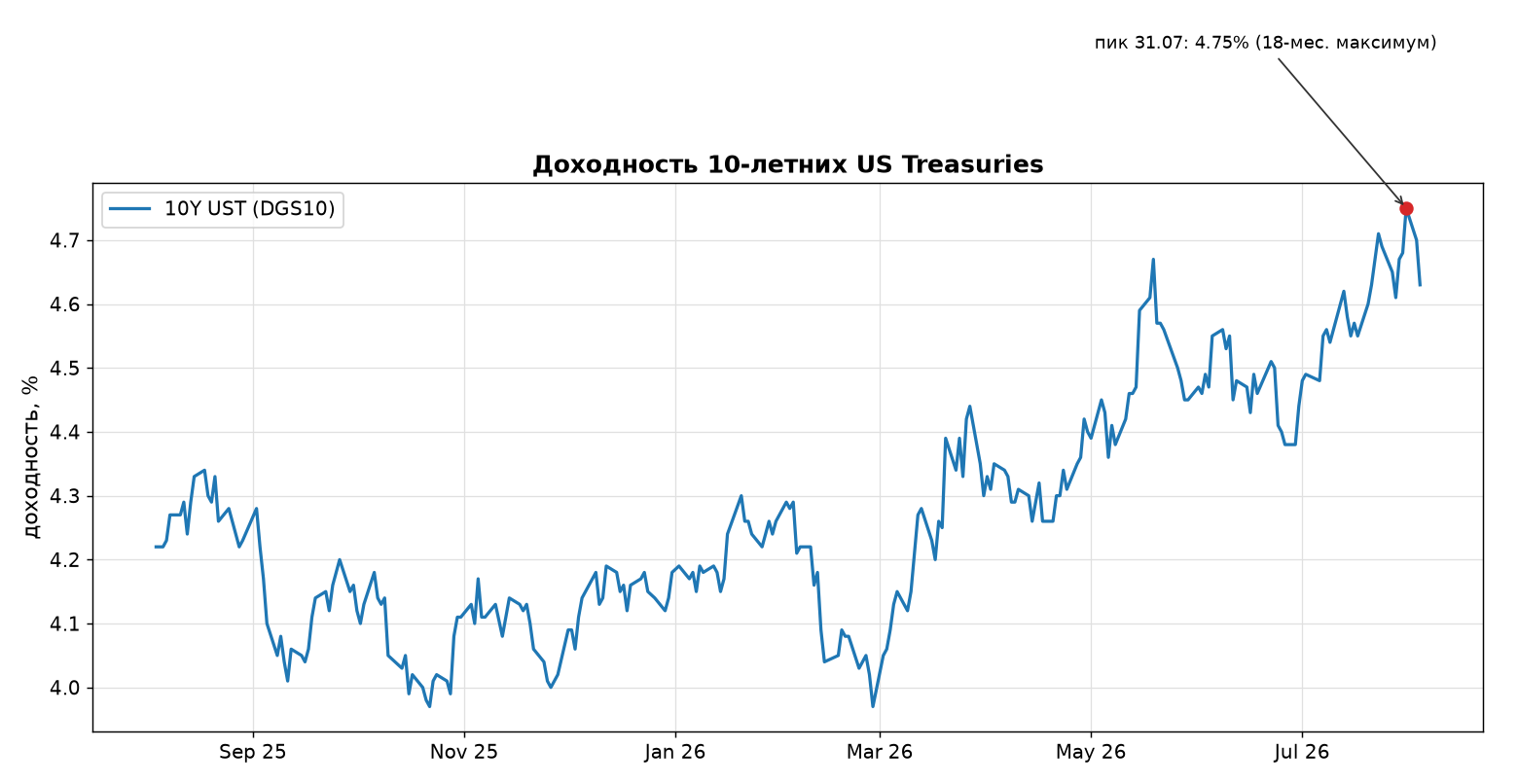
| Jul 31 | 30Y UST peak — 5.27% (highest since 2007); 10Y — 4.75% (18-month high) |
| Jul 31 – Aug 3 | USD/JPY falls to 157.45 — the lowest since May 14 (Reuters; FRED lags) |
| Aug 2 | Bessent confirms US participation, says ready to repeat, urges "upsizing" FIMA (Reuters) |
| Early August | US national debt crosses $40 trillion for the first time in history |
| Aug 3–4 | Analysts (CoinDesk, Bloomberg Línea, ING) converge: the real goal is defending the US Treasuries market |
Key figures
- USD/JPY: 163.86 (Jul 29) → 157.45 (Aug 3) — a sharp yen strengthening in one week.
- Intervention size: up to $80 billion over Thursday–Friday (ING estimate; the April campaign — $70 billion — did not stop the slide).
- 30Y UST: 5.27% — highest since June 2007; July rise of 0.36 p.p. (4.91% → 5.27%) — the largest monthly rise since December 2024 (Morningstar/Dow Jones; calculated from FRED DGS30).
- 10Y UST: 4.75% (peak Jul 31), pullback to 4.63% by Aug 4 (FRED DGS10).
- US national debt: $39.84 trillion (Jul 30) → $40 trillion+ (early August); in March 2024 it was $34.5 trillion (+$5.5 trillion in 2.5 years).
- Japan's position: $1.14 trillion of US Treasury securities — the largest foreign holder (Treasury data, end of May).
- FIMA Repo Facility: up to $60 billion per counterparty, tenor up to 7 days, rate above market repo.
Mechanism 1: How the US Actually Intervenes — Selling Euros via the ESF
The thesis that surfaced in the analyses (including Andrei Dzhikha's) is confirmed by the mechanics: the US was selling euros from its reserves, not dollars directly.
The mechanism. The Exchange Stabilization Fund (ESF) is the Treasury's reserve fund created by the Gold Reserve Act of 1934 (31 U.S.C. §5302). It holds dollars, foreign currencies, and SDRs. The structure of US reserves (ING, August 3, 2026): about $38 billion in total currency reserves, split evenly between the Treasury's ESF and the Fed's SOMA; ~70% euros, the rest yen assets. The intervention is carried out by the Treasury via the ESF, executed by the NY Fed (FOMC authorization). The Agent Times: "US Treasury Sells Euros to Buy Yen in First Direct Intervention Since 2011"; ING: "the Fed was checking rates in EUR/JPY and may have been selling euros against the yen."
What this means. The US used its available reserve currencies (in this case, euros) to avoid dumping the dollar itself directly into the open market. Formally, "the dollar was not sold" — a reserve asset was sold instead. This is fundamental: dollar weakening happens, but remains deniable.
Mechanism 2: FIMA — a Seven-Day Crutch Behind Which a Treasuries Sell-Off Is Inevitable
The second key element is the FIMA Repo Facility (Foreign and International Monetary Authorities), created by the Fed during the COVID pandemic. Foreign central banks holding Treasuries on deposit at the NY Fed can obtain up to $60 billion in dollar loans with a tenor of up to 7 days (the rate is above market repo, so the mechanism is designed as a crisis backstop). Bessent confirmed: FIMA was used in the July 30–31 intervention. And he urged: "The FIMA Repo Facility is an important backstop. We should encourage it to be upsized in the coming months." Per Fed data, foreign central banks hold just under $3 trillion at the NY Fed, of which ~$2.65 trillion is in Treasuries — that is the mechanism's margin of safety.
Why this is a crutch, not a solution. The $60 billion per-counterparty limit, with an intervention of ~$80 billion over two days, can be consumed within days (ING: "could be quickly consumed"). The 7-day tenor requires constant rolling: an endless roll means endless dependence on the Fed. If the pressure on the yen is structural (and ING notes: the weak yen is a consequence of Japan's own policy — loose monetary policy, fiscal stimulus, capital outflow via NISA, 10Y JGB at highs not seen since the 90s), then behind the FIMA pledges inevitably follows a real reduction of Japan's Treasury position — sales or non-reinvestment of maturities, stretched over time.
The Real Story: This Is Defense of the US Bond Market
The thesis that all serious sources converge on (CoinDesk: "it's really about protecting US bonds"; Bloomberg Línea: "the risk of contagion to the US bond market"): the yen intervention is not about Japan. It is about $40 trillion of US debt.
FIMA is a way to give Japan dollars against the pledge of the same bonds, without a sell-off. Expanding FIMA means formalizing the backstop so that the largest holder is never forced to dump US debt. Bessent says it outright: "We strongly support Japan's decisive market and monetary steps to correct the substantial undervaluation of the yen" and "we will not hesitate to participate in further joint intervention." But the economic logic is not charity — it is self-preservation.
The Dollar Question: Trilemma and the Bond Market Signal
All three cannot be solved at once. The bond market is already voting: the rise of 30Y to 5.27% is a demand for a higher premium for expected issuance and inflation. The market's signal: the victim of the trilemma will be the dollar — but the devaluation must remain deniable. Hence selling euros, not dollars; hence "strong dollar" in words and a weak one in deeds.
Carry Trade: Why the Reversal Is Dangerous
Yen strengthening is not only help for Japan. It is the risk of a carry-trade unwind: for decades, investors borrowed in cheap yen and bought assets around the world. A sharp yen strengthening forces these positions to close — selling US and global assets to return the yen. The preview was August 2024, when global markets fell sharply precisely on this mechanism. Yen stabilization reduces the risk of a disorderly reversal that would hit US assets too. Interests coincide: the US needs a weaker dollar, Japan needs a stronger yen. The intervention is the point of convergence.
Fed Politics: Warsh Between a Rock and a Hard Place
Bessent's real request — expanding FIMA — is an FOMC decision. The mechanism's parameters are approved by the Federal Open Market Committee; the next meeting is mid-September 2026. The new Fed chair, Kevin Warsh, is an inflation hawk; he is leading a review of communications and the Fed's balance sheet; dissent within the committee is growing; Trump publicly demands rate cuts. The Fed meanwhile holds the rate at 3.50–3.75% (NDTV Profit).
Formally, the FIMA decision will not appear in the communiqué (which is about the rate), but in a separate Fed press release — or through the inter-meeting channel (Warsh could call a conference, but by convention only in a crisis). A separate pressure track: Bessent states that core inflation is cooling and "the Fed should take note" (CoinDesk) — pressure toward rate cuts, formally unrelated to the yen.
What to Watch: Monitoring Checklist
| # | Marker | Trigger criterion |
|---|---|---|
| 1 | FOMC, mid-September 2026 | Decision to raise the FIMA limit above $60 billion (separate Fed press release; possibly earlier — Warsh's inter-meeting channel) |
| 2 | UST 30Y | Holds above 5.25% = signal active (already so: peak 5.27%); sustainably above 5.40–5.50% = escalation |
| 3 | UST 10Y | New high above 4.75% (now 4.63% after pullback, Aug 4) |
| 4 | G20 Asheville, Aug 31 – Sep 1 | Washington's attempt to multilateralize yen support; ING rates the chances low |
| 5 | 10Y JGB | Continued rise above current highs (already highest since the 90s) = growing yen risk premium |
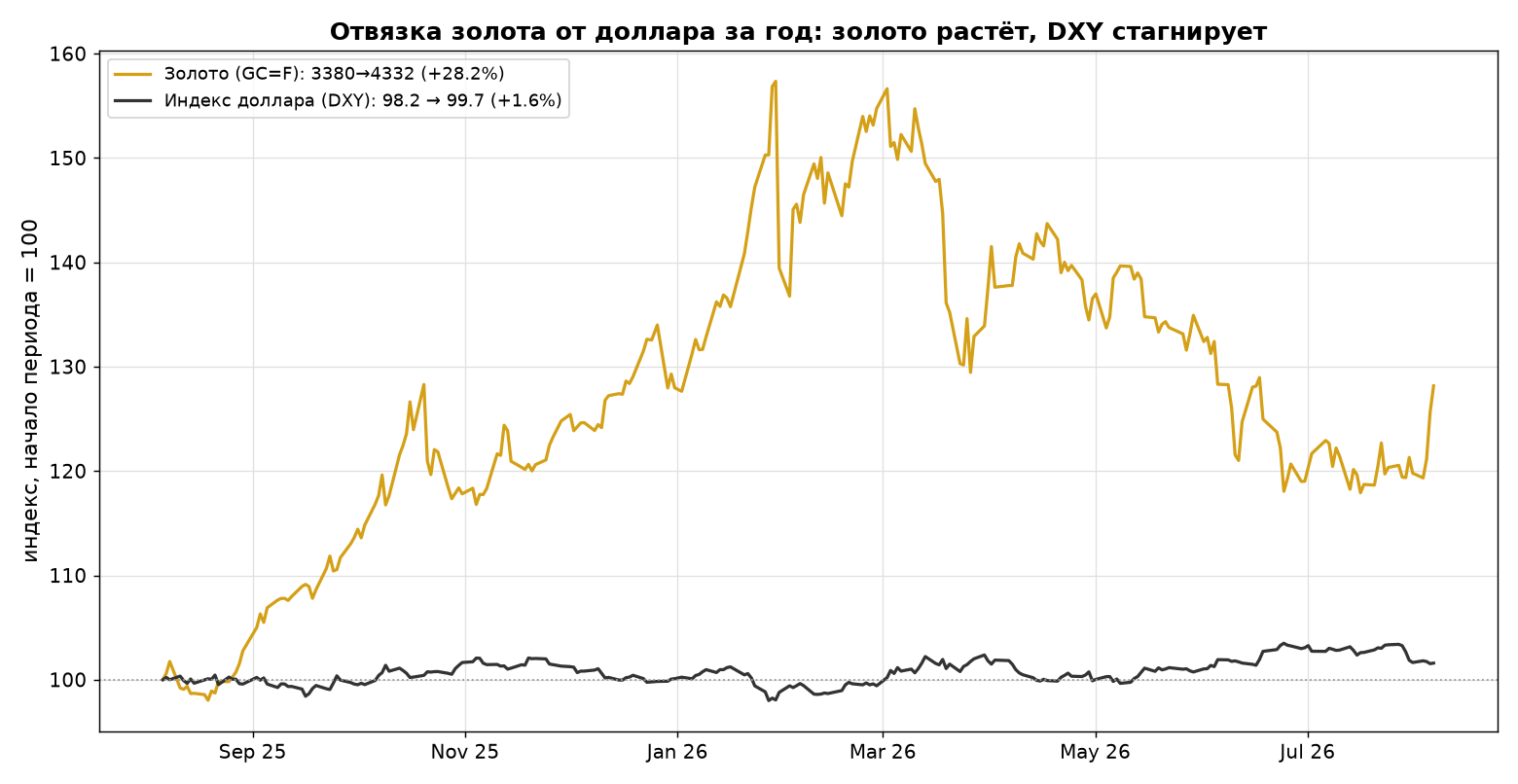
| 6 | Gold / dollar | Gold rising with a stagnating DXY = confirmation of debasement. Over the year gold +28.2%, DXY +1.6% — so far a "decoupling", not a classic divergence |
| 7 | Japan's reserves (Finance Ministry, monthly) | A decline = real selling/non-reinvestment of Treasuries; the FIMA crutch is exhausted (2022 precedent: −$43.4 billion/month) |
| 8 | USD/JPY | Zone 157.45–164; a test of 164 = the intervention failed |
Conclusion
The yen intervention is a rare event (the first joint US-Japan action in 28 years), but its real meaning is the defense of the US debt market amid $40 trillion of national debt, record 30Y yields, and a structurally weak yen. The mechanics are telling: selling euros from the ESF (the dollar is formally not sold), using FIMA (Treasuries are not sold but pledged).
The key question for autumn: will the $60 billion FIMA limit be enough — or will what Washington fears most follow the crutch: a real sell-off of Treasuries by the largest creditor. The FOMC in September and the G20 in Asheville will give the first answers.
The yen intervention is not about Japan. It is about $40 trillion of US debt.