
In autumn 2025, a myth hardened into common knowledge: China had built an analogue chip on a 28-nanometre process, a thousand times faster than top GPUs, rendering US sanctions and EUV steppers irrelevant. A number with three zeroes, a dragon on the cover image, a hashtag — every element engineered for instant reposting. Checking the primary source is inconvenient: the paper contains none of these claims.
The main finding
The original work in Nature Electronics is missing all four elements of the viral formula — not "there are nuances", but absent outright. No 28 nm, no 3 nm, no "a thousand times", no "beat GPUs at everything". The four key numbers were born from someone else's footnote, from iPhone review slang, and from a modal verb lost in transit.
1. What actually happened
On 13 October 2025, researchers from Peking University led by Sun Zhu (Pushen Zuo et al., "Precise and scalable analogue matrix equation solving using resistive random-access memory chips", Nature Electronics, vol. 8, no. 12) publish their paper. The subject is analogue solving of matrix equations of the form Ax = b on RRAM chips — resistive memory, popularly called memristors.
The hardware, contrary to expectations, is thoroughly mundane. TaOx RRAM cells were fabricated on an entirely standard commercial 40-nanometre CMOS platform. Not 28 nm. The experiment involves two chips: a 1-Mbit array for high-precision matrix-vector multiplication and a tiny 8 × 8 matrix for a "draft" pass. The cell is 1T1R (one transistor, one memory element) storing 3 bits of information.
RRAM is simply inlaid between standard metal layers without changing the base process. That was the core engineering idea: make it cheap and run it on existing fabs.
[Standard CMOS metal layers]
        ↓
 [RRAM layer (TaOx)]  ← inlaid without changing the base process
        ↓
[Standard CMOS metal layers]
In practice the authors demonstrate inversion of 16 × 16 real matrices at FP32-level accuracy, and signal detection in massive MIMO 128 × 8 systems with 256-QAM modulation within three iterations, at digital-reference quality.
2. Where "a thousand times" came from
Here is the source of the legend — a sentence from the abstract, worth reading verbatim:
"Benchmarking shows that our analogue computing approach could offer a 1,000 times higher throughput and 100 times better energy efficiency than state-of-the-art digital processors for the same precision."
The modal verb
Note could offer — "could potentially provide". This is a hypothetical model projection, not a stopwatch measurement in a lab. In the Discussion section the authors spell out the conditions: hypothetical operational amplifiers with 10–20 ns response (the real chip delivered 60–120 ns), normalisation per single GPU core, and the phrasing "in the best case". Three caveats, each removing part of the miracle.
Notice that part of the media preserved the verb. South China Morning Post and LiveScience wrote "could work 1000 times faster". The verb was still alive. The next layer of paraphrases finished it off: "Tests show the chip is up to 1,000 times faster". No tests were run — there was a calculation. The meme was born in that gap, inside a single sentence.
3. How it works: physics in a single cycle
The real work is impressive without the fabricated records. A memristor stores not charge but resistance — like a wax tablet with grooves of varying depth pressed into it. A tantalum oxide film changes conductivity under pulses.
Picture a grid of crossing wires, with RRAM cells at the intersections holding the coefficient matrix. Apply voltage to the rows and school physics takes over: by Ohm's law the cell current equals voltage times conductance, and by Kirchhoff's current law the currents from all cells in a column sum themselves.
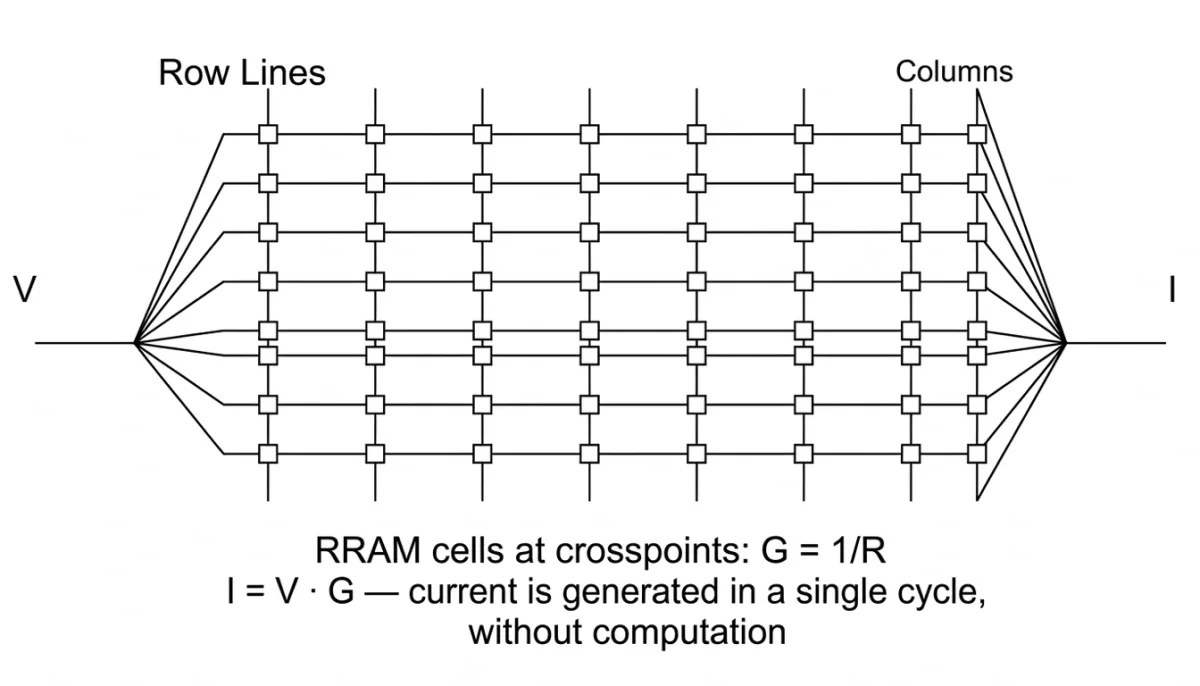
The result vector materialises instantly, in one cycle. The processor does not compute — it closes the circuit and lets physics do the work.
Defeating the original sin of analogue computers
Analogue computers died in the 20th century because of noise and poor precision. The Peking group built a hybrid: large numbers are sliced into 3-bit segments — a thick tome cut into thin notebooks, each slice living in its own cell array. The analogue core produces a "draft" in nanoseconds, and a digital controller reads off the error immediately and drives precision to the FP32 standard.
The Achilles heel: an analogue array outputs current, while the digital world needs numbers. ADCs sit between them, and as the array grows, ADC energy consumption rises faster than the core's savings. The paper's graphs show this. Clickbait bloggers cannot read graphs, but they can write headlines. Everyone picks their own skill.
4. The reality table
Let us match every element of the viral meme headline against what the scientific paper actually says.
| Viral formula from social media | What the primary source says | Where exactly |
|---|---|---|
| "The chip is made on a 28-nanometre process" | TaOx RRAM fabricated on a commercial 40-nm CMOS platform. | Methods, figure 2b caption |
| "Kills 3-nm top GPUs" | Compared against Nvidia H100 (TSMC 4N — 4 nm) and AMD Vega 20 (7 nm, 2018). | Fig. 5, reference list |
| "1000 times faster" | "Could offer" — a theoretical projection "in the best case", normalised to a single GPU core. | Abstract, Discussion |
| "100 times more efficient" | "100 times better energy efficiency" — with the same hypothetical caveats. | Abstract |
| "Beat GPUs at everything" | The task is narrow: matrices and MIMO. No neural network training, no graphics work at all. | The whole paper |
The surprise
The string "28nm" appears in the paper exactly twice — and both times in the reference list, pointing at someone else's 2017 paper that has nothing to do with the Peking chip.
5. Detective work: the genealogy of the fake
This numerical anomaly turned out to have two genealogical branches.
The "28 nm" branch: a bibliographic ghost
The reference list of the Peking paper included a 2017 paper on MIMO chips at 28 nm. Search algorithms pulled the string "28nm" into a snippet next to the Peking paper's title. Diagonal skimming of search results concluded: "If the number sits next to it, the chip is 28-nanometre!"
In parallel, Chinese media wrote: "The architecture is compatible with mature 28 nm nodes and older" — in Chinese discourse, 28 nm is a synonym for mature production without EUV steppers. From the honest "compatible with mature fabs" to "the chip was made on 28 nm" is one repost and half a second of inattention.
The chip is in fact 40 nm. And that is a plus: the entire economics of RRAM rest on the technology being cheap and inlayable into old fabs.
The "3 nm" and "1000 times" branch
"3 nm" in posts is folk shorthand for "the coolest GPU", carried over from iPhone reviews. The chip was actually compared against Nvidia H100 (4 nm) and AMD Vega 20 (7 nm, from 2018).
The "thousand-fold advantage" is even simpler, as we have already seen: hypothetical amplifiers, a single GPU core, and one operation — matrix inversion.
6. Special circle of hell: sofa analysts on X
On X (formerly Twitter) the story hit a perfect storm: opening the original PDF from Nature there counts as a sign of weakness. The feed instantly split into two camps of armchair academics.
Camp 1: the "geopolitical OSINT shaman" (bio: Semiconductor Analyst / Anti-Hegemony / Web3): "SHE IS CRYING!!! While Washington imposed sanctions, Beijing assembled a chip from 28-nm clay on its knees and buried Nvidia H100. ASML EUV steppers are no longer needed, TSMC is bankrupt! #China #Semiconductors #EndOfHegemony". Attached to the post is a screenshot with a giant red circle drawn in Paint around the phrase "1000 times", plus a stock photo of a glowing processor.
Camp 2: the "silicon dogmatist" (bio: NVDA Bull / AI Maximalist): "This is CCP FAKE!! Analogue computers died under Brezhnev. Huang is a god, TSMC is irreplaceable, and the authors translated 'could offer' as 'already on sale'. NVDA is going to the moon anyway!"
Not a single participant in a 500-comment discussion tried to find the string "28nm" in the paper. X has an iron rule: the less you understood of the scientific work, the louder your caps lock must be in the first post of the thread.
7. The phenomenon of "digital aliasing"
Radio engineering has a term for this: aliasing. If you sample sound too slowly, low bass starts to sound like a high squeak — phantom frequencies appear in the recording that were never in the original. Exactly the same thing happened to the information.
Original signal — Nature Electronics, 13.10.2025
- 40 nm CMOS
- the modal verb "could offer"
- narrow task: Ax = b
- normalised to a single GPU core
↓ discretisation by headlines
Media filter
- SCMP: "could work 1000 times faster" — the verb is still alive
- paraphrases: "Tests show the chip is up to 1,000 times faster" — the verb is gone
- 40 nm glued to someone else's 28 nm footnote
↓
Phantom signal — the viral meme
- 28 nm without EUV
- "killer" of the 3-nm H100
- 1000 times faster "out of the box"
The information flow distorted in four steps — and each level lost another layer of meaning.
Conclusion
The real chip is an excellent lab prototype accelerator for 6G base stations, but not a "Nvidia killer". Both yes and no: 24-bit precision of an analogue compute unit has for the first time been demonstrated not in simulation but on real silicon off a production line. Yet "Nvidia is bankrupt" does not follow. A GPU is a universal combine that runs both 3D and neural network training, while a 16 × 16 matrix is a microscope, not a datacentre rack.
But let's be honest: you will press "Share" anyway. Because writing "scientists in Peking demonstrated a promising prototype analogue accelerator for a narrow class of matrix operations" will not collect even three likes. But "NVIDIA IS DEAD, CHINA WINS" will collect three hundred. The ghost is always faster than the original, and the algorithm knows it.
The main filter against sludge on the internet remains the same: before reposting, open the primary source and press Ctrl+F.