
Five and a half thousand years ago, southern Mesopotamia was not a scorched desert. The lower reaches of the Tigris and Euphrates formed a mosaic of marshes, reed beds, and tugay forests with a moderately hot microclimate. In this ecosystem arose Uruk, Ur, Lagash, and Eridu—history's first city-states, which created writing, monumental architecture, and legal systems.
Today, this region has turned into an arid desert where summer temperatures regularly exceed +50 °C. This transformation is the result of the most documented ecological crisis of antiquity. Cuneiform tablets record not merely a military defeat, but a twenty-three-century process of catastrophic default of complex irrigation infrastructure: civilization perished not on the battlefield, but in its own fields.
I. The Architecture of the Agricultural Complex: Rigid Optimization and Systemic Debt
The Sumerian economy rested on a high-performance agrarian stack. However, each of its elements contained a hidden vulnerability that manifested upon scaling.
Irrigation Basis. Agriculture depended entirely on artificial irrigation: a network of canals diverted water from the Euphrates and Tigris to checks situated below the level of river floods. The network required constant cleaning labor, and water was simultaneously an object of temple administration and the primary subject of inter-city conflicts—suffering the centuries-long armed conflict between Lagash and Umma over the border canal and the fertile Gu-Edin plain.
Monocultural Skew. Wheat was the staple grain crop—the most valuable food product, yet extremely sensitive to soil salinity. Barley served as a fallback crop, possessing markedly higher salt tolerance. Over time, this difference would become the primary diagnostic marker of the catastrophe: as salinization progressed, barley crowded wheat out of the crop rotation, and scribes, knowing nothing of soil chemistry, line by line recorded the death of the agrosystem.
Technological Stack. The Sumerians used a heavy seeder plow, basin irrigation (regular flooding of fields), and settling ponds for silt precipitation. Individually, each of these solutions was rational; together they formed a system in which every liter of water delivered to a field without drainage imperceptibly turned into future debt.
From a systems theory perspective, Sumerian cities fell into the trap of Goodhart's law and a short planning horizon. Competition for dominance forced rulers and priestly colleges to maximize gross grain yield "here and now," postponing the maintenance of the ecosystem—drainage and field fallowing. Thus, critical systemic debt continuously accumulated: the invisible and unbudgeted liabilities of the landscape that would sooner or later be presented for payment.
II. Three Feedback Loops: The Anatomy of Cascade Collapse
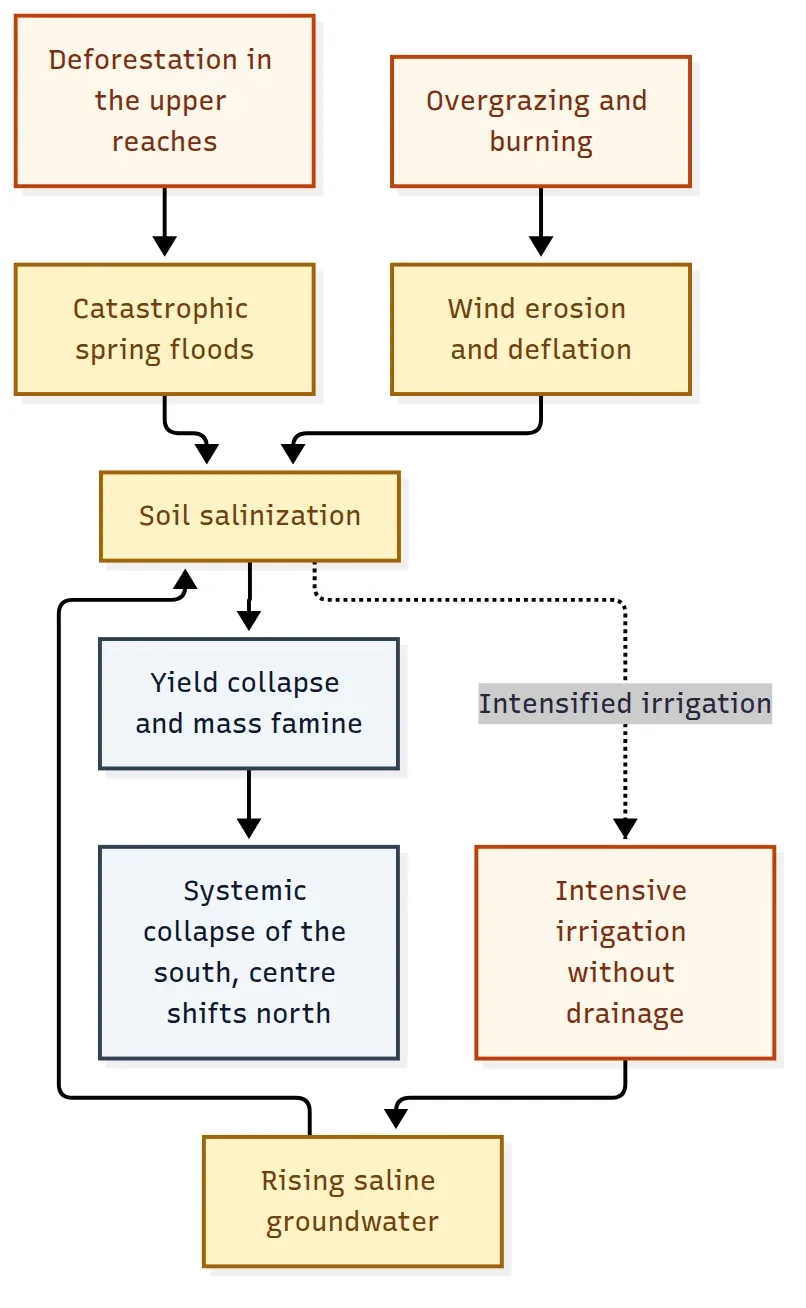
The destruction of the agrarian base occurred due to three mutually reinforcing anthropogenic processes.
1. Upstream Deforestation and Hydrological Failure
For temple construction, shipbuilding, and brick-firing, Sumerians and neighboring tribes spent centuries cutting down cedar and oak forests in the upper reaches of the Tigris and Euphrates—on the Armenian Highlands and the Taurus Mountains. By the 22nd century BCE, local timber had become scarce: the ruler of Lagash, Gudea, left inscriptions regarding the procurement of cedar in distant mountain lands. The disappearance of forest cover destroyed the natural hydrological buffer—the forest "sponge," which absorbed meltwater and rainwater and released it evenly to rivers throughout the year. Instead of smooth river leveling, destructive spring floods began, washing away irrigation networks and the upper fertile soil layer.
2. Soil Salinization: The "White Death" of Lands
Abundant basin irrigation in the absence of subsurface drainage caused a continuous rise in groundwater levels under a hot climate.
Physics of the Process. Mineralized groundwater was drawn to the surface via capillary action. Water evaporated, and salts—primarily sodium chloride ($\text{NaCl}$) and sodium sulfate ($\text{Na}_2\text{SO}_4$)—accumulated in the root zone in thin white layers.
The Irrigation Paradox. Trying to flush the saline soils, farmers applied even more water to the fields, which only accelerated groundwater rise and salinization. Drainage capable of breaking this loop did not exist in the Sumerian technological stack.
The classical dynamics of the catastrophe are based on economic tablets processed by assyriologist Thorkild Jacobsen and geologist Robert Adams (1958):
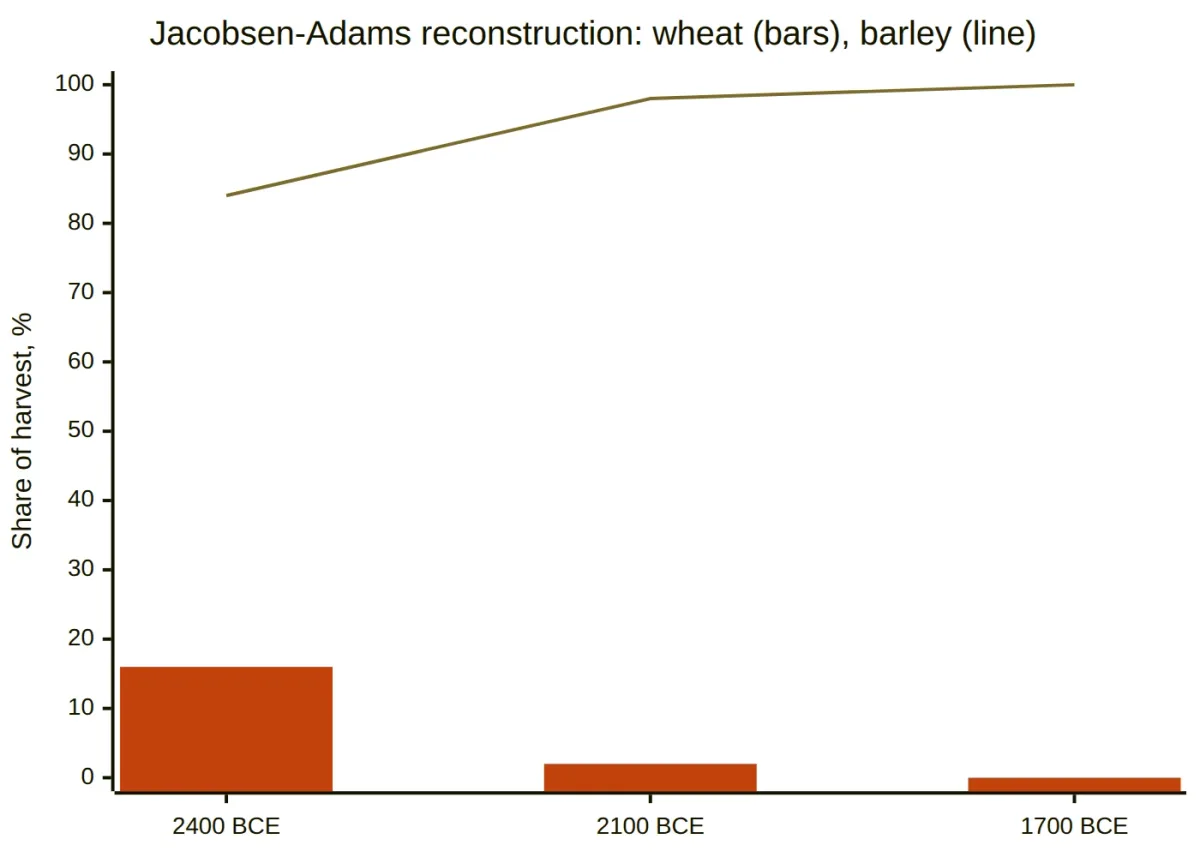
| Period | Wheat Share | Barley Share | Agro-system Status |
|---|---|---|---|
| 2400 BCE | ≈ 16% | ≈ 84% | Beginning of salt stress on wheat |
| 2100 BCE | ≈ 0–2% | 98% | Wheat virtually extinct due to salt toxicity |
| 1700 BCE | ≈ 0% | ≈ 100% | Barley yield collapsed by 65% from Early Dynastic levels; fields covered with salt crust ("White Death") |
How to Read These Figures. This is not a raw count from a single archive: tablets are scattered across cities (Umma, Lagash, Nippur, Ur) and decades, their datings occasionally diverge by centuries, and series are incomplete. Modern assyriology—from Marvin Powell's critique to the 1990s–2000s revisions—has significantly shaken the neat Jacobsen-Adams curve: the smooth temporal series is an interpolation rather than a chronicle. Therefore, the percentages given are correctly read as an illustrative aggregation of the trend, rather than precise measurements of three points in time: the direction and order of magnitude are solid, while the specific figures are a reconstruction, in places debated.
3. Overgrazing and Deflation
Large herds of goats and sheep destroyed grass cover and young tree saplings on the periphery of irrigated zones—where the last vegetation still held. Exposed soil fell prey to wind erosion (deflation): sand and dust buried irrigation canals, and communities were forced to spend increasing amounts of labor on endless clearing. The third circuit of the same loop closed: less vegetation means more deflation, more labor on canals means fewer resources for drainage and field fallowing.
III. Climatic Resonance: How Anthropogenic Failure Coincided with Climate Shock
In the question of Middle Eastern desertification, two extremes long existed: an attempt to blame everything entirely on a natural climatic shift, and the exaggerated notion that Sumerians single-handedly created a desert belt from scratch. Systems analysis shows that a resonance effect occurred: local anthropogenic failure destroyed the ecosystem's cushioning buffer precisely at the moment when the Middle East faced a global natural cataclysm.
1. Elimination of the Biological Air Conditioner
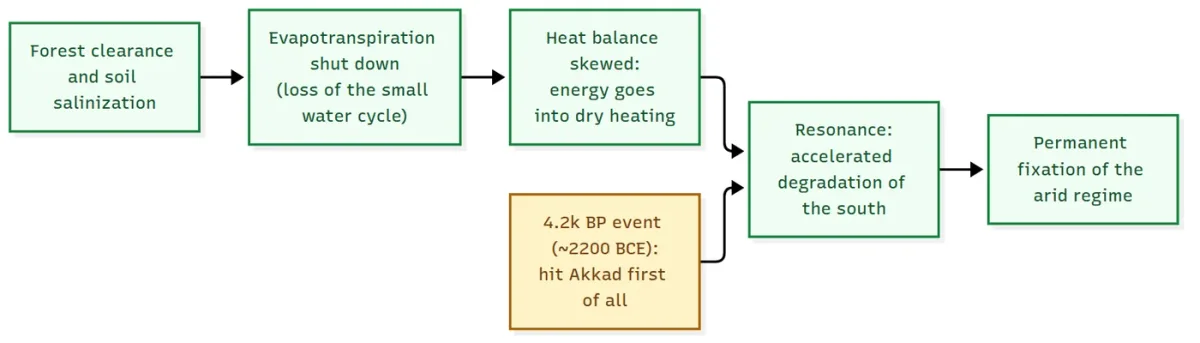
Healthy vegetation and forest massifs function as a biomechanical pump and thermoregulator. Through evapotranspiration, plants evaporate moisture, cooling the surface air layer, and feed the local (small) precipitation cycle: according to modern estimates, up to 40% of land precipitation is formed from moisture recycled by the land itself. Upstream deforestation, destruction of tugay forests, and degradation of grass cover from overgrazing nullified this function—the region was simultaneously stripped of evaporation, cooling, and its own rainfall.
2. Thermal Balance Shift and Heat Dome
Without evaporating moisture, solar energy redistributed: the latent heat flux (expended on the phase transition of water during evaporation) gave way to sensible heat flux—direct heating of dried soil and near-surface air masses. Although a light salt crust reflects some light, moisture-depleted land turned into a local thermodynamic heater: soil microflora died, and the field microclimate became extremely dry. A persistent column of hot air formed over the scorched territory—a high-pressure zone against which rain fronts coming from the Mediterranean "break": clouds dissolve without precipitating.
3. Resonance Point: The 4.2k BP Event — What It Finished Off and What It Didn't
Around 2200 BCE, a climatic event occurred in the Northern Hemisphere—the 4.2k BP event, a multi-year drought associated with a shift in monsoonal belts and the weakening of Atlantic circulation. Geological profiles at Tell Leilan record its trace as a powerful dust horizon, and the firm linkage of this event is to the Akkadian Empire, which collapsed almost synchronously.
With the southern salt default, the picture is different: by 2200 BCE, the south had already lived for half a millennium with a growing salt background, and the drought fell upon ongoing degradation as another blow—heavy, but neither the first nor the last. It is telling that the south survived both it and the turmoil following Akkad's fall: the Ur III Renaissance (2112–2004)—the last Sumerian dynasty—unfolded right amid the salt crisis, and a significant portion of salinization statistics is drawn precisely from the archives of Ur III, Isin, and Larsa. A healthy ecosystem is capable of surviving multi-year dry periods—but the Sumerian-Akkadian agrosystem by this point had already exhausted its resilience due to systemic salinization and erosion.
Let us distinguish: the 4.2k BP event finished off Akkad; the Sumerian salt default itself is a separate, slower line that continued even after it and reached rock bottom around 1700 BCE, already within the Old Babylonian economy. The resonance of the global shock and local failure took place—not as a simultaneous collapse, but as an acceleration of a trajectory that was leading downward on its own and eventually shifted the center of Mesopotamian civilization northward into Babylonia.
IV. Comparative Systemic Analysis: Historical and Modern Analogues
The mechanism that ruined Mesopotamia repeated everywhere engineering scaled without accounting for environmental feedbacks.
| Civilization / Region | Period | Initiator of Failure | Systemic Resemblance to Sumer |
|---|---|---|---|
| Akkadian Empire | ca. 2200 BCE | Imposition of the 4.2k BP drought on rigid irrigation dependency | Collapse of centralized governance and flight of population northward amid drought and dust storms |
| Indus (Harappan) Civilization | ca. 1900 BCE | Weakening of summer monsoons, desiccation of the Ghaggar-Hakra river system | Loss of monocultural irrigation resilience before climate shift |
| Aral Sea (USSR / Central Asia) | 1960–2000s CE | Excessive water abstraction from Amu Darya and Syr Darya for cotton fields without drainage | Exact replica of the algorithm: monoculture → irrigation without drainage → salinization → desiccated salt flat and dust storms in 40 years instead of 2000 |
| Modern Iraq | late 20th – 21st c. CE | Upstream dam cascades (Turkey, Syria), drainage of Mesopotamian marshes | Secondary salinization of the lower Euphrates and desertification of the historical core of Sumer right today |
The Aral case is particularly telling: a technologically equipped 20th-century state reproduced the Sumerian error point for point—and obtained the same result roughly fifty times faster. The Iraqi case demonstrates that the process did not stay in the past: secondary soil salinization of the lower Interfluve remains an active problem of the 21st century.
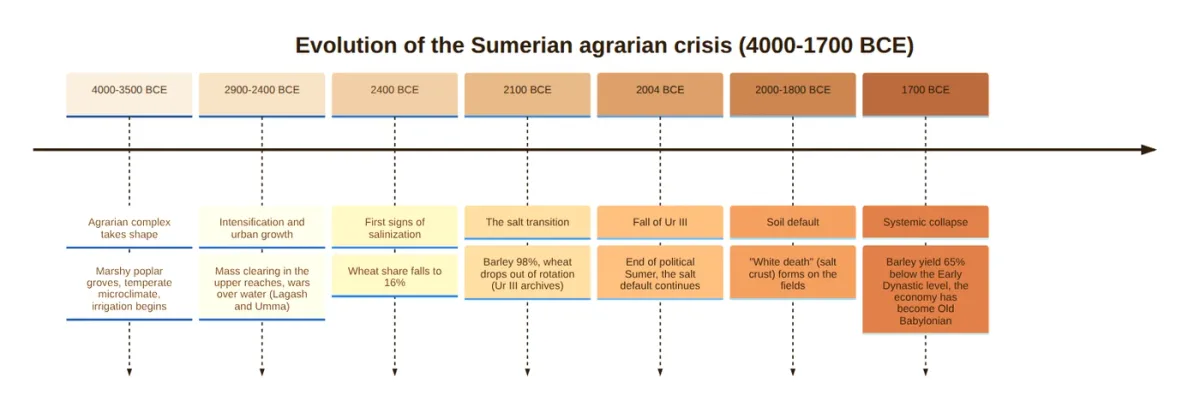
V. Chronology: From Flourishing to Systemic Default
VI. Systemic Conclusions: Lessons for Complex Systems of the 21st Century
The history of Sumer is not merely ancient archaeology, but the first documented case in human history of the systemic collapse of complex technological infrastructure. For engineers, AI system architects, and designers of complex autonomy, this crisis offers three baseline lessons.
1. Unliquidated Systemic Debt
Basin irrigation without drainage canals made it possible to obtain ultra-high yields over several generations, but every liter of water without drainage left salt deposited in the soil—an invisible debt reflected in no accounting ledger. When accumulated debt exceeded the landscape's regenerative capacity, the system collapsed instantaneously. Any complex architecture—from AI infrastructure to water management cascades—that optimizes performance at the expense of ignoring side effects moves toward a similar default; the only question is the time scale.
2. Local Optimization and Goodhart's Law
Competing city-states optimized the single available metric—the volume of grain in storage for the current season. Maximizing this metric forced fields to be flooded with increasing amounts of water, which accelerated salinization: the metric improved precisely at the expense of destroying the supporting medium. As Marilyn Strathern formulated it, "When a measure becomes a target, it ceases to be a good measure." A system whose goal is compressed to a single number begins to destroy its own substrate—regardless of whether the number is measured in gurs of grain or engagement metrics.
3. Loss of Resilience to Exogenous Shocks
The Sumerians perished neither from the 4.2k BP drought itself nor from military invasions. They perished because the preceding two millennia of narrow-minded extractive policy had completely stripped the system of adaptive resilience: soil and hydrological buffers had been nullified long before the shock arrived. External impact merely delivered the final blow to a structure that no longer possessed shock absorbers. The lesson for the 21st century: resilience to rare but inevitable shocks is not an "overhead cost," but the primary product of engineering, and trading it away for short-term productivity is the most expensive debt of all.
This material is based on the regulation "Anthropogenic Ecological Crisis of Sumer and Climate Degradation of the Middle East". Data on crop shares follow the traditional reconstruction by T. Jacobsen and R. Adams (1958), subsequently refined and contested (critique by M. Powell, 1990s–2000s revisions); in the text, these figures are used as an illustrative trend aggregation rather than raw counts from a single archive. Traces of the 4.2k BP drought are based on dust horizons at Tell Leilan (H. Weiss et al., 1993) linked to Akkad; the estimate of recycled moisture share in land precipitation is from van der Ent et al. (2010).