
Three centuries of British history as the biography of a building. The house went up with no general project, and now the time has come to count what the upkeep costs.
0. Two photographs
The first photograph was taken in the summer of 1851 in Hyde Park. Under the glass dome of the Crystal Palace crowds of visitors mill about. The pavilion of the Great Exhibition went up in a matter of months from cast-iron beams and standard panes. The country that proudly called itself the workshop of the world was showing off its chief skill: building fast, building to last, with an enormous margin of safety. The pound confidently directed the world's flows, the fleet kept order, the factories turned out metal. The reserve seemed large enough to last forever, but it was burned in the furnaces of two world wars: by 1945 nothing was left of that hegemony.
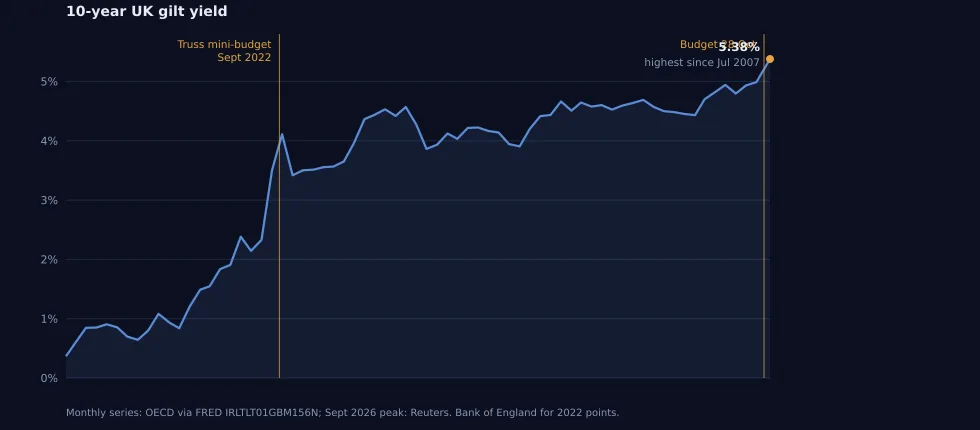
The second photograph was taken in September 2022. Liz Truss's cabinet announces its mini-budget with fanfare. On paper lies a handsome plan of sharp tax cuts. In reality a financial explosion goes off: bond yields fly upward, pension funds stand on the edge of instant bankruptcy, and the Bank of England floods the market with billions to save the country from collapse. Truss leaves after 49 days, the shortest term of any British prime minister.
Between these two shots lies the story of how the load-bearing piles were gradually pulled out of the house. The crisis is not caused by Britain's reluctance to write laws: it has thousands of them. The cause is different. For three centuries the country kept adding rooms and storeys without once taking up the task of drawing a plan of the building itself.
1. The accident we were forbidden to remember
Disasters usually drive people back to the drawing board. When the Civil War of the seventeenth century claimed proportionally more British lives than the First World War, logic demanded a strict inspection: what exactly collapsed, and how do we build next?
The British elite answered the other way round. In 1660 Parliament passed an Act with a telling name, Indemnity and Oblivion. The document ordered the accident struck from memory, as if it had never happened. The ruined institutions were declared previously completed works.
The rest of Europe acted differently. In 1787 the United States wrote a constitution and honestly admitted the old walls could not be trusted. In 1949 Germany built its Basic Law on the rubble, out of norms written in blood. France rewrites its project at every deep crisis, and every rewrite is an admission that the previous one failed. Britain walled the wreckage into the basement and kept building storeys on top. Even the Glorious Revolution of 1688 was recorded as routine maintenance of liberties, and the change of foundation never entered the protocol. Economists North and Weingast called it credible commitment, a promise investors trusted so much that they financed the fleet and the empire on the cheap. Where the archaism itself came from was explained earlier than anyone by Tom Nairn and Perry Anderson: an early, unfinished bourgeois revolution left the state archaic inside, and the constitutional magic became a cosy self-deception for the elites (The Break-up of Britain, 1977; The Enchanted Glass, 1988).
Rules in Britain were certainly written down. The Parliament Acts of 1911 and 1949 clipped the Lords, the Human Rights Act 1998 embedded European norms, the Constitutional Reform Act 2005 separated the judges from the government, and devolution laws handed part of the power to Scotland, Wales and Northern Ireland. But all of these are separate instructions for particular joints. Without a general project, the simple questions, where is the limit of power and what is load-bearing in this house, get answered from scratch every time: all the foremen are convened and the dusty notebooks of three centuries are raised. A written constitution does not guarantee the right answers. It merely cheapens the enquiry.
2. The eaten harvest and the lost hands
By the end of the 1970s the bill came due: the winter of discontent, uncollected rubbish on the streets, humiliating IMF loans. Margaret Thatcher's reforms turned the trend around, but quite specific people paid the price. The mining towns and industrial cities of northern England were left outside the new life: over three decades industrial jobs shrank almost threefold and after the crisis stood at two and a half million. The machine tools were sold off, and the economy's centre of gravity finally moved into the financial offices of London. Another wrench, filed once again as routine maintenance.
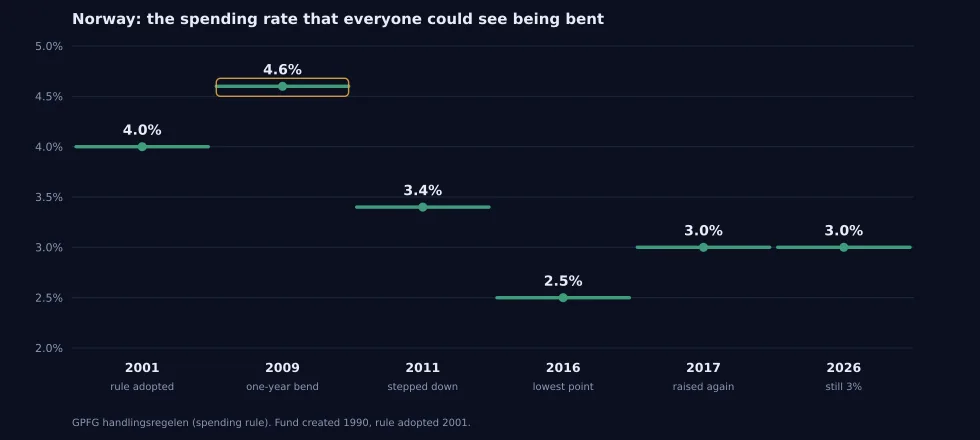
The most vivid page of this philosophy was written in North Sea oil. Norway and Britain were harvesting the same crop, but the neighbour approached the wealth like a thrifty engineer, in two moves. In 1990 the Norwegians created a fund, a piggy bank that lay empty at first, and in 2001 they introduced the firm handlingsregelen, the action rule: spend no more than the expected real return, at first four per cent a year. The rule is not sacred. In 2009 it was bent to 4.6 per cent, then walked back step by step: 3.4 by 2011, 2.5 by 2013, and three again from 2017. Every bend was a public, measurable event. A bent norm is visible; a quietly bent one is visible to no one. Over three decades, from the first deposits in 1996, the piggy bank grew to roughly 2.3 trillion dollars and became a safety cushion for future generations.
Britain did the opposite. Parliamentary sovereignty legalises any spending, and the oil rent went to immediate needs: patching holes in the budget and tax cuts under Chancellor Lawson. The harvest was simply eaten. Every British worker felt the result. According to ONS data, real average wages returned to their March 2008 level only at the end of 2021: thirteen years of stagnation, and without bonuses later still, by 2025. In 2022 the Indian economy overtook the British one.
But the tragedy is not even the squandered money. The country lost the skill of building. High Speed 2 turned into the most expensive railway on the planet per kilometre, and the northern branches to Leeds and Manchester were cut off from it altogether. The Hinkley Point C nuclear plant is being built by the French from EDF, because Britain no longer has crews of that calibre: the estimate grew from eighteen billion to over thirty. When you build nothing for forty years, you lose not only the ability to write projects but the ability to accept the work.
3. The beam that is missing from the drawing
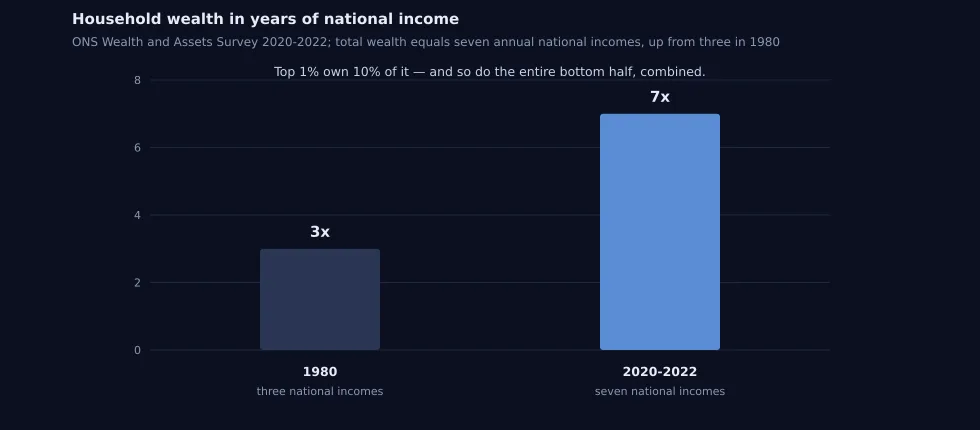
The squandered harvest has a flip side, and in the reports it looks almost like prosperity. According to the ONS survey for 2020-2022, household wealth in Britain is worth seven annual national incomes; in 1980 it was worth three. The top one per cent holds a tenth of that wealth, and exactly the same share goes to the entire bottom half of the country taken together. The threshold of the top percentile is 3.1 million pounds, the median household holds 294 thousand. This wealth grew, however, not out of saved wages: in the latest measurements rising asset prices contributed more than all the saving. In the top decile's basket housing takes almost 40 per cent and pension accounts almost as much. Machines and workshops are nowhere in that basket.
This is the changing of the load-bearing members, a transition recorded nowhere as a decision. The old walls rested on earned income: on a shift at the machine tool and an export invoice. Now they rest on asset prices, the income that ownership itself brings. The median wealth of a household headed by someone aged 65 to 74 is half a million pounds; where the head is under 25 it is fifteen thousand. A thirty-three-fold difference, and the difference is not one of ability but of dates: whoever entered the market before the price turn rose with it. Inheritance tax collected a record 8.2 billion in the 2024/25 financial year. Wealth moved from hand to hand, bypassing the pay desk of wages.
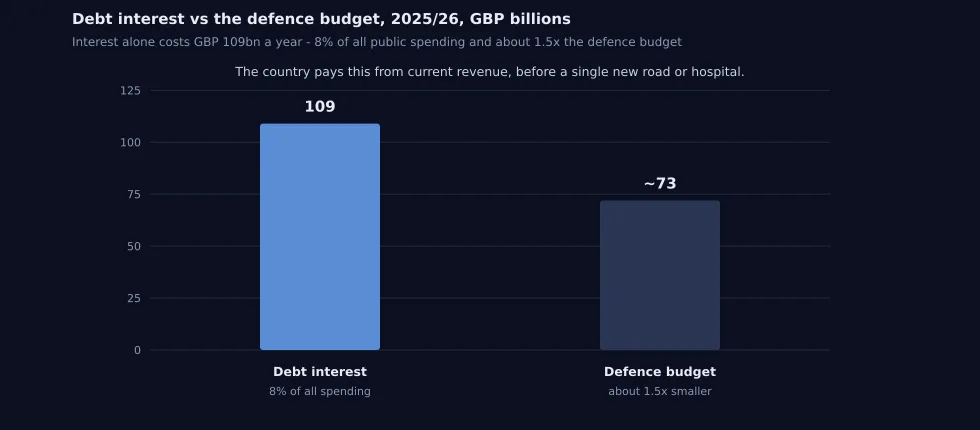
The new load-bearing member has a property neither wages nor machine tools ever had: it must be fed cash every day. The state lives on annual rewriting of its debt. On current OBR estimates the Treasury sells new gilts worth 8.5 per cent of GDP a year, and part of that paper goes to redeem the old. In the 2025/26 financial year interest on the debt ate 109 billion, eight per cent of all spending, one and a half times the defence budget. Lower down the floors the same holds, only without consoling formulas. Birmingham, the second city of the kingdom, banned new spending on itself in September 2023: the budget did not add up even before 760 million pounds of equal-pay claims landed on top. Thames Water, England's largest water company, made it to the end of the quarter only by leave of the court: in late 2024 it warned the money would run out by March. Creditors provided three billion of emergency financing to keep the water flowing, and in spring 2026 promised more than three billion more of their own. The cash gap, where obligations arrive today and the money arrives someday, stopped being an emergency and became the working regime. A household knows this state as being till payday; for the state it became a permanent address.
Not one of these transitions was recorded as an act. Nowhere is it written that asset prices and annual debt rewriting have been declared load-bearing while earned income has been moved to the secondary structure. The house rebuilt itself, with no project and no acceptance inspection. And when in the autumn of 2022 the new beam trembled first, it turned out no instruments had ever been mounted on it either.
4. The hospital where the queue is measured in millions of lives
The National Health Service, created in 1948, was the chief object of national pride, the symbol of a state that looks after everyone. Today millions of families stand in its queues.
Ageing presses on every developed country, and Britain is no exception here. The problem lies in the financing design. With continental insurance systems the difference is not annuality: the French financing law is passed every year too, and the NHS has received multi-year packages, a five-year one in 2018. The difference is that there the money is earmarked. Contributions are tied to wages, treatment rights are written into law, and taking them away for something else is costly. Here the NHS lives on a straight line of the general budget that officials redraw annually, and the first items under the knife are the capital ones: repairing buildings, buying scanners, upgrading computer networks.
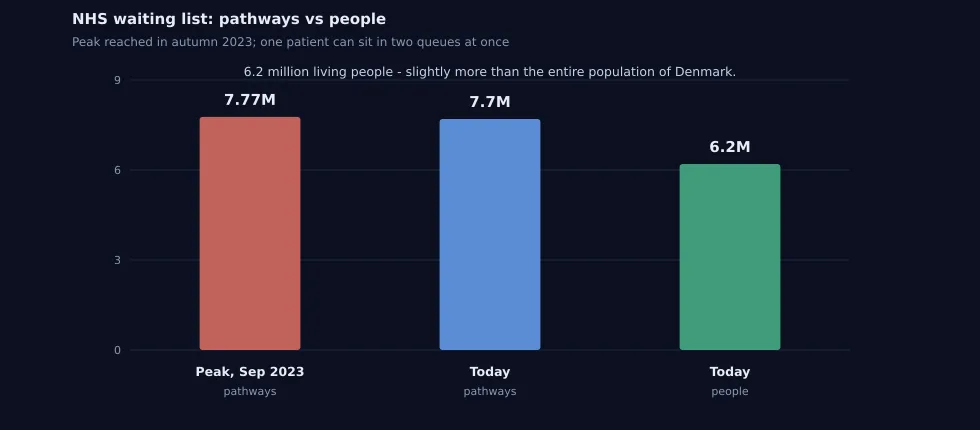
As a result Britain stands at the bottom of the G7 in healthcare capital stock, and on MRI and CT scanners per head it trails below the OECD average. By autumn 2023 the queue had reached an astronomical peak: 7.77 million treatment pathways. A pathway is not a person: one patient can stand in two queues at once. The peak has passed, but the lists still hold 7.7 million pathways, that is 6.2 million living people, slightly more than the entire population of Denmark. Behind the report lines stand people who sit for months on painkillers waiting for surgery, and cancer patients for whom every week counts. The queue itself is not a verdict: after the peak it receded. But it recedes by hands and equipment, and the monolith was starved of both for decades. When the social contract turns into endless waiting at a closed door, trust in the state cracks along with it.
5. The warehouse with two keys
Having lost the role of the world's factory, Britain learned to sell a new product: a quiet harbour for other people's capital. The warehouse even has its own pedigree. The eurodollar market of the 1950s grew partly out of Soviet dollars that Moscow kept in London so that Washington could not freeze them. Neutrality was turned into a service, and on the ruins of the empire a unique network of granaries arose, from the Channel Islands to the Caymans and the British Virgin Islands. By Tax Justice Network estimates about a third of the planet's offshore money stands in this system.
The entry rules were blind for a long time. Registering a company at Companies House cost less than dinner, with no identity check at all. Everybody used it: the Moldovan laundry pumped billions of dollars through in a few years, the Azerbaijani one followed; golden visas opened the doors of elite schools and Belgravia real estate. To the buyer it seemed he was acquiring an impregnable fortress.
In February 2022 everything came out. Under SAMLA, a law passed long before the crisis and coordinated with the US and the EU, the visas were annulled, tens of billions of pounds of assets were frozen, and the money from the sale of Chelsea, about two and a half billion, has now sat blocked in a special account for the fifth year. The freeze was a lawful step: Switzerland and Euroclear behave the same way. But London thereby smashed its own chief myth. For half a century the city had sold itself as a perfectly neutral vault. Now everyone can see the warehouse owner always keeps a second key.
The result was not long in coming. The technology giant Arm chose New York for its IPO, and big companies like CRH and Flutter moved their listings out of London. In arbitration London is still first: in the 2025 Queen Mary survey it took 34 per cent against 31 for Singapore and the same for Hong Kong. The lead is narrow; there is no monopoly. When the warehouse shows it can slap a padlock on other people's property at any moment, the merchants start looking for other granaries, and every quote, every clause moves next door.
There is a quieter loss too: the right to set the standards themselves. The British Standards Institution became the world's first national standards body: the committee was set up in 1901, the first samples came out in 1903 for rolled steel sections, and all the world's engineering later worked by them. After the divorce from the EU the country introduced its own quality mark, UKCA, and postponed its launch again and again: the foreign certificate was recognised indefinitely in practice. The shops keep accepting the foreign mark because nobody accepted theirs. A warehouse that sets the terms dictates the invoice format. A warehouse that loses its customers accepts someone else's.
6. The jackal at the stranger tiger's side
In Kipling's Jungle Book the jackal Tabaqui fusses at Shere Khan's side: he barks loudly at the weak, brings news and feeds on scraps from the tiger's table. The foreign policy of late London is arranged exactly the same way.
The scheme rests not on the beast's character but on its function. The jackal's bark is selective: only at those who will not answer. Its food is only what the strong left behind. When the patron changes, the bark changes with him.
Having lost the factories and the machine tools, Britain made normativity its main export, lectures on human rights, the rule of law and correct state design. Lecturing Beijing, Delhi or Moscow is safe: there is no strength left for economic or military pressure, and the lecture demands no role. The lesson is cheaper than sanctions, and demand for it still held.
But the goods had a flaw. At any violator of international rules the jackal barks loudly, and falls silent the very second the chief patron breaks them. The nuclear shield depends on American Trident missiles serviced at the Kings Bay base in Georgia, and key intelligence works inside the Five Eyes alliance.
So when Washington publicly squeezes British drug prices and the NHS, Westminster answers with silence. When Ambassador Kim Darroch called Trump clumsy in his dispatches, the prime minister and the foreign secretary stood up for him, but Johnson, then contending for the top job, publicly refused to back the ambassador, and Darroch resigned. Loyalty is only as reliable as dependence allows. Washington can tell its vassal from the others, ten per cent tariffs against fifteen for the EU, but the price of friendship rises every year: quotas for American ethanol and beef, priority terms for pharma. And the jackal goes off to haggle with other predators: the rapprochement with the EU after May 2025 is not a strategic choice but a search for a cheaper substation.
This vulnerability is best seen in the Chagos Islands. In 2025 the archipelago was handed to Mauritius, and Britain paid 3.4 billion pounds in capitalised payments, 101 million a year for 99 years, merely for the right to rent its own former base, Diego Garcia. Britain yielded not to Washington's plans but to the rulings of international law, and the whole bill stayed with the payer. Squander your own industrial foundation, and now pay rent for living in your own former house.
The tiger leaving is only half the trouble. The warehouse built in his shadow will now have to be sold without it.
7. The shift that was never entered in the work order
Why did the unwritten structure stand for three centuries without collapsing? Because instead of rigid laws an ideal training of the shift was at work.
Everyone who governed the country passed through the same closed boarding schools, the corridors of Oxbridge and the gentlemen's clubs of London: MPs, judges, officials and newspaper editors. The elite was reproduced not by instructions but by grafting onto a common rootstock: ideas could differ, the unwritten code was one. The formula of everyone knowing how things are done here genuinely worked.
The breaking point came when people of a different training entered the system: populists, new-wave media magnates and outside players. They did not break the laws. They simply did not know the unwritten rules and acted on the dry letter against the unwritten spirit.
September 2019 showed it in pure form. Prime Minister Boris Johnson suspended parliament by royal prerogative to push Brexit through. The unrecorded system had no ready answer to the question: where is the boundary of this power? The Supreme Court (R (Miller) v the Prime Minister) had to draw it on the move, and it unanimously declared Johnson's action unlawful, void and of no effect. Defenders of the system called it self-correction. In fact the court was finishing the load-bearing walls before a stunned public, mid-storm.
The system answered with tightening. The Judicial Review and Courts Act 2022 clipped the judges, and rhetoric about judicial activism became the norm. The criminal toolkit went into action. Under the Public Order Act 1986 Lucy Connolly received 31 months in prison for a post about the Southport attacker: the claim proved false, the post was written amid riots, deleted almost at once, and guilt was admitted. Over five years the country logged more than 120 thousand non-crime hate incidents, nearly 24 thousand a year. In April 2026 the Home Office narrowed the rules: only what bears on proper policing stayed in the protocols. Protective structures do exist. The Simms case raised free speech into a general principle of law limited only by what is prescribed by law and by necessity, and Article 10 of the European Convention works through the Human Rights Act. But these shields are a distributed folder, not a consolidated sheet: their strength depends on who sits in court this year. The old training left with the old shift. And without the unspoken understanding of norms, what remains of an unwritten constitution is only what was hurriedly written down.
8. The instruments that no longer exist
Worse than a blind gauge can only be an instrument that was switched off deliberately. The history of British institutions contains both tragedies.
The first story: the deliberate abandonment of control for the sake of money. The Companies House register worked for decades like a giant grain elevator: it took in any data without checks. Journalists, as a joke, registered firms whose directors were named Adolf Hitler. The state switched off input control for the speed of financial transactions and turned its own register into a laundry for doubtful money from around the world. Only in 2023-2025, after a series of loud scandals, did the system begin to be repaired frantically and identity verification introduced. Repairs after the fire.
The second story: a human catastrophe caused by one legal line. The Horizon accounting software from Fujitsu drew virtual shortfalls in post offices for years, and the Post Office, true to the British tradition of private prosecution, conducted criminal prosecutions of its own postmasters.
Until 2000 the law required the prosecution to prove strictly that the computer worked. The instrument was removed in two moves: in the mid-nineties the requirement was dropped from civil courts, and from April 2000 from criminal ones. Here the working block was not dismantled; the protection was removed in advance, years before the accident: from then on the computer was presumed correct until the citizen proved otherwise. An ordinary provincial postmaster was left alone with a giant corporation and a failing program. The result: more than 700 broken lives, ruin, prison terms, suicides. A special law of 2024 mass-rehabilitated the victims, and in January 2025 the Ministry of Justice launched a review of the presumption. Its argument is known: the fault lies in disclosure failures, and the presumption is only an amplifier. Perhaps. But an amplifier placed where a recorded protection used to stand is no trifle: it is an element of the structure nobody checked for a quarter of a century.
And in the autumn of 2022 came the fiscal skid of Liz Truss. The requirement of an Office for Budget Responsibility forecast is fixed by the 2011 statute, but the mini-budget came out under the name plan for growth, not a budget, and the statutory trigger did not fire: the OBR offered to prepare a forecast, the Treasury refused. Tom Scholar, the Treasury's living memory, was dismissed two weeks before launch. The vulnerability of the LDI pension funds was known to the regulator in advance; the warnings sounded. The internal fuses were switched off by hand, and the only honest instrument turned out to be the government bond market: only it showed the true scale of the catastrophe.
9. The grown house against the drawn one
The classic objection suggests itself. The philosopher Edmund Burke and the economist Friedrich Hayek taught that the beauty of the British system is that it was never drawn on paper but grew organically. Spontaneous order is always more supple and alive than any artificial Gosplan blueprint.
The argument is strong, but it has two cracks.
First, a consolidated drawing has nothing in common with Gosplan. A general project does not dictate how many bricks to produce next year. It merely fixes honestly which walls are load-bearing and what happens if you knock them out: the roof falls on your head. Codification remains an inventory of the grown order, nothing more. Burke never forbade writing down acts and precedents; the one document that stays beyond consolidation is the register of load-bearing joints.
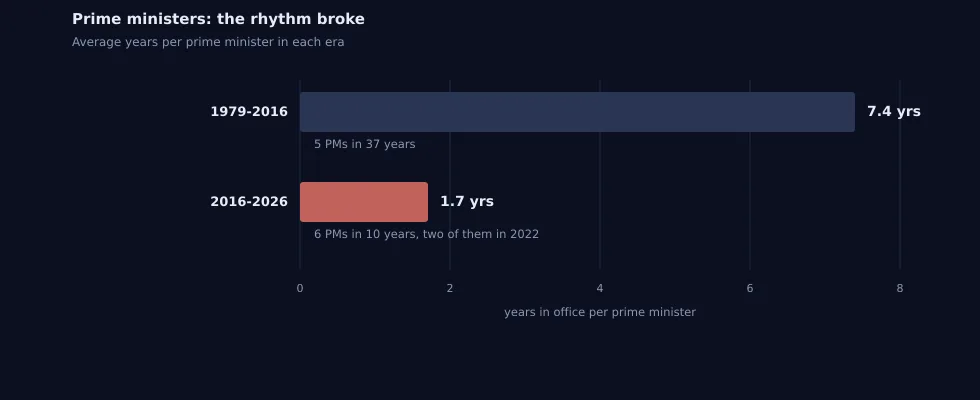
Second, the grown order rests on the handover of experience: each shift teaches the next. While the handover went smoothly the tradition worked. But the rhythm of history has accelerated. From 1979 to 2016 Britain changed prime ministers only five times, about seven to eight years each; from 2016 to 2026 it changed another six, two of them in the one stormy year of 2022, and the latest was installed on 20 July 2026. Weather does not change like that.
When the handover of experience breaks, the unwritten order turns into a game of Chinese whispers, each retelling distorting the rules. At such a moment the winner is the one whose rules are written in ink: paper survives a handover that tradition may not. The US wrote its project in 1787. Political erosion eats their institutions too; Levitsky and Ziblatt described it precisely as the death of unwritten guardrails with the document alive. But the written document at least cheapens disputes and survives generational change. The absence of a general project does not explain every British misfortune. It explains the measurable: why the North Sea harvest was eaten, why the hospital was starved of capital, and why nobody checked the presumption of the machine's correctness for a quarter of a century.
10. The heirs and the new tenants
Every house keeps two lists for the future: who inherits and who moves in. Either is worth reading more closely than any election manifesto.
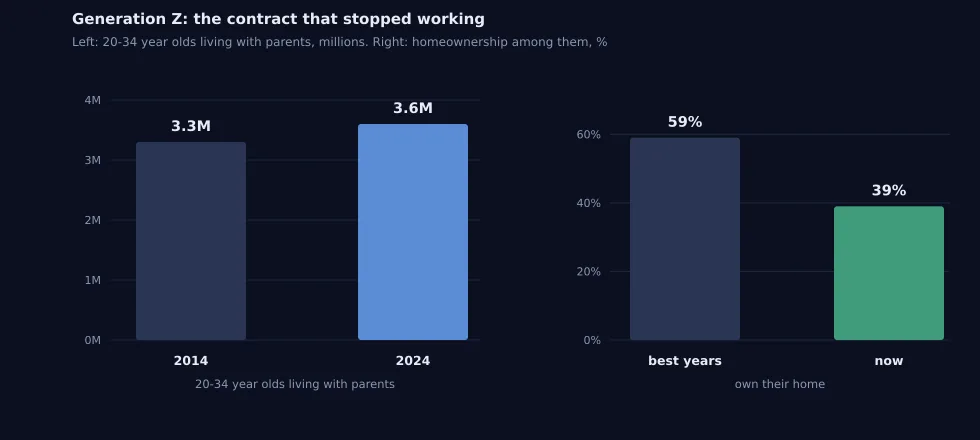
The first list is the heirs. The oldest of generation Z, born after 1997, turns thirty in 2026, the youngest is about fifteen; they are entering adult life right now, and the will has already been drawn up. The contract read to them in childhood sounded familiar: study, work and you will get the keys. Reality looks different. 3.6 million people aged 20 to 34 live with their parents on the 2024 measurement; in 2014 there were 3.3 million of them. In the best years 59 per cent of such households owned their home; on the latest measurement 39 per cent do. After the 2023 reform a student loan is written off only after forty years: a forty-year payment for a certificate of education. On top lies the general clause of the will: interest on the national debt, those same 109 billion a year. They never borrowed it. They will pay from their first wage.
The promise is also load-bearing, though it appears in no act. For three hundred years the house stood on the belief that effort turns into status: work and you will own, pay your contributions and the state will catch you. A generation whose first adult experience consists of renting, a hospital queue and a forty-year loan reads the contract differently: they were told one thing and handed another. Out of that difference their picture of the country and the system is assembled. A person who does not believe in the house stops caring for its walls. The unwritten structure stood for three centuries because each shift passed its training to the next; for the first time the shift has nothing to pass on except a payment schedule. The inheritance is a house living till payday, a condition the state knows better than any of its citizens.
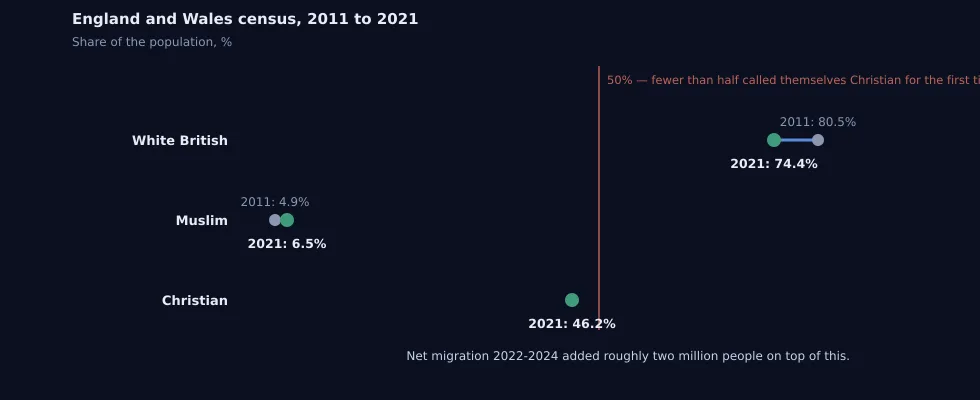
The second list is the new tenants. The 2021 census recorded a change in the composition of the house within a single decade: the share of white British in England and Wales fell from 80.5 to 74.4 per cent; Islam grew from 4.9 to 6.5 per cent, to nearly four million believers; fewer than half called themselves Christians for the first time, 46.2 per cent. Net inflow over 2022-2024 added roughly two million people to the population. By 2025 a third of mothers giving birth in England and Wales had been born abroad (34.6 per cent); children with at least one parent from abroad already account for over 40 per cent of births, and in London mothers born abroad account for all of 60 per cent of births. Sixty here is the share of births, not the share of white British in the city's population.
The same instruments recount the culture. Muhammad remains the most frequent name for newborn boys for the third year running once all spellings are summed: 8.5 thousand a year, roughly one boy in 33. Every fifth schoolchild in England grows up with a different native language. In Leicester, Birmingham and Manchester white British are already less than half the population.
In itself this is not yet a breakdown: the house was always finished by newcomers, and the Normans and Huguenots grew into the masonry so that the seam cannot be found. But they grew in through a common rootstock: school, factory, church, army, a shared screen. The rootstock worked because there was a lot of it: the same classes, one newspaper, one queue. The newcomers of the 2020s enter a house where the rootstock has dried out: the airwaves are splintered into feeds, the factories are gone, the church is empty. Assimilation was never a project here; like everything in this house it was left to grow by itself. As early as 2005 Trevor Phillips, head of the Commission for Racial Equality, warned that the country was sleepwalking into segregation. The 2021 census confirmed the diagnosis with numbers.
In late September 2026 a recording spread across the network that became the emblem of that drying. The Masala Bazar supermarket in Romford, on London's far eastern edge where the city passes into Essex, marked three years of work by giving away free vegetable oil. On the recording shoppers, without waiting for any instruction, split themselves into two queues, men's and women's. No signs hung; the manager insisted the staff had lined nobody up, people divided of their own accord, and a minute later the queues merged again. But a defect log is read from first reactions. A local woman who had lived in Romford all her life told journalists she had never seen anything like it in the shops; the shortest comment under the video read: Nobody ever passed a law on separate queues in England. The queue is held to be the most neutral institution of this country, the place where all are equal in waiting. When the queue divides of its own accord, the common hall has already been let out into rooms.
This is no longer the Britain of Shakespeare, Carroll and Milne. The new tenants are no worse than the old ones; the stones are the same. But the old walls rested on common reading: the country learned the language of Shakespeare and the nursery lines of Carroll and Milne as a shared code. That reading is also load-bearing, and it was pulled out as quietly as the rest. Nothing in the house is written down about what must remain common; unwritten means that at a quarrel every room writes its own statute. Heirs with nothing to inherit and newcomers with nowhere to be woven in go down as two lines in the same defect log, filed under cause not established.
11. The forecast: two axes and one background
The inspection ends here. The defect log has a second part: threshold figures at which a symptom becomes a verdict. From now on the country's future reads as a map of regimes: two main axes and one permanent background.
The background is chronic relative impoverishment: not a catastrophe but a drift along the Italian scenario. National debt near 100 per cent of GDP, an ageing population eating the budget, the young leaving, living standards sliding gently under ceaseless lectures about past greatness. In older literature this drift was called Argentine: in 1913 Argentina ranked among the richest countries on earth. One lesson follows: wealth guarantees nothing about the next century.
The first axis is fiscal: overhaul or a new storm.
The mimicry scenario, the overhaul: a quiet rapprochement with the EU after the decisions of 2025, the liquidation of the bloated NHS England bureaucracy with management passed straight to the government, completion of the Sizewell C nuclear plant. The country trims its ambitions and turns into a big Switzerland with nuclear weapons.
The storm scenario: a repeat of the 2022 crisis with a smaller reserve, and by autumn 2026 that is no longer a hypothesis. At the start of October the ten-year gilt yield holds near 5.38 per cent, the highest since 2007, and thirty-years stand at peaks last seen in 1998. The jump is explained by a global shock to long rates, oil and the Middle East, but a domestic, British, uncertainty is at work too, so telling world from structure will be done by the spread. The main test is Chancellor John Healey's budget, set for 28 October: if the market sees another unfunded hole, the fiscal axis will fire instantly.
The second axis is territorial: union or break-up.
The Acts of Union 1707 contain no divorce procedure. In 2022 the Supreme Court confirmed that Scotland cannot hold a referendum without London's permission. A building without a blueprint does not know how to divide amicably. The break-up of the union will run either through fiendishly complex new laws or through a protracted conflict in which Scottish healthcare and the status of Northern Ireland become the fracture lines. The historical irony: a country that exported cadastral surveys to half the world never surveyed its own house.
The thresholds are calibrated backwards: a marker must fire on an already past catastrophe; had it stayed silent there, it would measure nothing. The level of gilts in the list is deliberately replaced by the spread: the absolute figure measures the world, the spread measures the structure.
| Marker | Alarm threshold | What it means |
|---|---|---|
| 10-year gilt spread to Treasuries/Bunds | Sustained hold above 200 basis points for a quarter (a working calibration, not dogma) | A purely British, not global, nature of the shock |
| Debt / GDP | Sustainably above 110% with no downward path | Refusal of repair, faster impoverishment |
| Sovereign rating | A downgrade below AA− by at least one of the three agencies | Instant repricing of all debts |
| Scottish independence polls | Yes above 52% for a year | The de facto start of the union's break-up |
| Listings and clearing | A new wave of departures from the LSE, or the EU refusing to extend clearing equivalence | Final loss of financial-centre status |
| NHS queue | A return to the peak of 7.77 million pathways and above on a rising budget | Final failure of the catch-up |
Status at the start of October 2026: the level threshold is broken, but the level measures the world, not the structure, so the argument will be settled by the spread. The other markers still play for the overhaul: the queue is below the trigger, and Yes in Scotland sits near 50 per cent. The direct check is nearest of all, the budget of 28 October: publication before or after that date yields two different texts.
The axes are independent: mimicry is possible amid a break-up of the union, and a storm while it holds. If the spread stays calm while the levels roar, the storm is foreign and the overhaul is sturdier than stated here. The test of 28 October is cleaner than the test of 2022: back then the mini-budget came out with no OBR forecast, now the forecast is published on budget day itself, the gauge is on, the report lies on the table. A calm market with the gauge on confirms the mechanics, and a break can no longer be blamed on a missing report: either a global shock, or Britain's own figures laid out in the open.
No regime returns the margin of safety of 1851. The only question is whether the country rewrites its project before the weather rewrites it.