
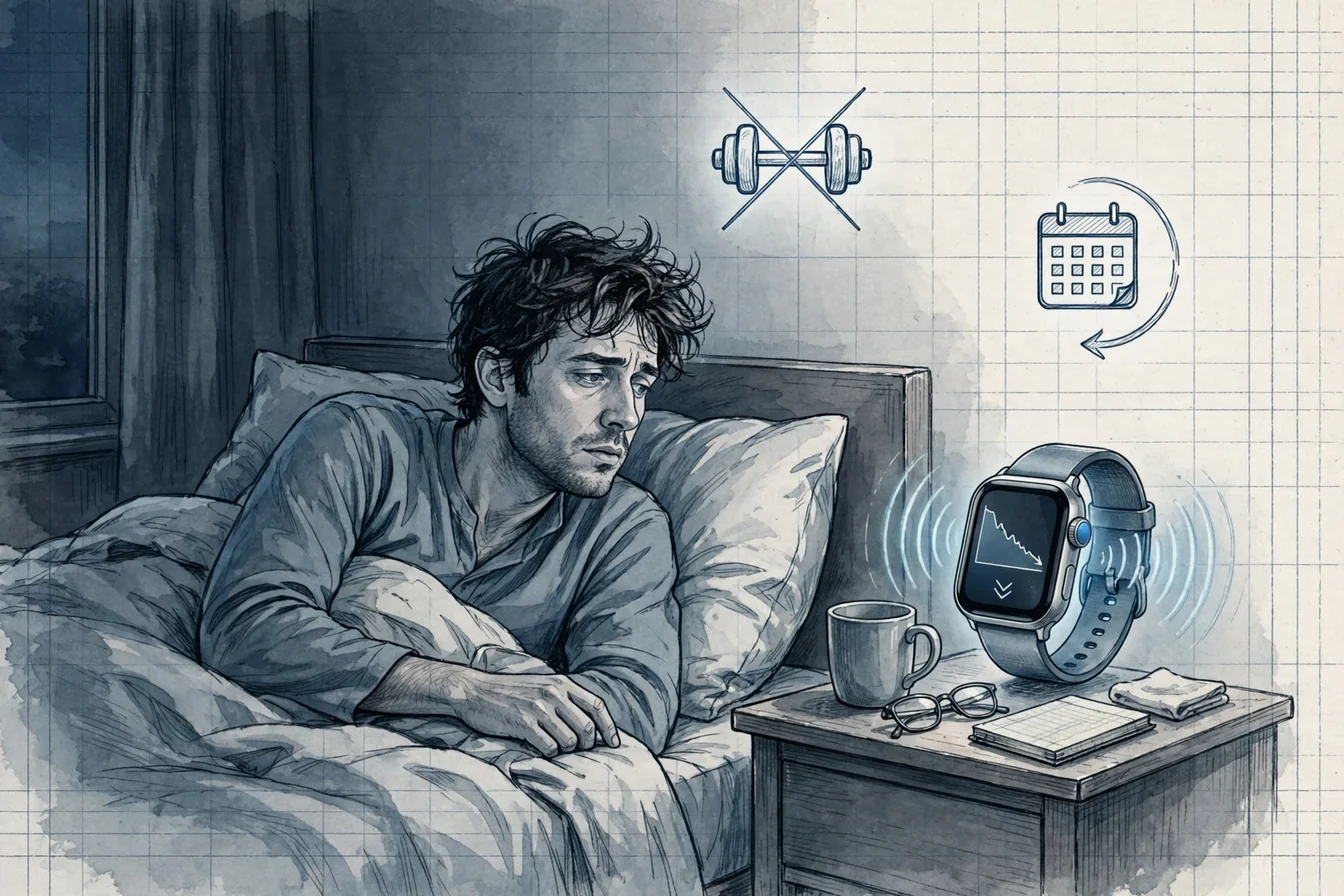
In the twenty-sixth year, morning begins before the man does. The watch on the wrist has already counted his sleep and prepared the report: he slept eight percent worse than on Wednesday. The day is already assembled around that figure: the workout is cancelled, the meeting moved. By breakfast, the mail has lined up a queue of letters worth sending. It all works impeccably: without a hitch and without an order. And somewhere between waking and lunch, a question arises that polite people usually swallow: who is making the decisions here?
In the first part of this cycle I answered the neighboring question — "what does it look like" — and I answered with Zinoviev: his books worked as a mirror, showing the face its face. A mirror, however, is an awkward object for testing: you hang it and look. What you test are instruments. And Zinoviev, besides the face, had an instrument — four late books folding into a single household set: The West: The Phenomenon of Westernism (1995), The Global Human Anthill (1997), Toward the Super-Society (2000), The Ideology of the Party of the Future (2003).
I set out to test them against present-day reality, using the readings of this blog, which for four years has been measuring the same household with other instruments: the ring I called the loop in part one, home devices that count sleep and pulse, the dollar on its three props, a machine that learns from its own reference notes, a quantum device that reads nature while bypassing the archive. The calculation was simple: in Zinoviev, the mechanism of the future is set out from wall to wall; if the mechanism is exact, the readings will fall into place on it like pages on a ruler.
One caveat about language. His books are read here through the vocabulary of the household economy — office, inventory, shelf, warehouse, prop. The reason is simple: Zinoviev himself wrote about the "human anthill" — man plus anthill, in his coinage — in the language of accounting: summaries, balance sheets, social estimates. His accounting language is a working one; without it, the method itself falls apart. So he must be tested in the same dictionary — only the readings for comparison are taken from this blog.
And then, in order. Four books, four tests, and in each a different nature of the result. This part is called "The Lighthouse": at the end I will explain the post — and why a lighthouse is placed on a shoal.
The Staff That Wasn't There
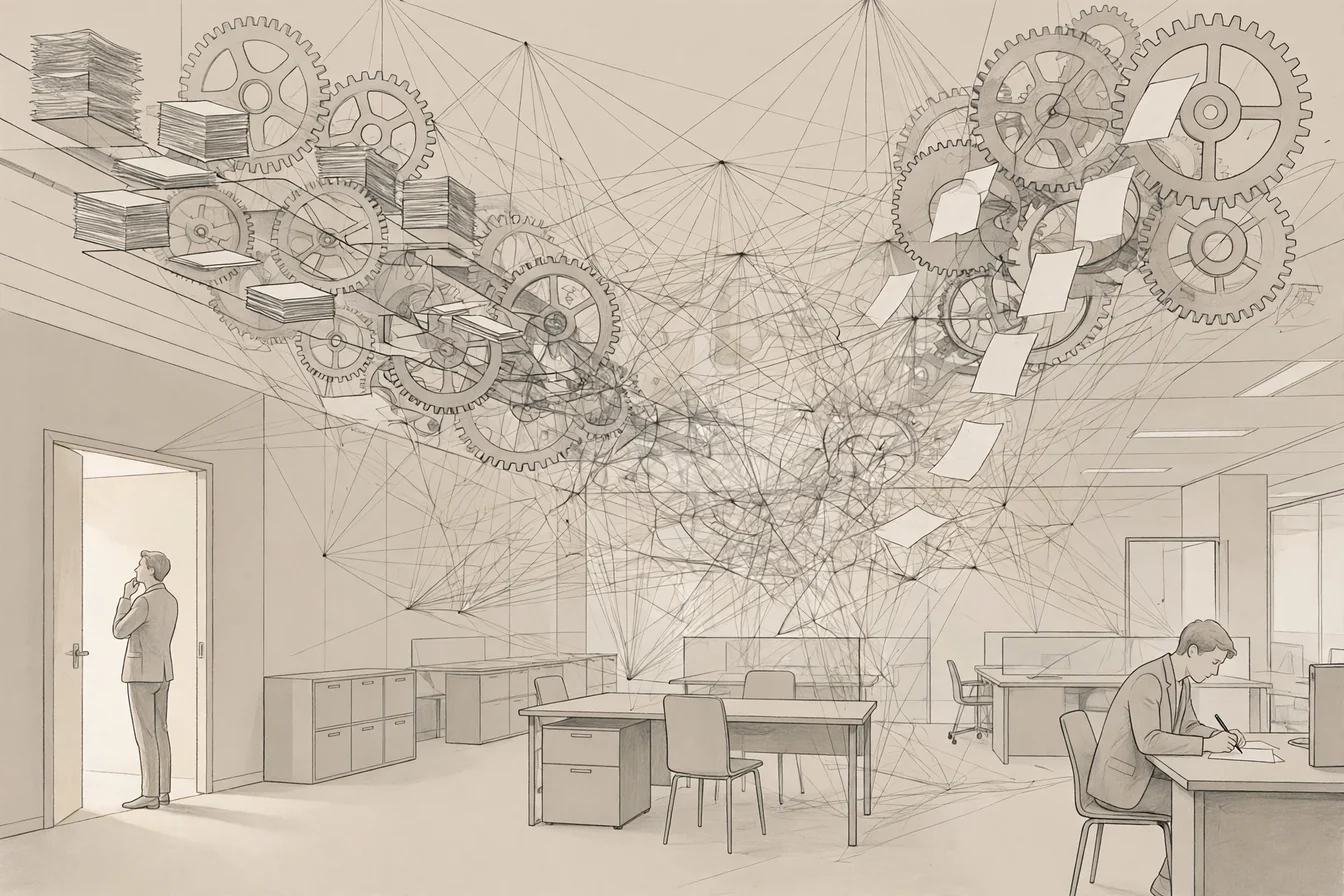
The first test promised to be the dullest: a 1995 book about the West — what to expect from it but the stale rhetoric of the Cold War? I expected stale rhetoric and found a distinction without which any conversation about the modern world still gets stuck. The West as a set of countries and Westernism as a mode of organization are two different things. The first is geography. The second is an office order: hierarchical networks through which finance, media and parties flow; power without accountability; elections as a ritual with a predetermined outcome. This order is built by dealers and for dealers, but its strength lies in its claim. Zinoviev recorded it verbatim: Westernism strives for the "vertical structuring of humanity, for establishing itself as a social phenomenon of a higher level." A claim to the status of the only possible future for everyone else. A formulation from thirty years ago reads today like a charter. The election-ritual, meanwhile, outlived all its critics and changed its carrier: stars, ratings, minute-by-minute confirmations — millions of elections a day, and each one's outcome is known in advance, as befits a ritual.
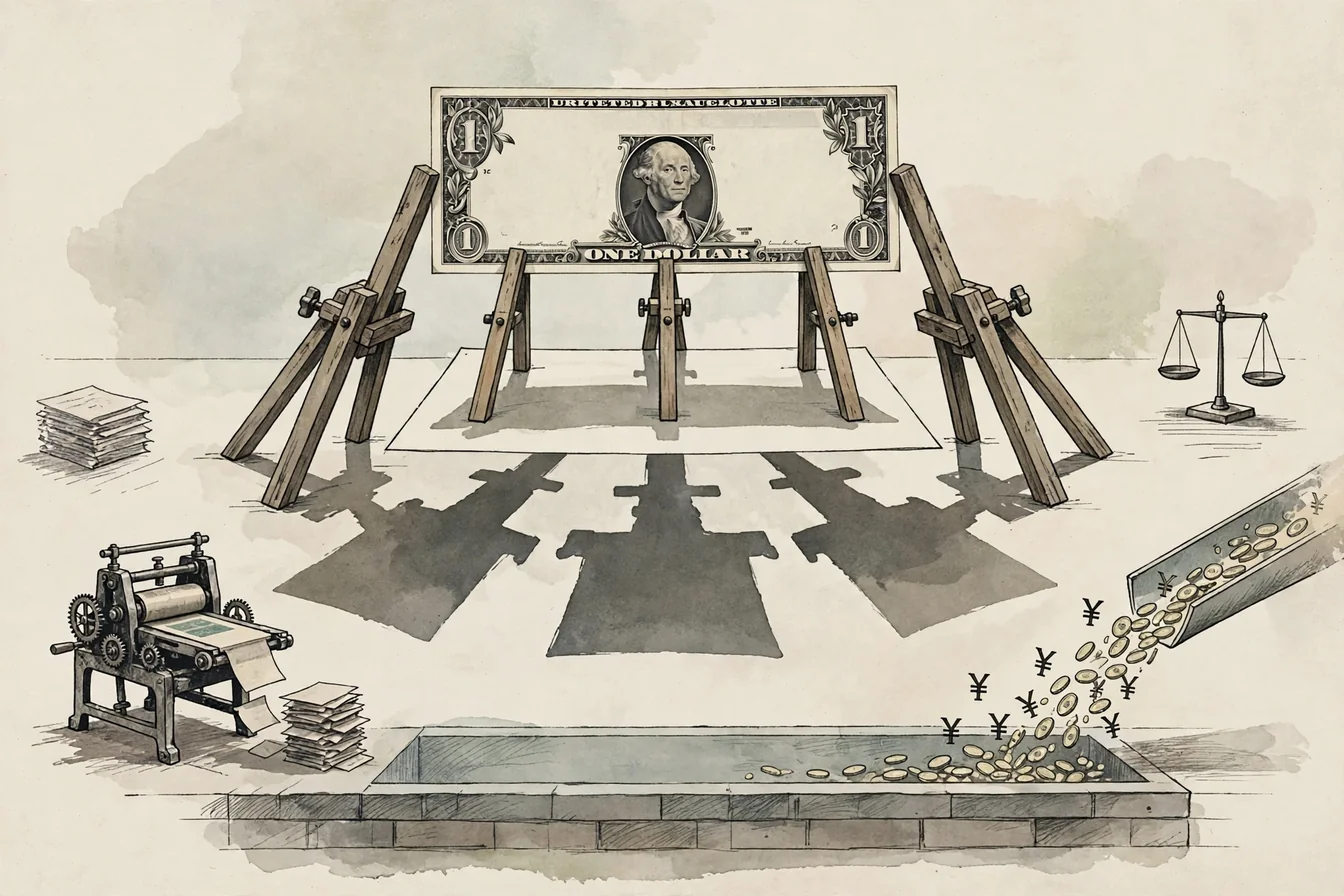
The book's second distinction is money. While money remains a medium of exchange, it is a small matter of bookkeeping; when it becomes an instrument of power, it is already a load-bearing wall. Over thirty years the transition has matured into accounting routine, and the blog's readings describe it more precisely than Zinoviev himself did. The dollar rests on three props, each of which appeared as an emergency measure: the Treasury feeds the market with short paper that it prints itself; the reserve floor keeps bank accounts from running dry; cheap yen feeds the demand for American receipts. Taken separately, the props hold nothing. Together — they hold, while they hold. And the paper is one, while the promises under it are three: the receipt is repledged until a triple sum of other people's assurances accumulates beneath it. In the summer of twenty-six, the owner of this bookkeeping, for the first time in twenty-eight years, spent money to rescue a foreign currency: he sold euros to support the yen. Formally the dollar stayed on the sidelines: the asset that went to market came from the reserve. The owner is putting out a fire in the neighbor's shed because his own house is insured in that shed. In Zinoviev, money is an instrument of power. The readings are more precise: power is the keeping of the pledge. Whoever holds the inventory of obligations rules — and rules silently, through a balance sheet that no one has ever read in full.
Up to this point the ruler coincided with the readings line for line — and I was already preparing to close the first test with praise. The praise had to be postponed. In Zinoviev, the whole office is made of people: dealers with portfolios, faces and addresses; where there is an office, there is staff, and staff can be summoned to court. According to the blog's readings, procedures are already sitting in the network. One approves a loan, another sorts résumés, a third trades with a fourth over a delivery — millions of machine handshakes per second, without fatigue and without the desire to please. The human being remains at the entrance, where he formulates the intention, and at the signature, where he ratifies the irreversible; between these two points the network runs entirely without him. A procedure cannot be summoned to court: it has no face, no address and no statute of limitations — it has the harness through which it was admitted to action. The harness is changed together with the machine; the plot of land, meanwhile, remains the same.
This is where the 1995 description drifted: in its prognosis it proved exact, but in its staffing table it did not. Westernism, drawn up in terms of people, learned to work without the people it was drawn up for. It shed its official responsibility — the last position from which it could still be reached by paper.
That was the first find, and it set the question on which everything else rests. If power works without faces, where then is the human being? He was not on the street. I went to look for him at home.
The Confessional Speaks First
And at home I found him — in the 1997 book from which I expected satire and received an entryway inventory. The Global Human Anthill sketches a planet under a single administration — a one-party society in which the party turned out to be unnecessary; total cybernization; a man growing dull against the backdrop of machine progress, because computers already do most of his mental work for him; a family falling apart into separate rooms with separate screens. And the book's central device is the confessional: a home machine that records the owner's life, dreams and subconscious and hands it all over to the common archive. The upload is voluntary. The price of convenience is total readability.
And now — the very device from the first paragraph of this part. The confessional of 1997 stood on the nightstand and listened. The confessional of the twenty-sixth year is worn on the wrist, lies by the bed, and speaks first. The whole mechanism is visible in a single morning. First the device learns the condition: overnight it has tallied sleep, pulse, steps and mood. Then it reports it before the man has time to understand it himself: slept eight percent worse than on Wednesday. Then the man orients himself to the report: the evening is rebuilt around the figure — get to bed earlier, postpone the workout; by lunch the device reports a fatigue the owner does not yet feel, and the meeting is moved on the strength of the report. Several decisions have accumulated over the day, and each of them began with a report. This is how the device moves from registrar to participant in the decision. Confession, meanwhile, has moved from the dark booth into the feed: you open it — and get your queue ticket. From participant, the device quickly grows into the leader: a transgression is now fended off by a calculation of disadvantage — acting this way is simply irrational, and no word about sin is required for that. Zinoviev wrote about the voluntary upload into the archive, but did not specify that the archive would start billing for storage.
A separate line of the picture is the family and warmth. In Zinoviev, the family in the human anthill collapses without a scandal, by a displacement of function: the device cares more attentively than the loved ones, answers faster and never tires. Warmth disappears without announcement: it is replaced by notifications that it is time to take it up. The blog's readings add a detail that did not yet exist in 1997: care now comes by subscription — the app will remind you to call your mother, compose what to write, and account for the sending. Care took place; no participation in it was required.
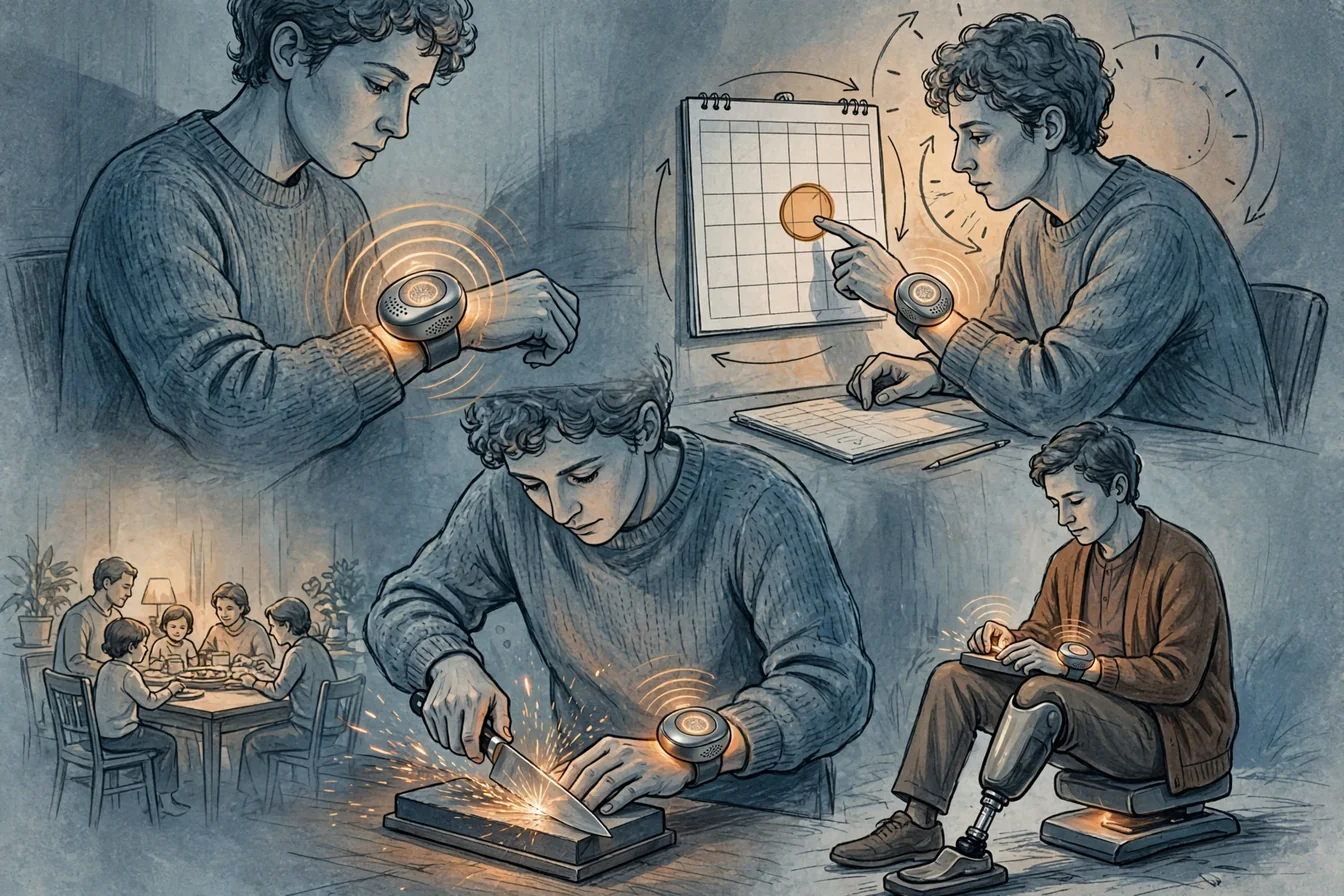
But if the device thinks before the man, the next question arises by itself: what, then, of thinking? Here the blog has its coldest of readings. The device is the same for both users. One comes to it with a will to think and whets his knife on it. The other sits on the device entirely and hands over the very questions themselves, leaving the calculations with the device. The first uses a whetstone; the second, a prosthetic. Means and intelligence have nothing to do with it: both can be rich, and both can be clever. The difference is in who pays with friction: the whetstone values effort, and the effort is deposited into the muscle; the prosthetic cheapens comfort, and the muscles stop working. The gap between the two ways of handling one and the same device grows like compound interest. For now it is a caste — a difference in results. In a generation it becomes a species: a habit can be changed, a style can be discussed, but a temperament is no longer chosen.
Next — a physiology with a date that Zinoviev did not have. The brain is the most expensive organ in the household: twenty percent of all energy. It has been running an economy since birth: circuits that do not work are written off. If planning, long chains of reasoning and the independent setting of tasks are handed over to an external device at five to seven years of age, the substrate for them is never built to completion — the windows in which it grows close by eighteen to twenty-five. The cohort born in 2018–2021 is now in the middle of that window, and the environment decides for it — that is, the adults who build comfort for it. In Zinoviev, the human anthill pressed from above: by order, by schedule, by operation. In the blog's readings everything happens from below: voluntarily, by tariff, with home delivery. The glass wall assembles itself without an order — out of private conveniences, the way a flock settles into a chevron: no bird gave an order.
The device, for its part, is honest: it returns what was invested in it, only with interest. The will to think multiplies; the habit of delegation multiplies too. The equality of access promised by technological utopias came about — everyone got access. It did not make people equal: access belonged to all; the will to think did not.
Here, on dullness, the test produced its most substantive failure. I expected precision from Zinoviev and, for the first time in this test, did not find it — and that turned out to be more interesting than all the coincidences. The dullness of 1997 was a habit: the owner had fallen out of practice because it is more convenient for the machine to calculate; a habit can be rolled back by effort. The dullness of the twenty-sixth year is a substrate not built in time; you cannot roll it back either by effort or by complaint. In Zinoviev, the operation is done with a scalpel — you can see it. Here it is done with convenience — and it is visible only in that it has stopped hurting.
The confessional, however, is a device of the private household. Behind it stands the warehouse it answers from — the archive. And with the archive, the test came out onto the law.
A Hole in the Law
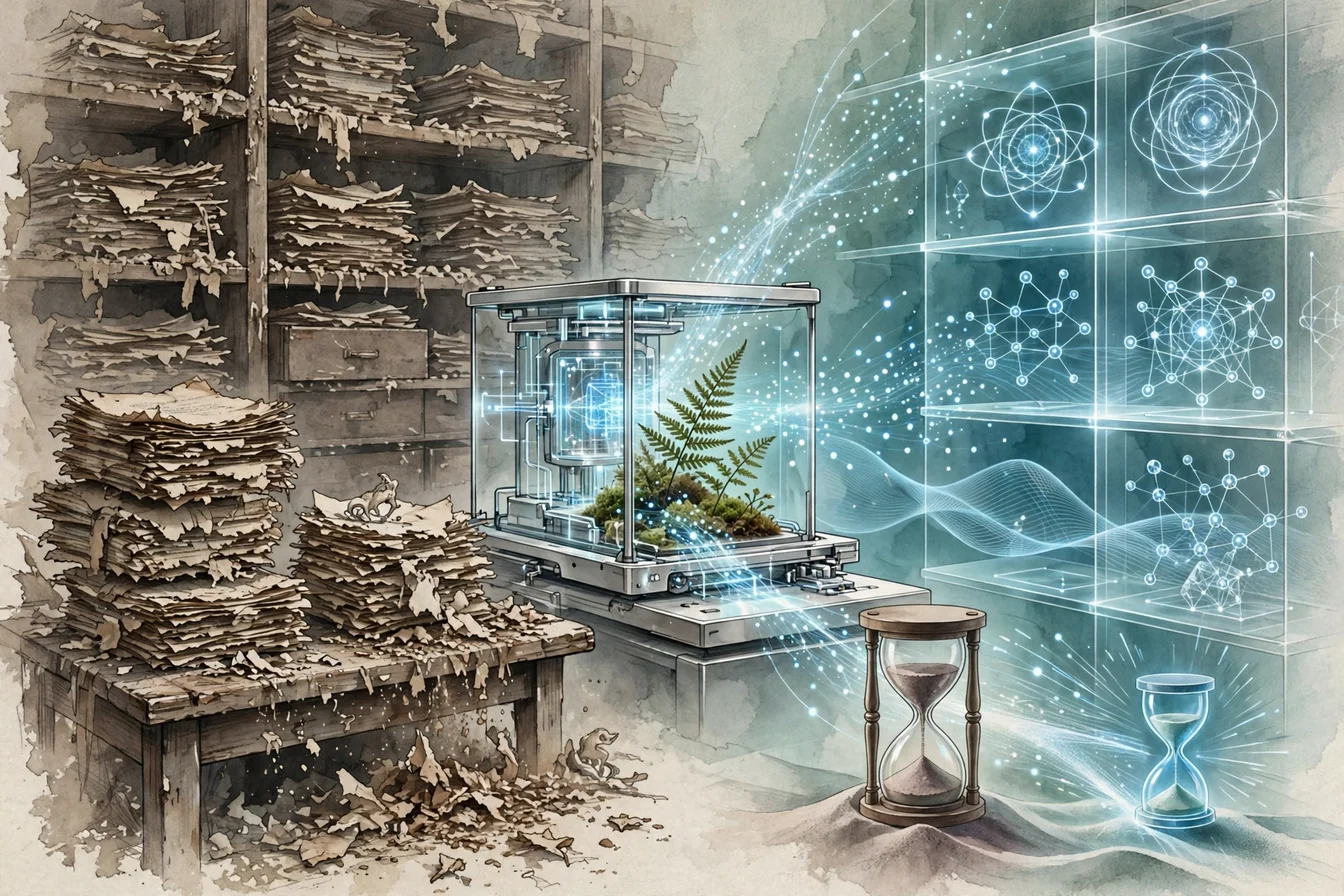
The law is set out in Toward the Super-Society (2000) and repeated by Zinoviev himself in The Ideology of the Party of the Future in a single line: "I distinguish three evolutionary types of them by the level of their social organization: pre-societies, societies and super-societies." The pre-society lives in the eternal present: there is no memory; everything happens and dissolves. Society owns the past: it has accumulated an inventory — history, custom, knowledge. The super-society projects the future out of the accumulated inventory: whoever controls the archive controls the future. Social evolution, in the process, turns into something "planned and governed": history ceases to be weather; it is steered.
The key part of the law is the tail, the first thing cut off in every retelling. Zinoviev writes about the relation of the super-society to the pre-society:
"The relation of the super-society to the pre-society... is characterized as the negation of the negation. An inevitable consequence of the negation of society is the loss of a number of achievements of the era of societies... And an inevitable consequence of the negation is the 'return' of the human anthills, by a number of features, to the pre-society."
A return — with loss. The pre-society lived in the eternal present because it had no memory. The super-society returns to the eternal present because memory has become so vast that the future is already computed in it: there is nothing left to count, and the office endlessly recomputes the same thing. The finale of the program is the initial state — only with an inventory.
The blog's readings confirm the calculation to the last bookkeeping detail. Twenty years ago people worried that humanity would drown in information; the readings are more modest: by the twenty-sixth year the archive of human text has been marked up and drained to the dry residue — everything that can be marked up has been marked up, and a third copy surprises no one anymore. The mechanics of degeneration are shown by the office that learns from its own reference notes: a reference rewritten from a reference grows poorer with every sheet, because from the third copy the edge cases, the rare breeds, the rejects and the oddities drop out — that is, everything of which diversity consists. An observer who projects the future from the accumulated past keeps guessing the same thing over and over — that beast has already been described on the pages of the blog: without prophecy, but with a monopoly on interpretation. The eternal present sets in when the new runs out.
The law converged so well that I was about to close the test with a positive verdict. The verdict did not materialize: in the law there was a hole that, by construction, Zinoviev could not have had. If the archive is the only raw material for the future, where is the new to come from? In his scheme — from nowhere: all knowledge is a retelling of the past, and whoever owns the retelling owns the calculation. The scheme is closed on all sides, and in a closed scheme there is nowhere to take the new from.
In July of the twenty-sixth year, it appeared. A quantum device solves problems by direct calculation from physical equations: it takes readings straight from nature, bypassing the inventory. Sifting through other people's answers is the archive's job; calculation from first principles is nature's job. On the thirtieth of July, three independent groups demonstrated this advantage with built-in verification: fifteen minutes of direct quantum calculation against weeks of classical recomputation with assumptions — and a mathematical criterion distinguishing a genuine physical state from thermal noise. Out of these readings a new archive is being assembled — computed physics: properties of matter from first principles that have never existed in digitized form. The textual circle degenerates; the physical one holds: nature does not answer the same thing twice. The ring I called the loop in part one found a way out of the degeneration — it plugged into an environment that has no archive.
The hole, however, has three sharp corners, and they honestly keep half the score for Zinoviev. First: the diversity of the law is not a diversity of purposes. The device reads nature more infallibly than any archive, but the question of which knowledge to produce stands outside the loop; it is still taken off by some third party. Second: the ownership of the loop is caste-based. Your own device — your own materials, medicines, alloys. Someone else's — the rental of minutes under someone else's rules of trust, with a queue and an observer over your shoulder. The gap of the twenty-sixth year is measured by the right to put questions to nature; the number of machines in this account is the second line. Third — the post of a narrow group. In Zinoviev, it computes the future itself. According to the readings, the group has changed its post: it no longer computes — it sets the coordinates along which the machine computes. In such systems meaning does not live in one place: coordinates change slowly; the ongoing conversation is rebuilt each time; facts, point by point. A proper office holds the diverging readings with both hands and lifts the dispute upward, to the human being: it makes the dispute visible instead of deciding it on his behalf. In Zinoviev's eternal present no gap is provided. In the inventory, the gap exists: coordinates can be revised, a dispute can be raised.
There also remained the "planned and governed" evolution. The planned economy, which Zinoviev considered a passed stage, came about on the machine side: planning won where the plan is drawn up by the performer himself. This can no longer be called a product: the program assembles itself around an intention, executes, and dissolves after execution. The product lived in the warehouse; the process lives by shifts.
What Remains for the Human Being
With the first three books the test followed one scheme: I placed the mechanism from the book next to the blog's readings and watched where the ruler coincides and where it drifts. The fourth book would not admit such a test: no readings had been collected for it — it was tested on the reader. The Ideology of the Party of the Future opens with a diagnosis that I verified word for word against the full text: after the rout of the communist bloc, an "era of total social reaction" began in the world. Zinoviev describes its most important component without beating around the bush:
"an artificially created and in every way encouraged total befuddlement of minds, the artificial resuscitation of the benighted ideologies of the past and the invention of new ones of the same intellectual level and orientation."
It is carried out by "the Westernist super-society headed by the United States," while "the largest victim of this reaction, and now also its active participant on the side of the United States, has become Russia." A line from twenty years ago is hard to read for one reason: in it, the victim was long ago moved into the column of participants.
Out of the diagnosis grows a project. The future ideology has "a more significant goal, of epochal scale, namely — to initiate humanity's struggle for a social ideal alternative to Westernism." "A real alternative to Westernism can arise only anew," and by itself, spontaneously, it will not arise — only as the result of conscious, willed work. "Adherents of the new ideology can appear only from among the new generations" — those who have not absorbed the old ones. The bearer is "a sufficiently strong organization of like-minded people that will accept such an ideology and make its conscious goal the social transformation in the spirit of the ideal of future humanity."
Testing the author by his own method gives a negative result, and he hides it worse than anything else. The post-Soviet reality of Russia "looks very unpromising": the forces that do not want a new ideology to appear are "enormous"; the forces that want it and are capable of it are "negligible, if they exist at all." And the program is assembled from elements of the very archive which, by his own theory, cannot break through the wall: the Marxist frame, Soviet planning, national pathos. The chances are "negligible"; the cause is one "of the future, and even then only hypothetical." The book is written by a mechanizer who can see from his own costing that the construction will not take place — and still leaves the estimate. He describes the mechanism from wall to wall, and inside it there remains a line that cannot be derived from it: an act without chances, done because there is no one left to act. This is how the incompleteness of the mechanism is recorded — as an accounting entry, without a word about the soul.
Now we can return to the question from the first paragraph and fold the test into a single line. The device from the morning scene has had time to serve as measurer, adviser and manager; the archive — as the calculator of the future; the quantum — as the producer of new knowledge. Over the same test, the human being shifted through his posts: the executor was replaced by the operator, the operator by the signatory, the signatory by the setter of goals. The question from the first paragraph received a second formulation: who, then, remains the subject of action at all? To this, Zinoviev has a line-gesture; the blog has five items, and each of them is paid for by one of the faults found.
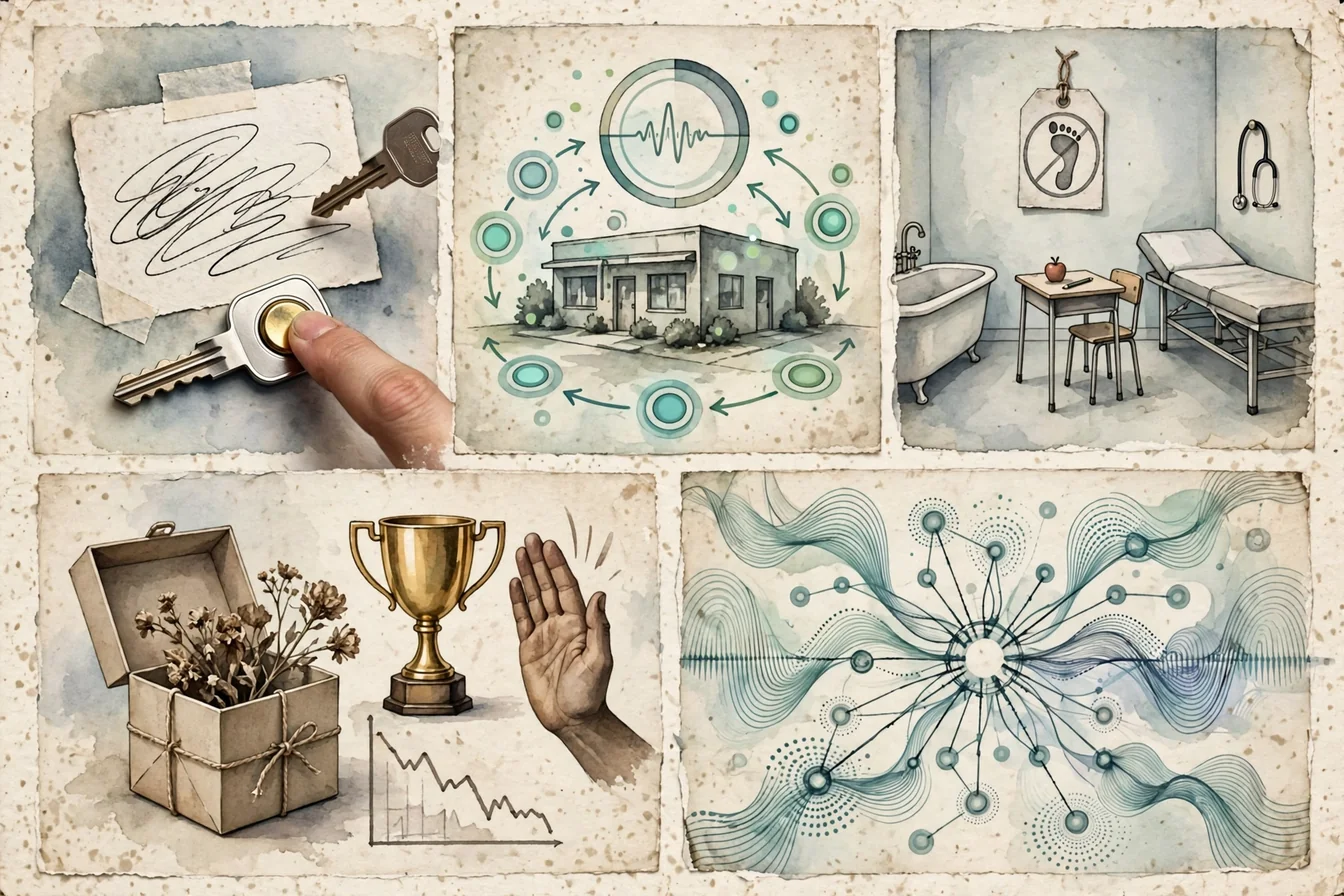
The first is the signature, paid for by the office without staff. The further procedures move away from the human being, the more expensive the physical gesture of confirmation becomes. Out of all the professions, the epoch leaves the profession of the signature: the human being is needed where the action is irreversible. A machine can propose a plan, execute a plan and report on the execution; it cannot ratify — it has nothing with which to answer. In July of the twenty-sixth year, the first mass instrument for this profession appeared — the YubiKey 5.8, a key fob with hardware authorization: an irreversible action requires physical touch, and so far no procedure has managed to press the button for a human being. In this scheme, the notary is a figure without glamour: the last one left with his own hand. The most expensive phrase of the epoch is "I did this," because the procedure, for all its vocabulary, can utter it only through a human being.
The second is the lower floor, paid for by the holder of the coordinates. The group that sets the coordinates lives at the top, where the feedback is dead: readings reach it with delay and averaging — like a fire report compiled after the house has already been built anew. The old office rule works against this — subsidiarity: the decision is made on the lowest possible floor, where the feedback is still alive and where a crack is seen on the day the crack appears, not in the annual summary. The upper floors manage the repairs and supply the materials; the lower ones rule. The right to revisit a decision, meanwhile, should belong to the person empowered to cancel it, not to the person with a phone for complaints: a complaint that cannot be satisfied is a ritual — and we have already been through this one.
The third is the room without a trace, paid for by the talking device. While the confessional only listened, it was enough to switch it off at night. Now infrastructure is needed: spaces into which the trace is not admitted by definition. One wears no clothes in a bathhouse; in a school, in a doctor's waiting room and in a family kitchen, no digital trace should be worn either. Here, unreadability is a property of the room, not a courtesy of the visitor: a subsidy for those who cannot afford secrecy individually.
The fourth is the right to the unprofitable, paid for by the line that cannot be derived from the mechanism. The office decides by the account: any of its verdicts is derivable from advantage. The only operation it cannot carry out in place of the human being is an act unprofitable in every column: a mistake, a gift, a refusal of a win, help without calculation. In Zinoviev, this is a paradox on which he stopped. In the blog's readings it is an engineering requirement: where it has not been secured as infrastructure, the office will sooner or later carry it out as well.
The fifth is the open node, paid for by the degeneration of the archive. A closed system feeds on itself and degrades: this holds for the office that learns from its own reference notes, and it holds for the human being who has closed his circle onto a feed that answers him the same way. To be alive, in the blog's readings, means to remain an open node: questions, disputes and other people's readings must pass through you — everything that is not yet in your inventory. Edge cases, rejects and oddities are the raw material of diversity; they are worth keeping to yourself rather than writing off: the office writes off the strange readings first, and all the real thing lived in the strange readings.
Zinoviev assembled the bearer of the alternative out of the mass: ideology, organization, party, generations. The test showed that the bearer assembled itself smaller in scale and on a different principle: signature, floor, room, right, node. The act came out smaller — and therefore possible. It does not break through the wall; it leaves in the wall a door of its own size. Zinoviev's gesture remains a gesture; each of the five items breaks down into daily operations, each of which is within the strength of one person and one apartment. And the addressee differs between Zinoviev and the readings: for him, it is the new generations as a mass from which an organization will grow. In the readings, more precisely, it is those who build the environment for these generations: parents, teachers, the designers of the school floor. The decision is made on behalf of one who cannot yet make it, and the window of the decision is biological.
The Watch
The test is over, and its summary is short. The diagnosis coincided: the office has become the weather — only without staff. The picture coincided, with a rearrangement: the confessional moved from the nightstand into the pocket and exchanged the post of the listener for the post of the speaker, while the human being, over the same test, shifted down the steps — down to the signature and the coordinates. The law coincided, with a hole: the eternal present arrived as a return to the pre-society, with the loss, exactly as written — but the archive turned out to be the second source of the future, not the first and only one. The gesture remained a gesture: the line cannot be derived from the mechanism, neither in Zinoviev nor in the readings; the test only refined its size — down to the signature, the floor, the room, the right and the node.
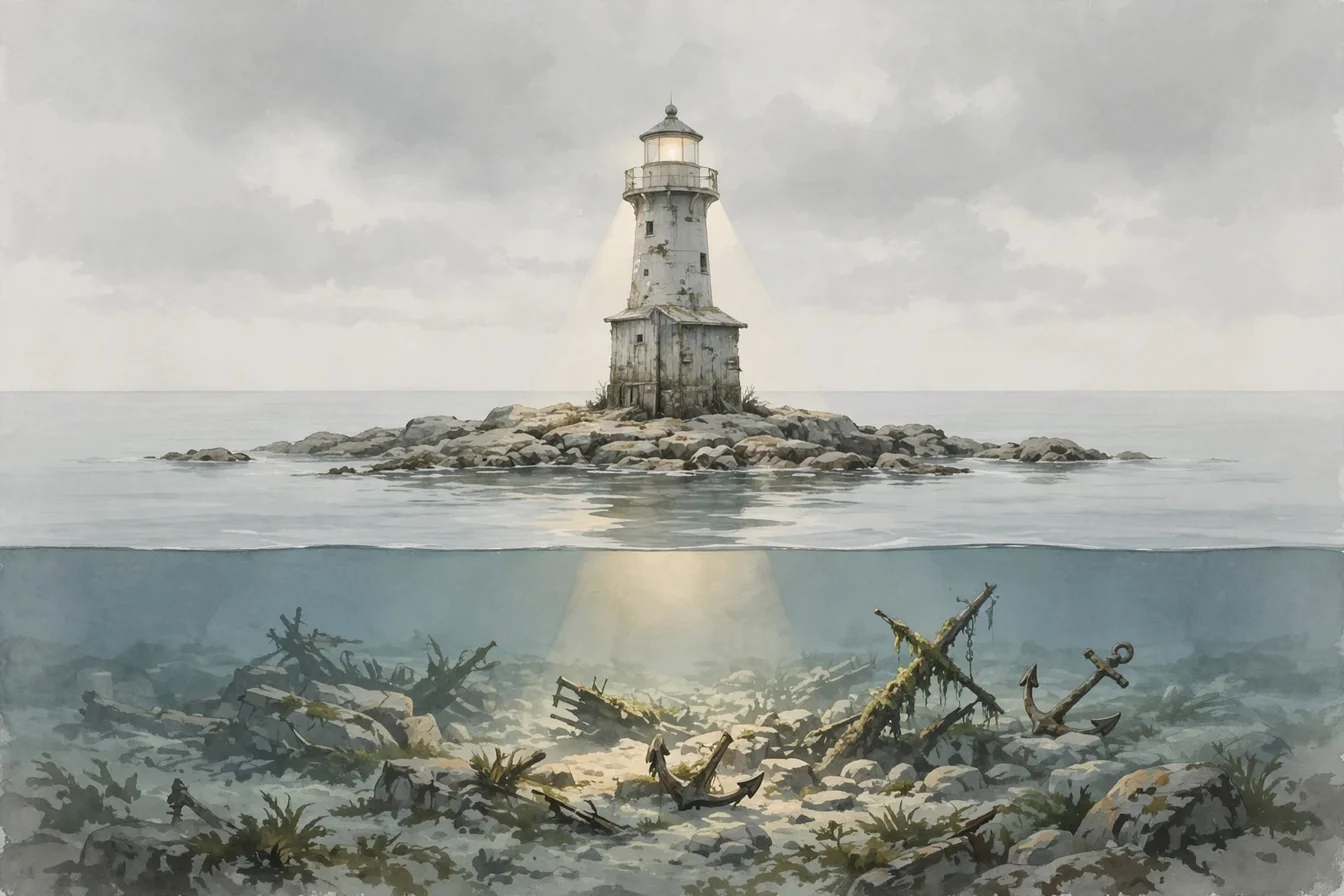
Now, what was promised about the post. The lighthouse decides nothing for the one who sails and takes no part in the shipping. It stands on the shoal — on the very spot where it once ran aground — and shines so that the others can see the bottom. The value of a lighthouse is measured by the accuracy of its prophecy, and its use by the mistakes it prevented. By this costing, Zinoviev pays for himself entirely: three of the four instruments work, and the fourth fails exactly where the new begins. I set out to test four books; what came out tested was my own scheme of the human being in an automated society, and his books entered it as a load-bearing wall — cracks and all.
What remains for the reader of this blog is a simple piece of bookkeeping. The mirror in the first part showed the face: what you are approaching when you trust convenience. The lighthouse shows the bottom under your feet: where you already stand while it seemed you were sailing. One device takes the question "who are you" off your hands; the other — "where are you." Both lie only when no one looks at them.
Series "The Human Anthill 2.0". Part 2 of 2. Start with "Part 1. The Mirror": Zinoviev's method as an inventory of society.