
Alexander Zinoviev wrote no manifestos and tried to save no one's soul. In 1954 he finished a dissertation in logic — calmly and doggedly, like an inventory of property drawn up in a district court. What interested him was not what people dream of, but how they are packed into a common heap and why this heap functions exactly as it does and not otherwise.
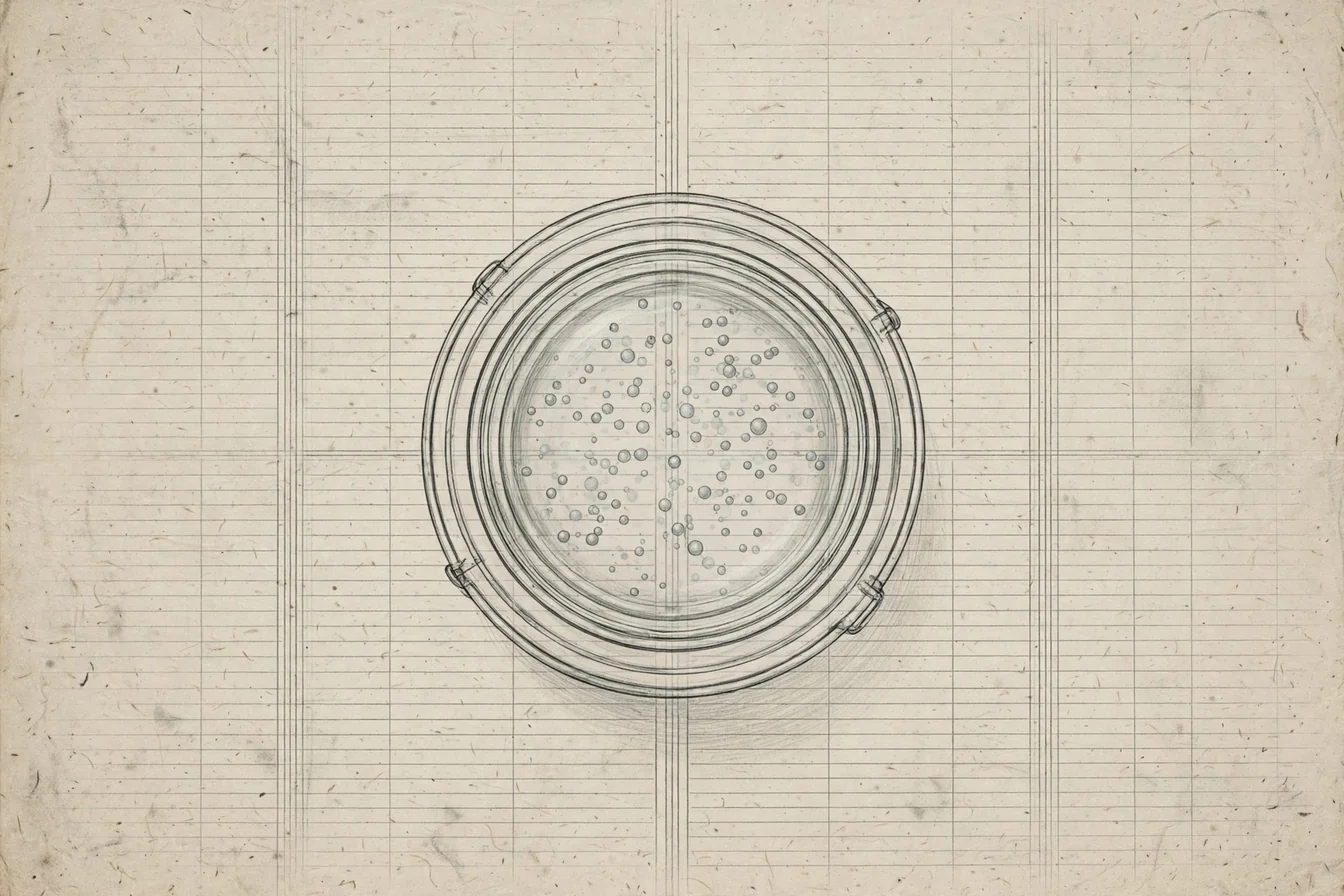
He has no tragedy and no sympathy — only a record. Society in his notes looks neither like a temple nor a theater, but a plain accumulation of bodies governed by dry rules. Under these rules, a single molecule of gas may fly wherever it pleases, yet the gas itself, sealed in a vessel, expands strictly according to instructions. A person sincerely believes he is making forward progress of his own free will, while dry statistics shows: the whole mass, slowly and inexorably, is drifting toward the buffet or toward the exit.
By 1960 the doctoral dissertation was ready as well — on many-valued logic, a science outwardly dull beyond words and, within, as strict as double-entry bookkeeping. Two rules survived from his method. First: take nothing on faith, including one's own sympathies. Second: describe society in words that smell of no ideology. This inventory makes no provision for flocks or audiences — there are only units of mass, from which collective behavior is assembled.
This law does not even require people. In The Yawning Heights there is a chapter, "The End of Rats' Paradise", about an experimental rat town. When the town perishes, lice get in and "established their own sociality in exact accordance with the rat pattern". Sociality starts on any biological mass, like mold in a damp corner; for it to begin working, no human being is needed.
The words "big data" had not yet been coined in his day, but the optics — the same as those of today's counting machines: a view of the population from above. The same book records a formula: the probability of an act equals the danger divided by the number of conceivable variants. A character pronounces it, but it serves the author's cause: the system assesses the mass, and the fate of any single person does not enter the calculation. I will hold to this optics to the end — it is verifiable, and Zinoviev ranked verifiability above consolation.
The Order
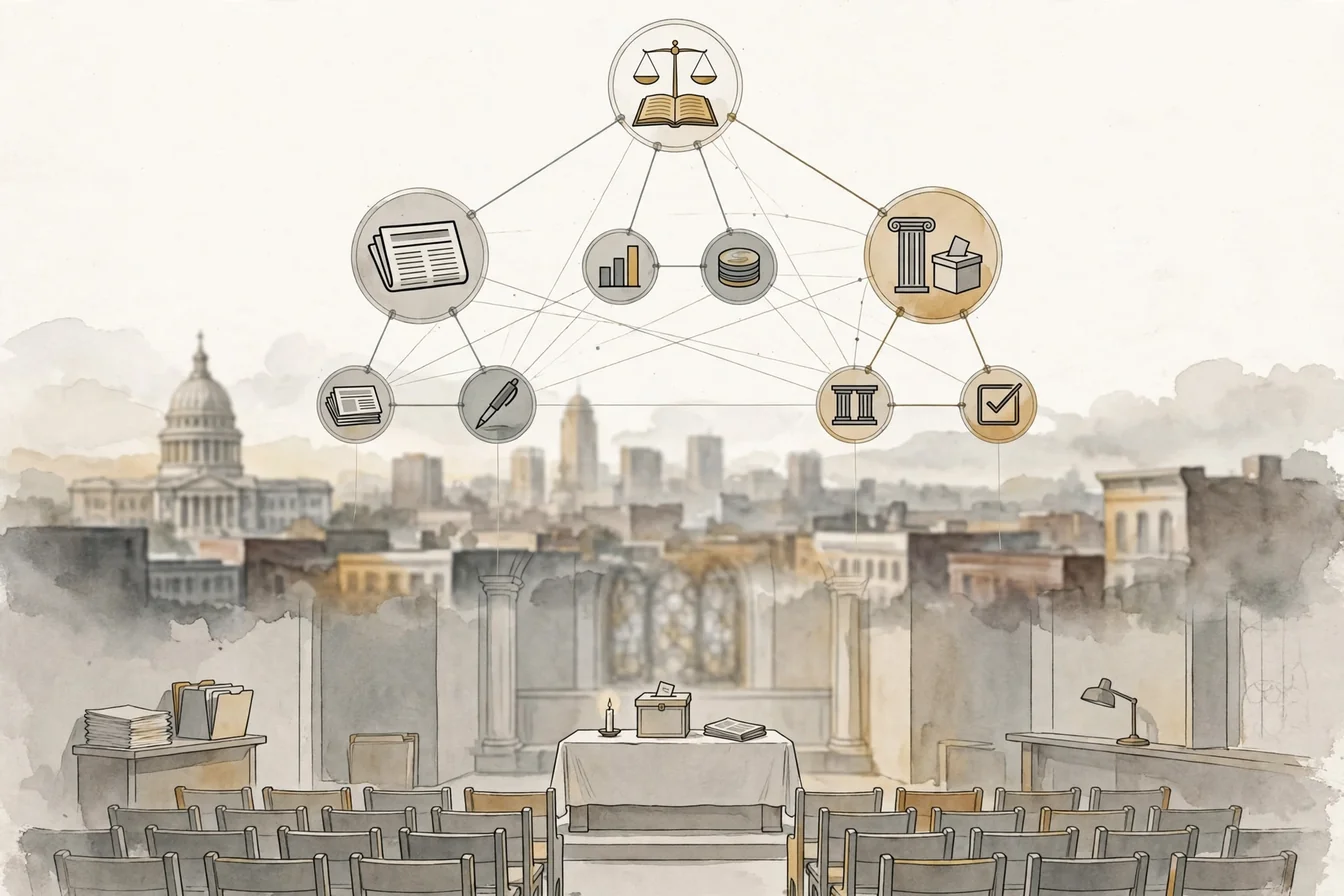
The book The West: The Phenomenon of Westernism (1995) is the middle of his system. For him, the West is the countries. Westernism is what took root in those countries: hierarchies that run the finances, the newspapers and the parties; power accountable to no one; elections like a church service — the rite in place, the management off to one side. Later this arrangement would be called post-democracy; he described it earlier and without the pretty word.
The core of it he calls monetary totalitarianism: money ceases to be a medium of exchange and becomes an instrument of power. Written in ninety-five — long before 2008, when it became visible even to those who read no books.
Globalization, from this point of view, is Westernization — and Westernization is the new colonialism. The metropolis here is not a country but a network, and its task — not to annex territories but to rewrite how people describe the world. Now it is language that gets colonized, instead of coastlines.
Under such an arrangement, dissidents are dealt with without noise. He recorded it with paternal irony:
"We do not burn dissidents at the stake, as in the days of the Inquisition, nor put them into concentration camps, as in the totalitarian regimes of the twentieth century. We have more humane means against them: they are simply ignored, and they do not appear at all."
The totalitarianism of past centuries required overseers, prisons, and loud speeches from the rostrum. The present order does without all that noise: it simply makes the unwanted opinion invisible. A man is not placed under arrest — people simply stop noticing him. He speaks, and the room is empty. This works considerably more reliably and more cheaply.
The Convenient Notebook

In the late nineties he described the "confessionals" — devices into which citizens, voluntarily and neatly, day after day, record their dreams, petty thoughts, and last testaments. Without any coercion, even with a certain pleasure. Then it looked like science fiction; today it is ordinary daily life: a person sits by the window of an evening, drinks tea, and uploads his whole life to the network, down to the last penny and domestic detail. No one stands over him with a whip. He was simply given a very convenient notebook.
In The Global Human Anthill (1997) — cheloveinik, "man" fused with "anthill" — this notebook is the central fixture. In all seriousness, the confessionals are regarded as the materialization of spiritual life, of bodiless souls. One of the heroines, Eve Adams, as she approaches death, dictates to the machine: "I bequeath the confession of my life to Humanity."
And the setting is described without a single miracle: "the information system of the Western countries has taken such a form that the analogous system of the totalitarian countries of the twentieth century, which produced a terrifying effect on the imagination of the Western liberal man in the street, would have seemed primitive." Knowledge, in this arrangement, is carried along with one rather than lived within one: "we carry with us (precisely with us, not within us!) all the riches of knowledge accumulated by humanity over its entire past history — we have become supermen." In such a layout, control becomes voluntary and therefore invisible.
A burden in one's pocket — still not understanding. In Communism as a Reality he wrote: "Knowledge of facts by itself does not yet give understanding." Understanding, he adds, does not come without effort; without effort come only delusions.
Next — culture of the same make. In the world of the human anthill, competitions are held in computer literature, music, and painting:
"Novels are composed astonishingly fast and professionally. Literally within minutes. The time difference among the contestants is like that of a 100-meter race — hundredths of a second. Computer judges grade the content in points, as in figure skating on ice and in dance, and just as quickly."
And the conclusion: "But this in no way prevents the overwhelming majority of such supermen from being fools and ignoramuses." Technology adds no intelligence — it duplicates emptiness at the speed of a printing press. Zamyatin promised "mathematically infallible happiness"; the human anthill has lived to see mathematically infallible creativity — novels in minutes, judges in points, not a single awkward word.
The Archive
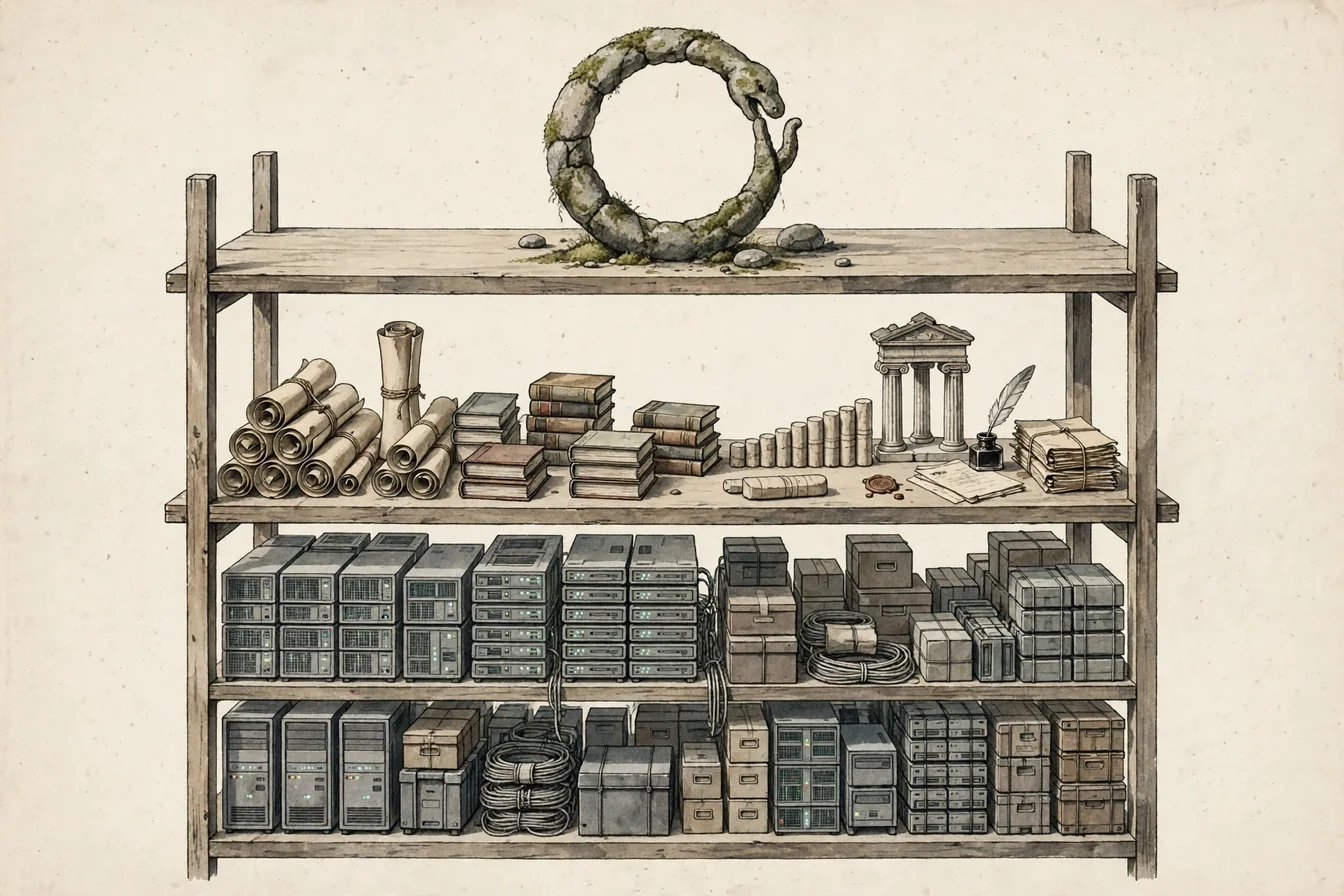
In Toward the Super-Society (2000) the theory is laid out on its shelves. Evolution, according to Zinoviev, has passed through three stages. Pre-society lives from day to day: no history, no accumulated experience, no project — only a cycle: born, fed, dead. Time here does not run forward; it walks in a circle. Society begins where the collective takes possession of the past: memory, writing, habit, and institutions appear, and time acquires a direction. Super-society is the third stage, on which the past ceases to be memory and becomes a warehouse. The word "archive" here is mine, not his, but the mechanism is described by him precisely: accumulated information becomes the raw material from which the future is computed. Super-society does not leap into the unknown — it computes the most probable continuation of the past and issues a forecast beyond the horizon.
On the relation of the third stage to the first, he records the following:
"The relation of super-society to pre-society is thus characterized as the negation of the negation. The inevitable consequence of the negation of society is the loss of a number of achievements of the epoch of societies… And the inevitable consequence of the negation is the 'return' of the human anthills to pre-society in a number of features, not secondary features but the very ones that define the lower boundary of super-society."
A return, then — but with losses. Pre-society lived in an eternal present because it had no warehouse. Super-society returns to the eternal present because the warehouse has grown so vast that the future has already been calculated and lies in the inventory. The loss of achievements is the loss of unpredictability: of everything that cannot be derived from what preceded it.
Whoever seizes the warehouse owns the future. Nothing needs to be invented: it is enough to extrapolate and, in good time, rewrite the description of the world. Under such mechanics, social time becomes an engineering problem.
A theory claiming rigor must state by what it could be refuted. What could break Zinoviev's model? If Russia after ninety-one had entered the West as an equal rather than as a raw-material appendage. If the Western states had preserved their sovereignty instead of handing governance over to supranational offices. If money had remained the servicing of the economy instead of becoming a self-sufficient superstructure. Then the model would not have worked. But no counterexample occurred: the finances fell exactly along his inventory, post-democracy — the procedures in place, the governance in the hands of those whom no one elected, while rules and sanctions issue from a single center and are enforced across the whole world without appeal.
I would suspect rigging if only events had come his way. But he hit the construction: his forecasts come true regardless of who sits in the White House or the Kremlin, because the trajectory is set by the apparatus, not by the designs of those sitting in their offices.
What did not come true — technical speed. The confessionals, the computer judges, the total inventory of life — all of this he had guessed. But he did not see how quickly the warehouse would begin rewriting itself: the computed future is written into the archive and becomes raw material for the next computation; the ring "counted — recorded — counted again" now turns faster than the environment manages to change. The circuit, of which he never spoke, closed without him.
The Prescription

A gap remains. In The Yawning Heights there is a "Parable of Oneself": a character by the name of Chatterer takes the smallest piece of bread from the table and forces himself to step aside from the struggle. A single act of will within a statistical mass: it does not repeal the law, but it registers the exception. Zinoviev left the question of individual escape open — he was the one who raised it.
And in 2003 — already an old man, fully aware that nothing could be set right — he sits down to write the program of the "party of the future". He himself calls the movement's prospects "disheartening" and the forces capable of creating it — "negligible". There is nothing heroic in this. It is a doctor grown cold from years of service, who knows the mixture will not help but still measures out the drops and writes the prescription into his notebook. Simply because a doctor must write prescriptions as long as he sits at the table.
The mechanism here is older than he is. Ibn Khaldun, in the fourteenth century, described the cycle: movements are begun by fanatics — people who hold to the form rather than the profit; continued by pragmatists, who build careers on the movement; ended by scoundrels, milking the leftovers. The triad "fanatics — pragmatists — scoundrels" I give in my own redaction; the principle itself belongs to the Muqaddimah. By this arithmetic, the party of the future should not have existed at all: by 2003 there are neither fanatics nor profit. The prescription was written against all the arithmetic.
What was it — a failure of the calculation, or the single free act inscribed in a deterministic system? A man who had spent his whole life compiling the inventory of someone else's apparatus, in the end opened a column of his own. I do not intend to resolve this tension — the whole construction rests on it. In the second part I will carry these laws over to what is happening around us: to the circuit that trims diversity, to monetary totalitarianism in action, to the man whom the system counts as a function. The question Zinoviev left open will become the entrance to the second part.
Series "The Human Anthill 2.0". Part 1 of 2. Continued in "Part 2. The Lighthouse": four late Zinoviev books tested against the readings of this blog — staff, props, the confessional, a hole in the law.