
The 2026 Nobel Prize in Physiology or Medicine: Deisseroth, Hegemann and Nagel — how optogenetics travelled from a single-celled alga to the clinic.
He lost his sight to retinitis pigmentosa. He was 58, and had been blind for about forty years. Then they fitted him with projector goggles, and after long training he could make out the white stripes of a pedestrian crossing. Next came objects on the table — a notebook, a cup, a box — that he could find, count and touch. Nobody repaired his retina. A gene for a protein invented by a green alga was delivered to the surviving cells of his eye, and those cells began to listen to light again.
Nature Medicine reported the case in May 2021. Five years later, the technology everything rests on received the Nobel Prize. On 5 October 2026 the committee named the laureates: Karl Deisseroth, Peter Hegemann and Georg Nagel — for discoveries concerning light-gated ion channels and optogenetics. The patient does not appear in the citation. But without the alga there would have been neither the goggles nor him.
This is a story of how curiosity about a single-celled alga turned into a tool that switches neurons on and off one at a time. What follows is how it works, what already works in people, and where science ends and science fiction begins.
Who got the prize, and for what
The three of them have different roles, but one chain of work. Deisseroth works at Stanford and at the Howard Hughes Medical Institute. A psychiatrist, he spent his time outside the clinic building a new tool for neuroscience. Hegemann (Humboldt University of Berlin) and Nagel (University of Würzburg) both came out of Max Planck Society laboratories: Nagel from the Max Planck Institute of Biophysics in Frankfurt, Hegemann from the Max Planck Institute of Biochemistry in Martinsried — by the time of the discovery he led his own group at the University of Regensburg. They found and described the molecule; Deisseroth turned it into a tool for studying the brain.
"This is an incredible honour — and unexpected. I am deeply honoured," Deisseroth said in a telephone interview on the Nobel Committee's website, picking up in the middle of the night after a working day on a new paper (our translation).
Fifty years of curiosity
In 1971 a bacterium with a purple protein was found in salt lakes: a protein that pumps protons across the membrane when lit, like a tiny pump. Pure biophysics — no brain, no disease, no use.
Then it was the algae's turn. The green alga Chlamydomonas swims towards light: it has a light-sensitive "eyespot" that tells the lit side from the dark one. In 2002–2003 Nagel and Hegemann worked out that what stands behind the eyespot is a pair of channel proteins — channelrhodopsins. ChR2 works like a gate in the membrane: light hits it, the gate swings open, positive ions rush in, the cell fires. The light goes off, the gate slams shut.
One question remained: would the algal gate open inside a mammalian neuron? In 2005 Deisseroth and colleagues inserted the ChR2 gene into neurons, and a flash of blue light made them fire with millisecond precision. Two years later, light delivered through an optical fibre reached deep into the brain of a living mouse, and the animal woke up on command.
Who was left out of the frame
A Nobel Prize is shared by at most three people, and optogenetics has more parents than that. Ernst Bamberg headed the Frankfurt department in whose group Nagel worked. With Nagel and Hegemann he shared the 2010 Wiley Prize and the 2012 Zülch Prize — and against that background the Nobel trio looks like a line-up with one person removed. Ed Boyden, co-author of the 2005 paper and today one of the leading neuroscientists at MIT, shared the 2016 Breakthrough Prize with Deisseroth. Georg Miesenböck of Oxford had already made nerve cells respond to light by other means back in 2002, and steered fly behaviour with light in 2005.
Awards have divided up this story before. The 2021 Lasker went to Deisseroth and Hegemann together with the discoverer of the 1971 purple protein, and Nagel was not among them. The Nobel went to a different line-up — which is nothing unusual: it never knows how to share with everyone.
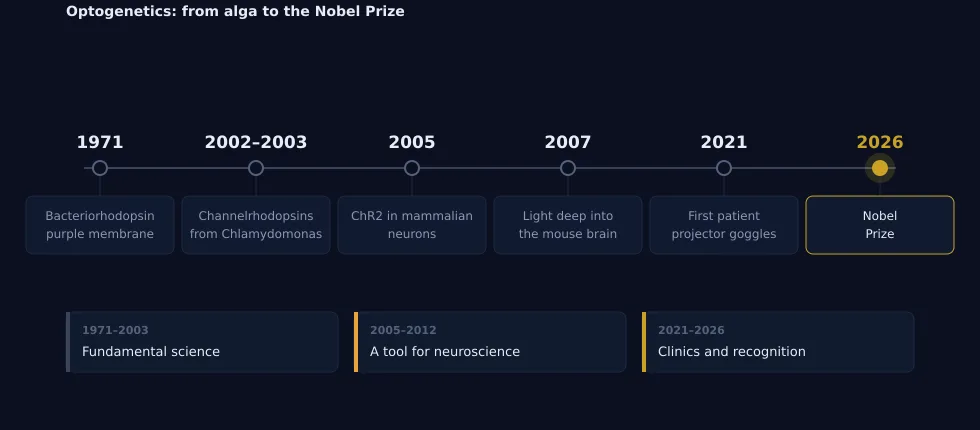
Fig. 1 — From the purple membrane to the Nobel Prize: the key dates of optogenetics.
How to make a neuron obey light
Two steps are needed. First, genetics: a viral courier (most often AAV, the most battle-tested vector in gene therapy) delivers the opsin gene into cells, and a promoter built into the construct makes sure the gene is read only by the right neurons. Then optics: a thin fibre or a tiny LED brings the flash to those cells — the ones that now respond to it.
After that, everything depends on the choice of protein. ChR2 lets positive ions into the cell, and a blue flash turns the neuron on. Halorhodopsin works the other way round: yellow light quiets it — that is the off switch. ChrimsonR is tuned to red light, which travels through tissue better, which is why it was the one put into the patients' eyes.
What makes light better than an electrode and a pill? Three things.
Time. An electrode hits everything that happens to lie nearby; a drug spreads over minutes and hours; a flash drives a neuron with millisecond precision, at the very tempo the brain itself runs on.
Address. An electrode cannot tell one cell type from another, and a drug binds to every target in sight. The opsin gene works only where it was delivered, so you can take, say, just inhibitory neurons, or just dopaminergic ones.
Cause. An MRI shows where in the brain the work is seething, but not what is cause and what consequence. With light you can switch one group of cells on and watch what changes in behaviour. That is no longer correlation but causation — a rare currency in neuroscience.
Inset. Channelrhodopsins use retinal, the same light-sensitive component that rhodopsin uses in our own retina. Nature took one and the same light detector for the alga and for us, even though the proteins around it are built quite differently. All that was left for scientists was to borrow the finished part.
The difference from earlier methods is easy to picture on a clockwork. An electrode and a drug are a hammer and a bucket of water: something breaks, something stops, and you never quite learn how the mechanism works. Optogenetics lets you slow one gear with light, without touching the others, and watch how the going of the clock changes.
What light has already figured out
After 2005 the method spread through the world's laboratories, and thousands of neuroscience papers acquired a new plot: switch it on, look, switch it off. Two experiments show how far it has gone.
Sleep. In 2007, flashes of light delivered through an implanted fibre switched on a rare group of hypothalamic neurons responsible for waking, and a sleeping mouse woke up markedly faster. A small group of cells turned out to be the lever that moves the state of the whole organism — and for the first time that lever obeyed light.
Memory. In 2012 researchers tagged the hippocampal neurons active at the moment of learning with a light-sensitive protein, and later switched them on with a flash: the mouse froze in fear inside a safe cage where it had never received a shock. The trace of a particular memory was found and run again. "Memory cells" stopped being a hypothesis and became an object you can work with.
The scale of this wave: nearly sixteen thousand papers with the word optogenetics (15,709 records in PubMed as of 6 October 2026) over twenty-odd years. A tool born from curiosity about an alga has become a standard fixture of the neuro laboratory — like a microscope and an electrode in a single body.
From the laboratory to people
Already in the clinic. Optical gene therapy for vision. The world's first optogenetics trial in humans started on the turn of 2015 and 2016: the American company RetroSense Therapeutics registered the RST-001 protocol in December 2015 and reported the first patient in March 2016. The project later passed to Allergan/AbbVie and was completed in 2024. The patient from the opening of this article entered a different programme, run by the French company GenSight (GS030). José-Alain Sahel and Botond Roska published his case in Nature Medicine: ChrimsonR in the retina, projector goggles — and the man could tell objects apart, point at them and pick them up.
"These results are proof of concept: partial restoration of vision through optogenetic therapy is possible" (our translation), Botond Roska said on the day the paper was published.
The GS030 trial continues, but enrolment is closed: according to ClinicalTrials.gov, completion is scheduled for October 2027. The Nobel Committee's own review likewise describes optogenetics clinical trials as ongoing.
For now, animals and tissues. Light is used to quench arrhythmias in heart tissue (cardio-optogenetics); optogenetic cochlear implants for hearing are being tested; epileptic discharges in mice are stopped at the moment they are born. All of this is still far from humans.
The most underestimated part. Optogenetics' main contribution to medicine today is not a device but knowledge. The circuit maps drawn with it suggest where to aim drugs and deep-brain stimulation electrodes. It rarely heals anything yet — but it already helps others heal.
Why this is not for tomorrow
Light does not pass through the skull. To illuminate deep structures of the brain you need implanted fibres or LEDs — which means surgery, risk and maintenance engineering.
Delivery remains the bottleneck. AAV is the best vector available, but it is still a virus: an immune response, dose limits and, above all, the fact that the gene stays in cells for a long time and cannot be recalled.
And a mouse is not a person. The circuits that flipped back and forth under light in a mouse are incomparably more complex in the human brain. Years of checking are needed to carry a result over.
So far as is known, optogenetics has never once been applied inside the human brain itself. The only trial in humans is in the retina of the eye — which is, however, formally part of it. The rest remains animal models and fundamental science.
Light as food
So far in this story light has been a command: a flash arrives, a neuron fires. But light has a second, far older role. It can be food. The question is whether you can feed an animal cell with it — and it starts not with science fiction but with bookkeeping.
The brain lives on a budget. The classic calculation by Attwell and Laughlin for grey matter showed that about half the energy goes to nerve impulses and a third more to the currents in receiving cells (47% and 34%, respectively). Later work goes further: energy costs limit the brain's computational power and set its key parameters — firing rates, the probability of transmitter release and the size of synaptic contacts. Laughlin puts it even sharper: energy supply and heat loss ultimately set the limit on information processing, and neurons turn out to be low-energy-density devices. The brain is not a wasteful giant but an economist in a very cramped flat. Hence the thought: if the budget is hard, perhaps it can be topped up.
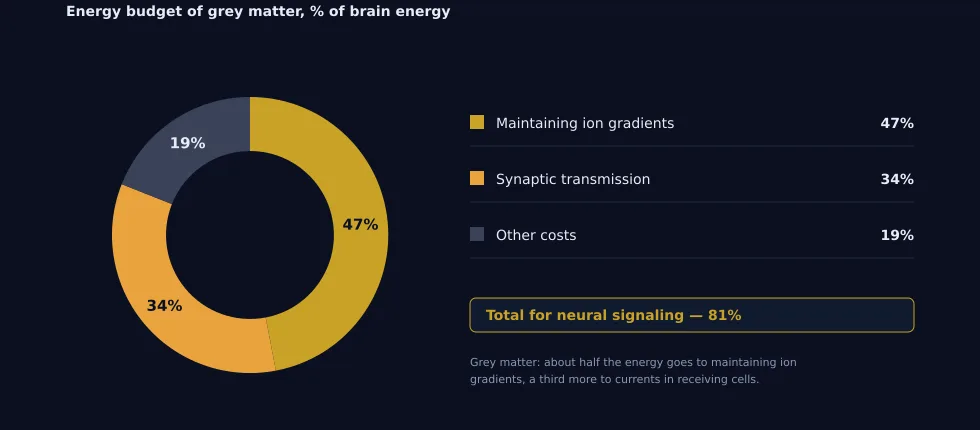
Fig. 2 — Where the energy of grey matter goes: 47% to maintaining ion gradients, 34% to synaptic transmission. Source: Attwell D., Laughlin S. B., Journal of Neuroscience, 2001.
How light becomes fuel. The cell has two routes here. The long, plant one: photosystems, the electron chain, the carbon-fixation cycle. And a short one, invented by bacteria: a single pump protein that drives protons across the membrane when lit and builds the gradient that ATP synthase runs on. That is the very purple protein from the salt lakes this article began with. The short route bypasses the most wasteful links — which is why people are trying to carry it into animal cells.
What science is doing now.
Pumps in mitochondria. Berry's group built a light-driven pump, Mac from the fungus Leptosphaeria maculans, into the mitochondria of the worm C. elegans and called it mtON. Light raised the proton potential in a dose-dependent way and sustained ATP synthesis, while the cells became more resistant to mitochondrial poisons — and ATP production did not depend on oxygen consumption. In the next work the rise in potential and ATP came with a marked extension of the worms' lives and improved age-related health measures. In a Drosophila model of Parkinson's disease the mitochondrial pump improved motor function and suppressed the production of reactive oxygen species. And in the retina of mice, the authors report, ambient light eased neurodegeneration by powering mitochondria through an engineered opsin. What makes this experiment curious is that no laser is needed: ordinary light will do. The protein needs retinal to work, and in the worm experiments it had to be added.
Chloroplasts in animal cells. In 2024 a Tokyo group led by Matsunaga transplanted chloroplasts of a red alga into hamster cells. The organelles kept working for about two days, with photosynthetic electron transport running inside them, but then began to break down, and by day four photosynthesis had apparently stopped. Cells with chloroplasts grew faster than ordinary ones, meaning the organelles probably fed them carbon. The authors allow that genetic tweaks to the host cell may help the newcomer avoid being digested.
Algae in the brain. We have already met them from the other side. In 2021 algae and cyanobacteria introduced into the blood vessels of tadpole brains produced oxygen under light, and that oxygen revived neuronal activity during severe hypoxia.
An old idea. All of this grows out of older experiments: a purified purple membrane with bacteriorhodopsin, built into vesicles with mitochondrial ATPase, allowed ATP to be made in the light.
Where the boundary is. In all of this work light was a medicine for a deficit: ageing, neurodegeneration, mitochondrial poisoning, hypoxia. What happens if you give extra fuel to a healthy brain — nobody has shown. Theory is silent on the point: the budget is hard, but the brain itself matches supply to demand, and extra energy is not obliged to turn into extra thought. The second boundary is geometric. Every successful experiment was done where light gets in by itself: transparent worms, flies, the retina. The brain under the skull remains behind a wall. And the third: none of these approaches has yet been tested in humans.
But the direction works. Light, first taught to switch neurons on, is now being taught to feed cells. And the first recipient turns out to be the eye again.
Where treatment ends
Any technology that controls neurons sooner or later runs into a question: where does treatment end and interference with a personality begin?
One boundary runs between therapy and enhancement. Returning sight to a blind person is easy to justify. But making a healthy person's memory slightly tighter, or their mood slightly steadier? The principle is technically the same, and society will ask where to stop.
The second boundary is irreversibility. A gene delivered by a virus stays in the cells for a long time. Consent to such an intervention is more than a signature on an ordinary operation.
The third is data. Implants that read and stimulate the brain produce neural data whose privacy is not yet systematically regulated. The first precedent was Chile: in 2021 it enshrined in its constitution the protection of brain activity and of the data about it.
The remote control for the mind remains a work of science fiction today rather than laboratory reality. But the therapeutic part is real and growing, so the rules are discussed in advance. A rare case where ethics arrived before the catastrophe.
The alga and the remote control
Let us return to the man in goggles before the striped crossing. There is no magic in his story — only half a century of fundamental science that promised nothing to anyone.
The purple protein from a salt lake (1971). A gate from an alga (2002–2003). Neurons under light (2005). The brain of a living mouse under light control (2007). A man who made out the white stripes (2021). The Nobel Prize (2026). A chain in which every link looked like pure curiosity and only in retrospect became a rung on the ladder to medicine.
None of them was curing blindness. They were taking an alga apart.
Where to look next: in December the laureates will give their lectures in Stockholm, while in laboratories red opsins, wireless micro-LEDs and the first "all-optical" schemes are growing — where light both stimulates neurons and reads their activity. "The remote control for the brain" remains a metaphor for now. But the button is already there, and it is made of an alga. And beside the button scientists are already looking for a socket: the same light, only not as a command but as food.
Sources
- Press release: The Nobel Prize in Physiology or Medicine 2026. nobelprize.org, 05.10.2026 (accessed 06.10.2026) — https://www.nobelprize.org/prizes/medicine/2026/press-release/
- Popular science background: A light-sensitive algal protein energised neuroscience. nobelprize.org, 05.10.2026 — https://www.nobelprize.org/prizes/medicine/2026/popular-information/
- Karl Deisseroth – Interview (transcript of a phone interview, Adam Smith). nobelprize.org, 05.10.2026 — https://www.nobelprize.org/prizes/medicine/2026/deisseroth/interview/
- Oesterhelt D., Stoeckenius W. Rhodopsin-like protein from the purple membrane of Halobacterium halobium. Nature New Biology, 1971; 233:149–152
- Nagel G. et al. Channelrhodopsin-1: a light-gated proton channel in green algae. Science, 2002; 296:2395–2398
- Nagel G. et al. Channelrhodopsin-2, a directly light-gated cation-selective membrane channel. PNAS, 2003; 100:13940–13945
- Boyden E., Zhang F., Bamberg E., Nagel G., Deisseroth K. Millisecond-timescale, genetically targeted optical control of neural activity. Nature Neuroscience, 2005; 8:1263–1268
- Adamantidis A. et al. Neural substrates of awakening probed with optogenetic control of hypocretin neurons. Nature, 2007; 450:420–424
- Liu X., Ramirez S., Pang P.T. et al. Optogenetic stimulation of a hippocampal engram activates fear memory recall. Nature, 2012; 484:381–385
- Gradinaru V. et al. Optical deconstruction of parkinsonian neural circuitry. Science, 2009; 324:354–359
- Sahel J.-A. et al. Partial recovery of visual function in a blind patient after optogenetic therapy. Nature Medicine, 2021; 27:1223–1229 (PMID 34031601)
- Zemelman B. et al. Selective photostimulation of genetically chARGed neurons. Neuron, 2002; Lima S., Miesenböck G. Remote control of behavior through genetically targeted photostimulation of neurons. Cell, 2005
- The 2021 Albert Lasker Basic Medical Research Award. laskerfoundation.org (accessed 06.10.2026); Breakthrough Prize 2016, breakthroughprize.org
- ClinicalTrials.gov: NCT02556736 (RST-001/AGN-151597: start 14.12.2015, completed 2024) and NCT03326336 (GS030/GenSight: ongoing, not recruiting, completion 26.10.2027) (accessed 06.10.2026)
- Max Planck Society press release on the award. mpg.de, 05.10.2026
- PubMed: 15,709 records for the query “optogenetics” as of 06.10.2026 (eutils.ncbi.nlm.nih.gov)
- Ruiz S. et al. Neurorights in the Constitution (Chile, constitutional reform, Law No. 21.383, 2021). PMC, 2024
- Klaus-Joachim-Zülch-Preis 2012 (laureates: Bamberg, Deisseroth, Hegemann, Nagel). uni-wuerzburg.de, 2019
- Attwell D., Laughlin S.B. An energy budget for signaling in the grey matter of the brain. Journal of Cerebral Blood Flow and Metabolism, 2001; 21(10):1133–1145 (PMID 11598490)
- Berry B.J. et al. Optogenetic control of mitochondrial protonmotive force to impact cellular stress resistance. EMBO Reports, 2020; 21(4):e49113 (PMID 32043300)
- Berry B.J., Vodičková A., Müller-Eigner A. et al. Optogenetic rejuvenation of mitochondrial membrane potential extends C. elegans lifespan. Nature Aging, 2023; 3(2):157–161 (DOI 10.1038/s43587-022-00340-7; PMID 36873708)
- Aoki R. et al. Incorporation of photosynthetically active algal chloroplasts in cultured mammalian cells towards photosynthesis in animals. Proceedings of the Japan Academy, Ser. B, 2024; 100(9):524–536 (DOI 10.2183/pjab.100.035; PMID 39477444); press release, University of Tokyo «Solar-powered animal cells», u-tokyo.ac.jp, 31.10.2024
- Özugur S. et al. Green oxygen power plants in the brain rescue neuronal activity. iScience, 2021; 24:103158 (PMID 34755084)
- Racker E., Stoeckenius W. Reconstitution of purple membrane vesicles catalyzing light-driven proton uptake and adenosine triphosphate formation. Journal of Biological Chemistry, 1974; 249(2):662–663 (PMID 4272126)
- The 9th Annual Wiley Prize in Biomedical Sciences, 2010 (laureates: Hegemann, Nagel, Bamberg, for the discovery of channelrhodopsins). wiley.com; UniCat TU Berlin, 18.02.2010
- Engl E., Attwell D. Non-signalling energy use in the brain. Journal of Physiology, 2016; 593(16):3417–3429 (PMID 25639777; online 21.01.2015)
- Laughlin S. The influence of metabolic energy on neural computation. BMC Neuroscience, 2013; 14(Suppl 1):A2 (conference abstract, no PMID)
- Imai Y., Inoshita T., Meng H. et al. Light-driven activation of mitochondrial proton-motive force improves motor behaviors in a Drosophila model of Parkinson’s disease. Communications Biology, 2019; 2:424 (PMID 31799427; DOI 10.1038/s42003-019-0674-1)