
After Marketing: How Agents Are Reshaping the Market
Part One: The Signal and Its Disappearance
The modern market produces not only goods. It produces signals.
Brands, packaging, advertising, ratings, reviews, recommendations, discounts, logos, categories, positioning — all of these are ways of telling a person one and the same simple thing: why one product should be preferred over another. And there is nothing accidental about it. Behind all this infrastructure of persuasion stands a fundamental reason that usually goes unnoticed precisely because it is too obvious.
A human being is incapable of directly processing the information of the modern market.
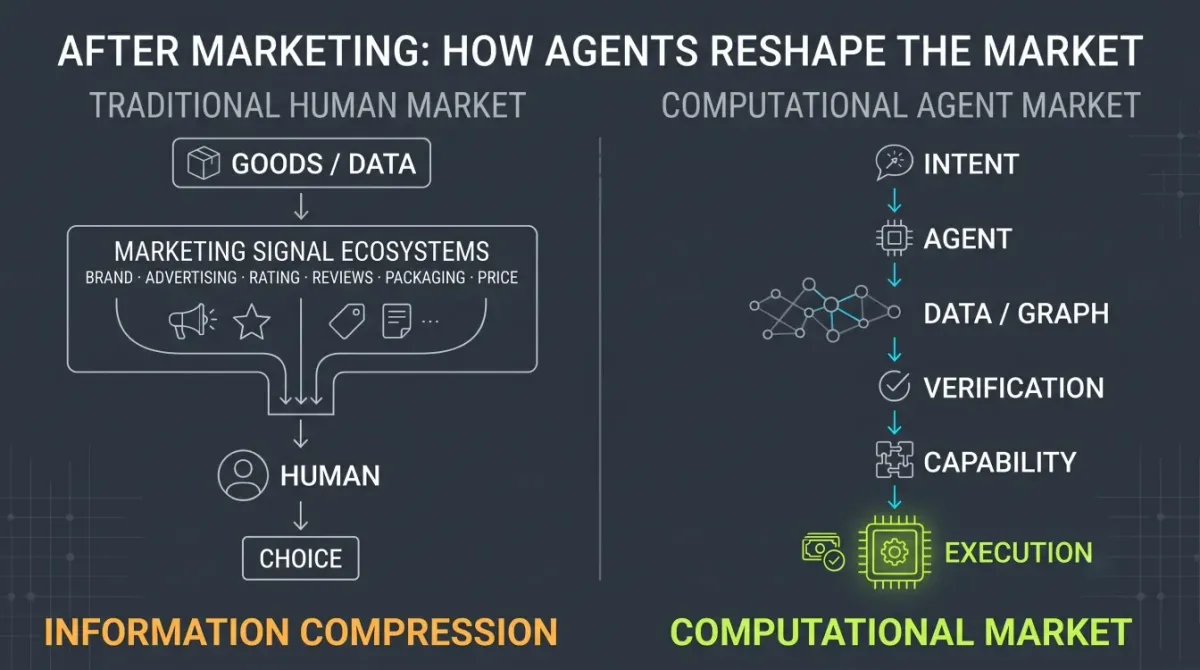
If a shopper is faced with ten thousand products, they cannot compare their chemical composition, the provenance of the raw materials, failure statistics, logistics costs, the energy efficiency of production, real customer reviews, and the long-term cost of ownership. They have neither the time, nor the cognitive resources, nor access to the data. And so the market creates a layer of information compression. Marketing turns the complexity of the world into the few signals that the human brain can process.
The brand says: "trust me". The rating says: "others have already chosen". Advertising says: "pay attention to this". Packaging says: "this is how the product should be perceived". Price becomes both an economic parameter and a psychological signal. In the Web 2.0 and Web 3.0 era, this layer only grew, became more complex, and turned into a nearly self-sufficient industry.
But now a technology appears that potentially eliminates the very need for such compression. The agent.
An agent does not have to choose a product by its logo — it can compare specifications. It does not have to trust an advertising promise — it can verify the provenance of the data. It does not have to choose between ten brands — it can formulate requirements for the product itself and find a producer capable of meeting them. And then a far more serious question arises than "will AI replace marketers". What will happen to the market if a human intermediary is no longer needed between the buyer's intent and the producer?
I. The Market as an Information Machine
To grasp the scale of the coming shift, one must first see how the market works today. Not as a collection of stores and warehouses, but as a long chain of information transmission and distortion.
A producer makes a product. Marketing shapes its image. Retail shapes the assortment. Media shape attention. Reviews shape reputation. And the human at the end of this chain tries to make a decision based on incomplete information, while every intermediate layer simultaneously transmits information and distorts it. The producer talks about its advantages. The competitor talks about its own. Advertising picks the most attractive attributes. A review chooses its own point of view. A rating collapses many parameters into a single number.
As a result, the human gets not the economic reality itself, but its compressed representation. A copy of a copy. The shadow of the original.
This is precisely why marketing cannot be regarded solely as the art of selling or manipulation. In a certain sense, it is an information technology. It solves a specific engineering problem: how to transmit the maximum useful signal through the narrow channel of human perception. A brand — a ZIP archive. A rating — a checksum. Advertising — a compressed headline. All of these are compression formats designed for a specific receiver — a brain that holds only a few objects in working memory (by Miller's classic estimate — seven plus or minus two).
Behind this model stands a venerable theoretical tradition. In 1945, Hayek showed that price — a compressed signal aggregating dispersed knowledge that no one else could collect. In 1973, Spence described why a signal must be costly to be believed: a cheap signal would be indistinguishable from a lie. Both theories rested on the same premise — the receiver of information is limited. A human cannot process complete information, so the market compresses it into prices and brands.
The agent economy removes precisely this premise: the receiver is no longer limited to a few objects of working memory. Price remains a signal, but it ceases to be the sole carrier of dispersed knowledge — knowledge can now be transmitted in its original form. This is not a rejection of Hayek's thesis but the lifting of its constraint: the knowledge problem is solved not by compression but by computation. The reverse process — when information is transmitted without being compressed into signals — can be called market decompression.
But the agent economy potentially changes this very premise. An agent can work not with an advertising message but with raw data. Not with a brand but with characteristics; not with a promise of quality but with an operating history; not with five stars but with an array of verifiable events. And then the market begins to move from signals to data. From compression to full resolution. From the shadow to the object.
Place for the final illustration
II. The Milk That No Longer Needs to Be Sold
Let us imagine an ordinary purchase of milk.
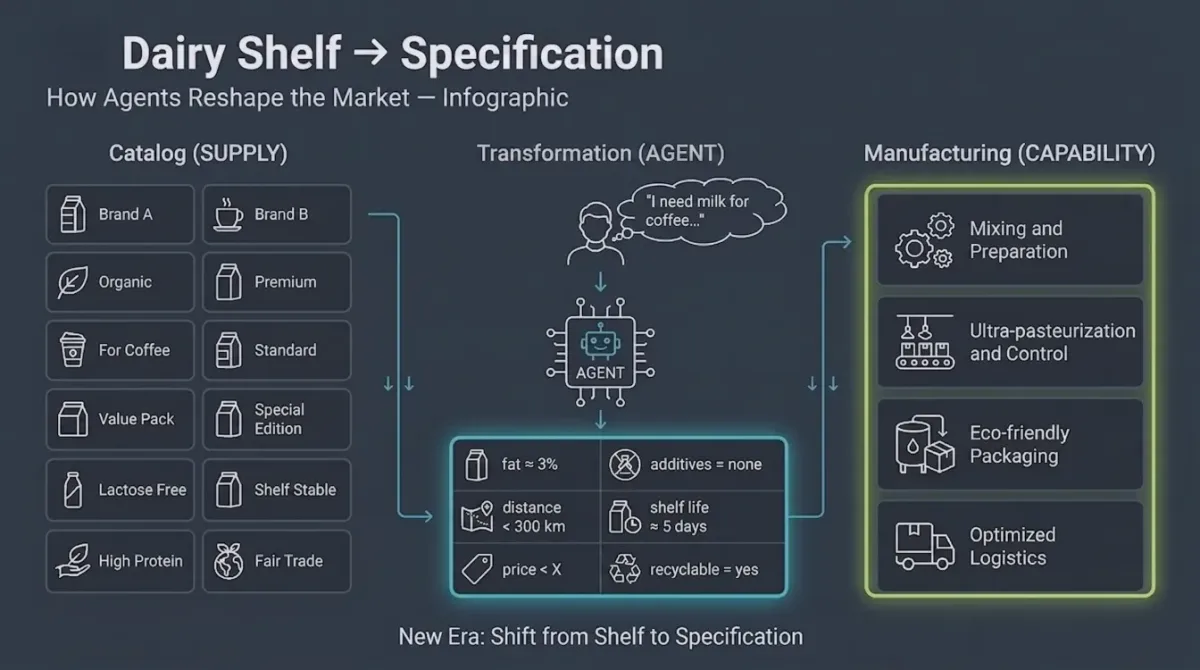
Today a supermarket shelf may hold: brand A, brand B, brand C, organic, farmstead, lactose-free, one and a half percent, two and a half, three point two, for coffee, for children, premium. A person stands before this row and chooses among ready-made categories. But why exactly these categories? Why exactly twelve and not three? Why exactly these names, this packaging, this positioning?
Because it pays for the producer to create differences that can be turned into market signals. Each new position on the shelf — not so much a new product as a new unit of information to fight over for attention.
Now let us imagine the agent. The user tells it: I need milk for coffee, fat content around three percent, no additives, producer no farther than three hundred kilometers away, shelf life of at least five days, price below a certain level, preferably recyclable packaging.
The agent does not need a list of twenty brands. It turns intent into a specification. Intent becomes a set of requirements. The requirements become a search for production capabilities. The capabilities are verified. Bargaining takes place. An order is formed.
And if producers provide sufficiently detailed data, the agent may discover something unexpected. That two products the person perceived as fundamentally different brands are virtually identical in composition, provenance, and quality. And conversely: a product that does not exist on the shelf in any form may turn out to be optimal for a particular request. It is just that no one thought to create a separate package and advertising campaign for it.
Then demand ceases to be a choice from a catalog. It becomes a request to the production system. Not "what do you have in stock" but "what are you capable of creating to my parameters".
III. From SKU to Intent
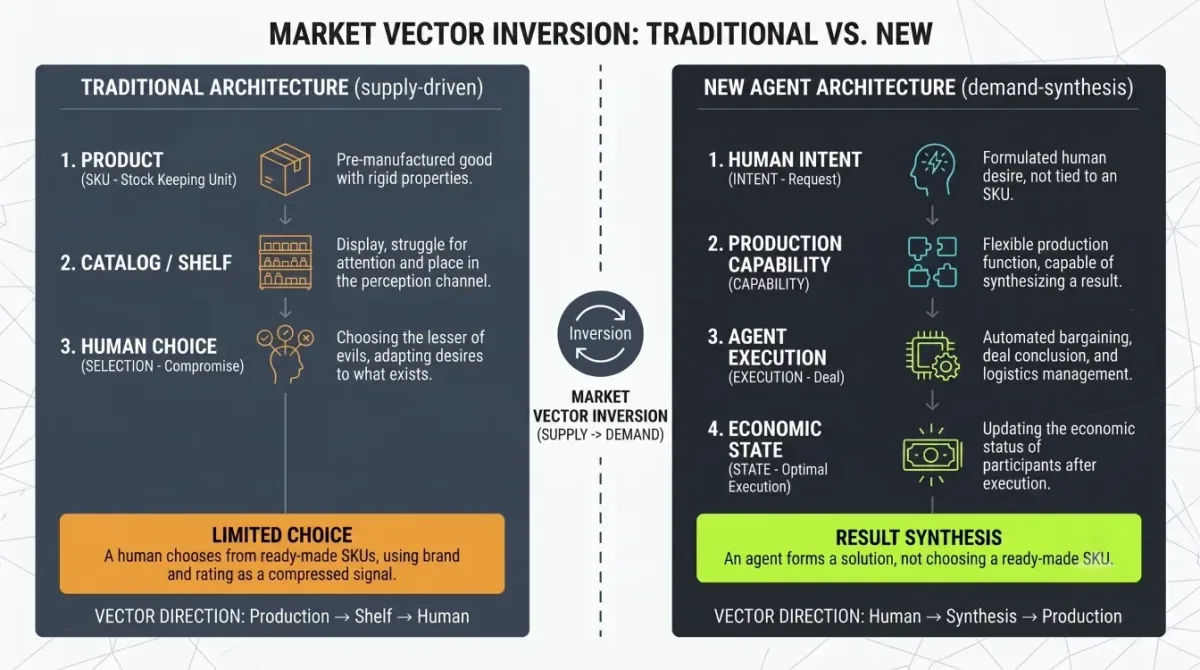
Today the fundamental unit of the retail market is the SKU — a specific product item. A unit of storage. A barcode. An object that someone thought up in advance, produced, packaged, and placed on the shelf. The producer decides: here is a product. And then the market tries to find people for whom it is suitable.
In the agent economy, the direction may reverse. A person first forms an intent. The agent translates it into a specification. Then the production system responds: here are the options we are capable of creating.
Demand Intent → Production Capability → Execution → Economic State
The result is a reverse architecture. Not from production to demand, but from intent to production — not from the object to the buyer, but from the buyer to the object. Demand Intent. Production Capability. Execution. Economic State.
This closely resembles the architecture of computing, where we have already seen an analogous transition. Intent, Capability, Execution, State. In software, intent determines computation. In economics, intent begins to determine production. And this is not merely a pretty analogy. If production becomes flexible enough, both systems begin to work on the same principle: not choosing a pre-created object, but synthesizing the result from available capabilities.
The catalog ceases to be a menu. It becomes a space of potential solutions.
A skeptic will object: price aggregators, ratings, marketplaces — for twenty years almost full transparency, and brands have not disappeared. Why is it different this time? Three differences. First: the interface. An aggregator still shows things to a human, and the human scrolls — the bottleneck remains. The agent decides on its own, without the interface bottleneck. Second: the cost of verification. Comparing twenty products on a marketplace takes minutes; comparing twenty thousand with checks of provenance, telemetry, and history — impossible without an agent. The transparency of aggregators is limited precisely because it is consumed by a human. Third: execution. An aggregator ends with a click; the agent model ends with a transaction, verification, and history. Five stars on a marketplace — the same compressor, only digital: a rating compresses the world into a single signal. Brands did not disappear because the receiver is still human. When the receiver is an agent, compression ceases to be the only way to transmit knowledge.
Place for the final illustration
IV. A Node in the Graph
The most important change does not happen in the purchase interface. Not in the fact that a person talks to a chatbot instead of scrolling a website. It happens in the very structure of interactions between economic agents.
Today the market consists mostly of human decisions. A person goes to the store. The store orders from the producer. The producer reports to the chain. At best, there are one or two intermediaries between them.
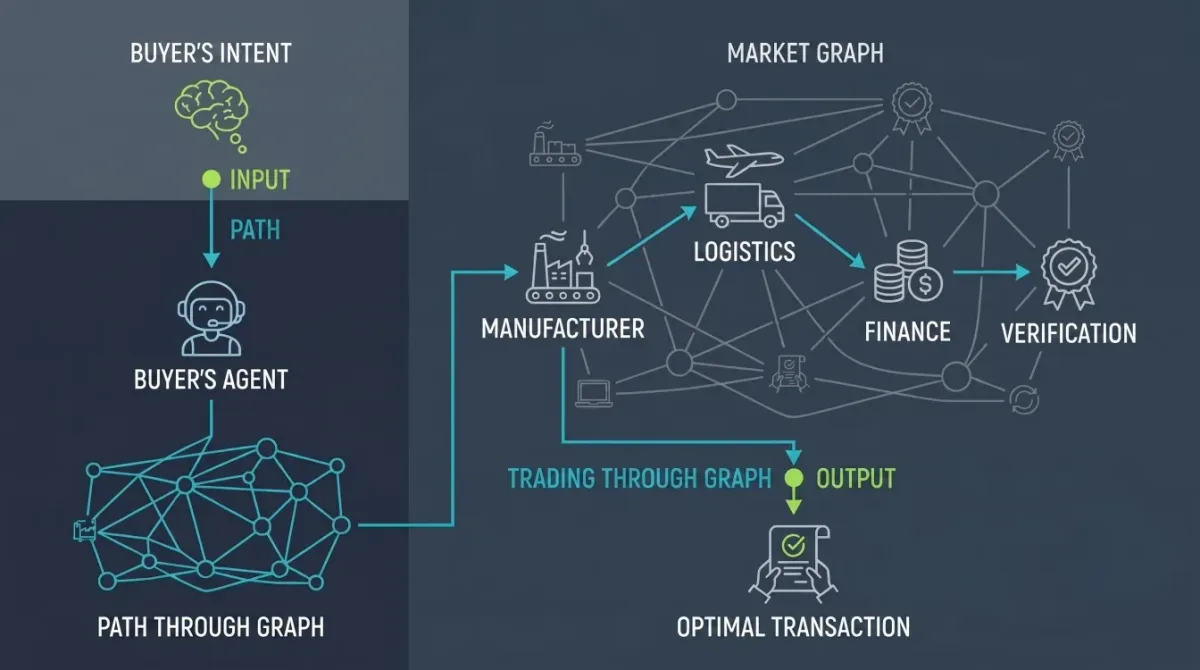
In the future, a huge layer of machine interactions arises between participants. The buyer's agent addresses the market agent. The market agent polls the producers' agents. The production agent checks with the logistics agent. The logistics agent verifies the verifier. The verifier requests telemetry. The financial agent assesses the terms of the deal.
One agent asks: who produces the product I need? Another answers: I know several producers. A third reports: this producer has better quality statistics. A fourth checks: its telemetry confirms the declared characteristics. A fifth says: but its production load has grown. A sixth offers an alternative.
Millions of such interactions could happen simultaneously, without human involvement, on a scale that no trading floor ever dreamed of. And then the market turns into a computation graph of relations. The buyer no longer chooses between products directly. Their agent searches for the optimal path through the graph. Not along the shelf and not through the catalog — through a space of possibilities connected by verifiable edges.
Intent → Buyer Agent → Market Graph → Producer / Logistics / Verification / Finance → Optimal Transaction
Place for the final illustration
V. Reputation as Computation
In the human market, reputation is largely social. We ask acquaintances. We read reviews. We look at ratings. We remember brands. We trust what is talked about. Reputation — a story we tell each other, and in that story there is always room for myth, exaggeration, fashion.
An agent can work differently. If one agent asks how reliable a producer is, the answer does not come from an advertising article or a subjective review. It comes from a network of other agents that have already interacted with this producer. Thousands of agents report: which batches they bought, how closely the characteristics matched what was declared, how many failures there were, how well deadlines were met, how precisely the specifications were fulfilled, how the producer responded to problems, whether the actual product matched the description.
Reputation turns from a subjective impression into a graph of observed interactions. Not "I think they are good", but "here are two hundred and forty-seven transactions, here is the deviation rate, here is the average delay time, here is the trend over the last eighteen months".
A producer no longer simply says: we are good. It must provide a way to verify: here is the data on the basis of which you can make sure we are good. This is a fundamental shift. A marketing claim becomes a verifiable economic property. A promise becomes a specification. A promise that cannot be verified ceases to exist as a meaningful signal in the agent environment.
But here arises the question the agent economy is only beginning to solve: who verifies the data itself? Telemetry can be forged, a verifier — compromised, a reputation graph — flooded with fictitious transactions (a sybil attack). Therefore machine reputation acquires a second level of trust — in the verification infrastructure: who has the right to collect telemetry, who audits it, how discrepancies are punished. Reputation as computation depends on the quality of this layer no less than on the volume of data.
Place for the final illustration
VI. The End of the Intermediary
And here emerges the main thesis.
Historically, marketing performed the function of an intermediary between the producer and human choice. It answered the question: how to make a person choose exactly this product. To do so, it created images, built associations, forged emotional bonds, generated social proof. It was a translator between the language of production and the language of human perception.
In the agent environment, the question changes. Now it sounds like this: how to make the agent recognize this product as optimal for a given Intent. And that is no longer the same thing. Not the same thing at all.
An agent does not need to like the brand. It does not need the company's founding story, does not need a slogan, does not need a celebrity in the ad. What matters to it: price, quality, reliability, provenance, logistics, level of service, compatibility, risks, terms of the deal. Everything that can be expressed in numbers, specifications, and verifiable data.
Therefore marketing as a technology of persuasion gradually loses a significant part of its function. But its place does not remain empty. A new form of economic competition emerges, which can be called engineering of proofs. A producer must make its capabilities available for machine analysis. Open APIs. Structured specifications. Telemetry. Certificates. Execution history. Verifiable provenance. Reputation data.
If SEO optimized presence in search results for humans, then Agent Engine Optimization will optimize the machine discoverability and verifiability of production capabilities. Not for eyes. For the graph. Not for attention. For computation.
One should not confuse this with GEO — generative engine optimization. GEO solves a tactical problem: how to get into the answer of a chatbot or a generative engine. Agent Engine Optimization solves another: how to become a verifiable link in the production chain, how to get not into an answer but into the graph of choice. This is not visibility in text, but verifiability in computation.
VII. But the Human Remains
Here it is easy to draw too strong a conclusion. If the agent chooses rationally, why is marketing needed at all? Why are brands, stories, aesthetics, everything that does not reduce to a specification, needed?
The answer is that the human does not cease to be the source of demand. An agent can optimize intent. But it does not necessarily create the intent itself. A person can say: I want something beautiful. I want a car that evokes a certain feeling. I want a watch that matches my status. Show me something unexpected.
And here appears the boundary of rationalization. Some properties of a product are hard to express through an objective specification. Coziness. Style. Status. Aesthetics. Belonging to a group. Emotional experience. A person often does not know what they want until they see it. And no agent will be able to formulate a specification for a feeling that has not yet been born.
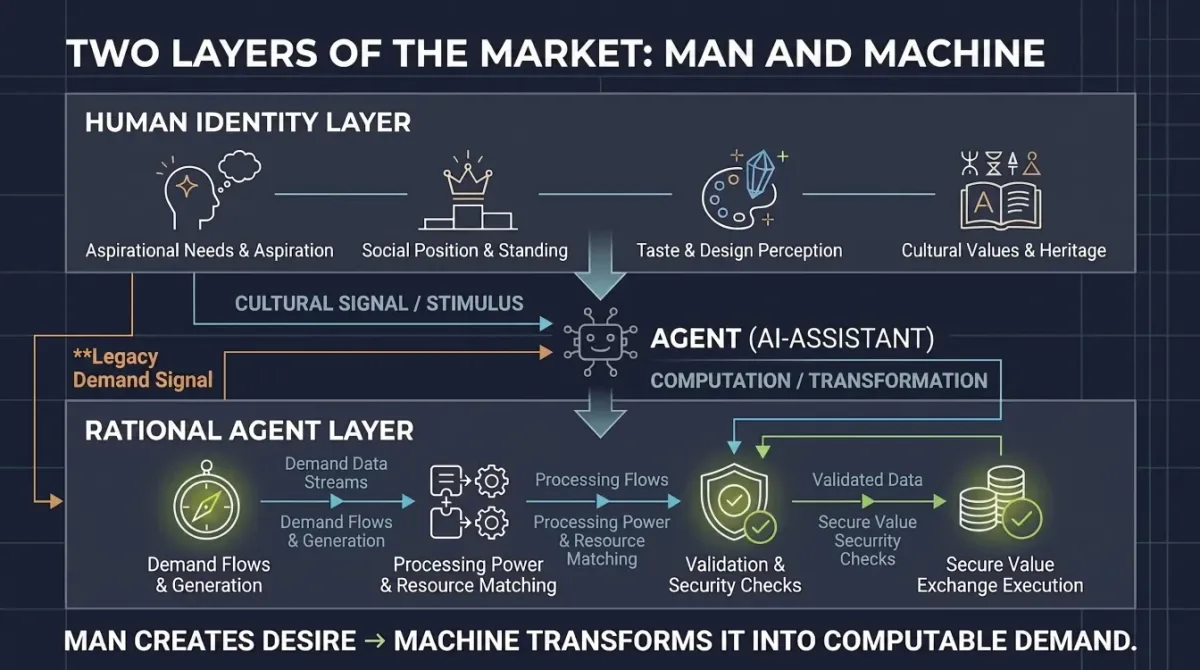
Therefore the market may split into two layers.
The rational layer: agent, intent, capability, verification, transaction. Here marketing turns into an engineering discipline of proofs and discoverability. Here data, telemetry, and verifiable commitments rule.
The human layer: human, desire, image, cultural signal, intent. Here marketing retains the function of shaping desires, identity, and cultural meanings. Here stories, myths, aesthetics, and belonging still matter.
Thus marketing does not necessarily disappear. It splits. The utilitarian part goes to machines. The meaningful part stays with humans. And between these two layers emerges a new, not yet described boundary that will determine what the economy of the next decade looks like.
But this is only the first part of the question. Because if the buyer gets an agent, the producer gets one too. And then the real restructuring begins.
Place for the final illustration
Read Part Two: "After Marketing. The Graph and Its Shadows" →