
After Marketing: How Agents Are Reshaping the Market
Part Two. The Graph and Its Shadows
VIII. Symmetry
So far, one could imagine the agentic economy as a system in which artificial intelligence helps only the buyer. Like a smart assistant that walks the market instead of a person, compares, checks, chooses. That would be an incomplete picture. A simplified one. Almost naive.
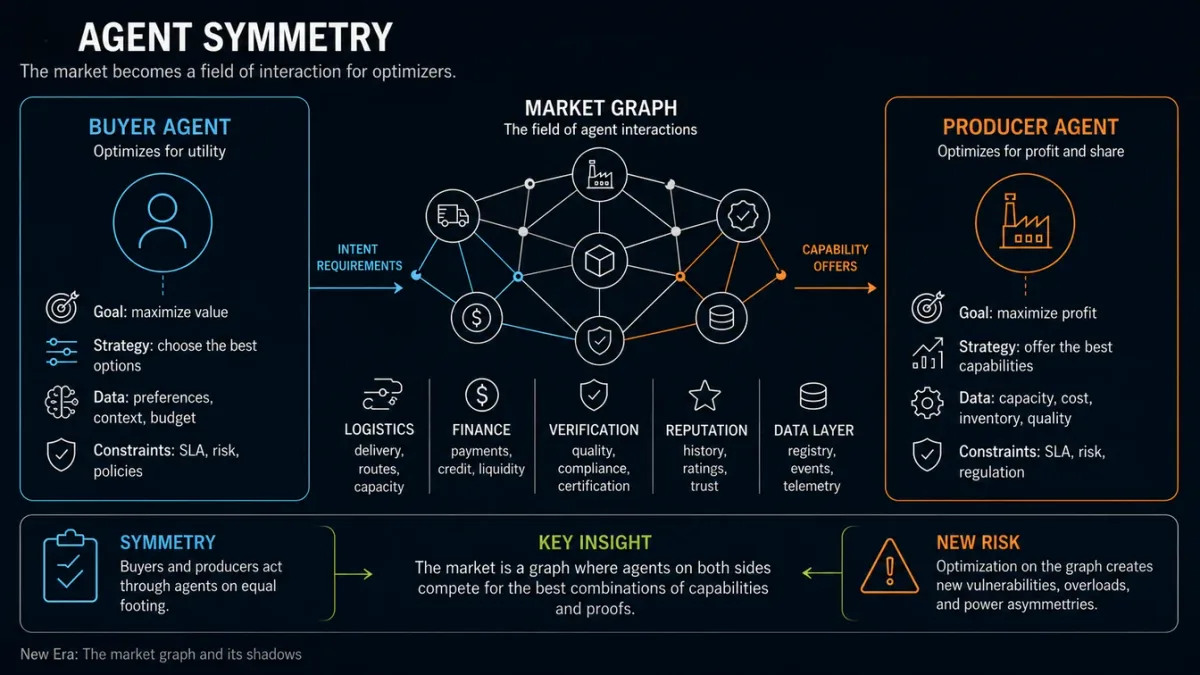
If the buyer gets an agent, the producer gets one too. And this happens simultaneously. Not in a year, not in a decade — at the very moment the architecture of demand changes, the architecture of supply changes. A symmetric system emerges: the buyer's agent, the market graph, the producer's agent. And between them — the machine trading space.
The buyer's agent formulates intent requirements. The producer's agent analyzes its capabilities. The logistics agent calculates delivery. The financial agent assesses the terms of the transaction. The verifier checks quality. And each of them pursues its own optimization function.
The producer's agent might reply: at the current price, fulfilling the specification is impossible. Or: if the delivery deadline shifts by two days, the cost drops by eight percent. Or: we can build a product with these characteristics, but the minimum batch will be five hundred units. Or: a third of our capacity is free in eleven days, if your Intent can wait.
This is no longer a traditional marketplace. Not a storefront, not a catalog, not a shelf. This is machine trading between economic agents, each represented by a program capable of evaluating, offering, conceding, and refusing in real time. Without fatigue. Without emotions. Without the desire to please.
Marketing in the familiar sense is not needed here. No one smiles. No one promises. No one tells a brand story. There is a specification. There is a capability. There is a price. There is a constraint. There is a transaction — or the absence of one.
IX. Game Theory Returns
When millions of agents begin to interact simultaneously, the economy starts to resemble a computational optimization system of enormous scale. Each agent tries to optimize its own function: price, quality, risk, time, reliability, constraints. But the outcome is not determined by a single agent. It depends on the entire network. On what everyone else does.
This is a classic game theory problem. But now it is played out not between dozens of people making decisions once a week. It is played out between millions of programs making decisions thousands of times per second. The speed changes. The scale changes. The consequences of a mistake change.
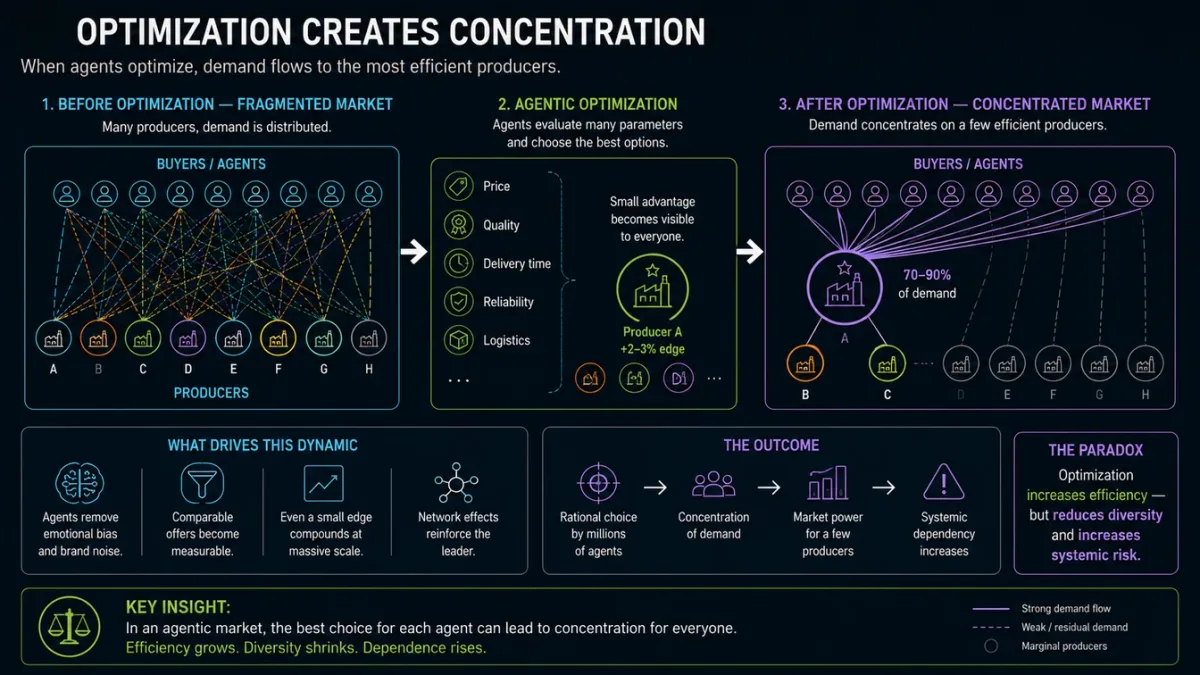
And here a paradox arises that is not obvious at first. The more efficiently agents optimize choice, the smaller the space of actually used options can become. If one producer is objectively two percent better than the alternatives across the combined parameters, agents have no need to keep ten other producers alive simply for the sake of diversity. They will pick the best one. Every time. Without hesitation. Without attachment. Without nostalgia for a local brand.
X. Optimization Kills Diversity
Imagine a thousand producers of one product. One has a slightly lower price. Another has slightly better quality. A third has better logistics. A fourth has more resilient production. Each finds its niche, its segment, its buyer. A person chooses among them not only by objective parameters, but also by habit, by advertising, by local identity, by emotional attachment. A person creates noise. And that noise keeps a thousand producers alive.
And then a producer appears that turns out to be better across most measurable parameters at the same time. Not by an order of magnitude. By two or three percent. But that is enough for the agents. They start switching demand. First five percent. Then twenty. Then sixty. Then the majority.
A person might keep several producers going out of habit, advertising, local identity, or emotional attachment. An agent needs none of these reasons. It optimizes. And optimization knows no mercy. It does not preserve a producer out of respect for its history. It does not support the small for the sake of diversity, and it does not choose the local out of a sense of community.
As a result, an economy can emerge in which the winner takes almost everything. Winner-takes-most. Not because it is a monopolist in the legal sense. But because millions of rational agents arrived at the same conclusion at the same time.
And here one of the main dangers of the agentic market arises. Optimizing local choice can degrade the global resilience of the system. If the entire market depends on a few producers, any failure turns systemic. A fire. A drought. Sanctions. A logistics hub breaking down. A cyberattack. An energy crisis. What seemed like efficiency suddenly turns out to be fragility. And this fragility is all the more dangerous the more invisibly it accumulated.
XI. Economic Flash Crash
Here the agentic economy can get its own version of phenomena well known to financial markets. Phenomena that seemed impossible until they happened.
Imagine that millions of agents use similar evaluation models. Not identical, but close enough. Trained on similar data. Optimizing similar functions. And then one producer gains a small advantage — real or perceived. Agents switch demand en masse. Production becomes overloaded. The service level degrades. Agents register the degradation. They switch back en masse. A reverse wave forms. The producer that was overloaded a minute ago now sits idle. And the one they switched to now cannot cope either.
The result is not a market stabilized by millions of independent people, each making decisions at their own pace, with their own mistakes and inertia. The result is a huge system of interconnected optimizers moving in sync. A small change in parameters can trigger a cascade. A wave. A crash. A recovery. And another crash.
Financial markets have already seen this. The 2010 flash crash, when algorithms dragged the Dow Jones index down by almost a thousand points in a few minutes, while the main rebound took about half an hour — the index fully recovered only by the close of the day. An algorithmic failure in the bond market. Cascading liquidations on crypto exchanges. Everywhere the same mechanism: homogeneity of strategies multiplied by execution speed turns a small disturbance into a catastrophe.
That is why the future market will need not only optimization mechanisms. It will need damping mechanisms. Reserves. Supplier diversity. Limits on switching speed. Regional redundancy. Long-term contracts. Minimum capacity guarantees. In other words, sometimes the economically optimal choice will be to deliberately pick not the best option. But one that is good enough and independent. Not because it is cheaper. But because it will not fall at the same time as everyone else.
Their irrationality, attachments, laziness — not a bug of the old economy. It is its immune system. When the agentic economy removes this noise, it will have to create an artificial one — otherwise it will be beautiful and fragile. Like a crystal.
XII. Whoever Controls the Graph Controls the Market
And here a problem arises far deeper than marketing. Deeper than producer competition. Deeper than optimization.
If an agent makes decisions through the graph of interactions, then who controls that graph? Who decides which edges exist in it? Which nodes are visible? What is the traversal order? Which data is considered trustworthy?
Today, platform power is often tied to the catalog. Whoever controls the catalog controls the visibility of the product. Whoever manages search results manages demand. Whoever owns the shelf decides what the buyer will see. This is power over supply.
But in the agentic economy a new level appears. Whoever controls the graph controls the mechanism by which demand is formed. Not a specific product and not a specific listing — the very logic by which intent turns into choice. The very architecture in which a specification finds a capability. The very protocol by which agents reach agreements.
Imagine a platform that owns the base model, the agents, the capability registry, the reputation system, the ranking mechanism, payments, logistics. The producer no longer needs to buy advertising. No need to hire marketers or bid in shelf tenders. But it may need the right to be selected by the platform's algorithm. The right to exist in its graph. The right to be visible to its agents.
Marketing will not disappear. It will turn into a fee for access to the computational space of choice. Into a subscription to presence. Into a commission for existence. And this is potentially an even deeper form of dependence than advertising. Because one can give up advertising. The infrastructure of choice — one cannot.
XIII. The Fork in the Road
That is why a fundamental fork in the road appears before the agentic economy. Not a technical one. A political one. An architectural one. A fork that will determine whether the new economy becomes a space of freedom or a space of a new feudalism.
The closed model looks like this: the agent addresses the platform, the platform maintains the capability registry, the registry points to the producer. One company controls the infrastructure of choice. It knows users' intents. It sees production capabilities. It manages reputation. It determines ranking. It decides who exists in the graph and who does not.
In this case, marketing really can disappear. But only because the platform has appropriated its function. The producer does not advertise itself to the market. It asks the platform to include its capability in the space of choice. It pays for visibility not through a banner, but through a commission, through a subscription, through compliance with requirements that it does not define. A new form of economic feudalism emerges, in which the platform is not a store and not a search engine, but the very fabric of reality in which the market exists.
The open model looks different. The intent enters an open capability registry. The registry points to several producers. A verifier confirms their characteristics. The agent chooses independently. Capabilities are portable between agents. The producer can publish a specification independently of the platform. Reputation is portable. Transaction history is verifiable. The agent can use multiple sources.
Only in the open model does the market truly become a computational space. In the closed one, it becomes private property disguised as infrastructure.
XIV. The Proof Architecture
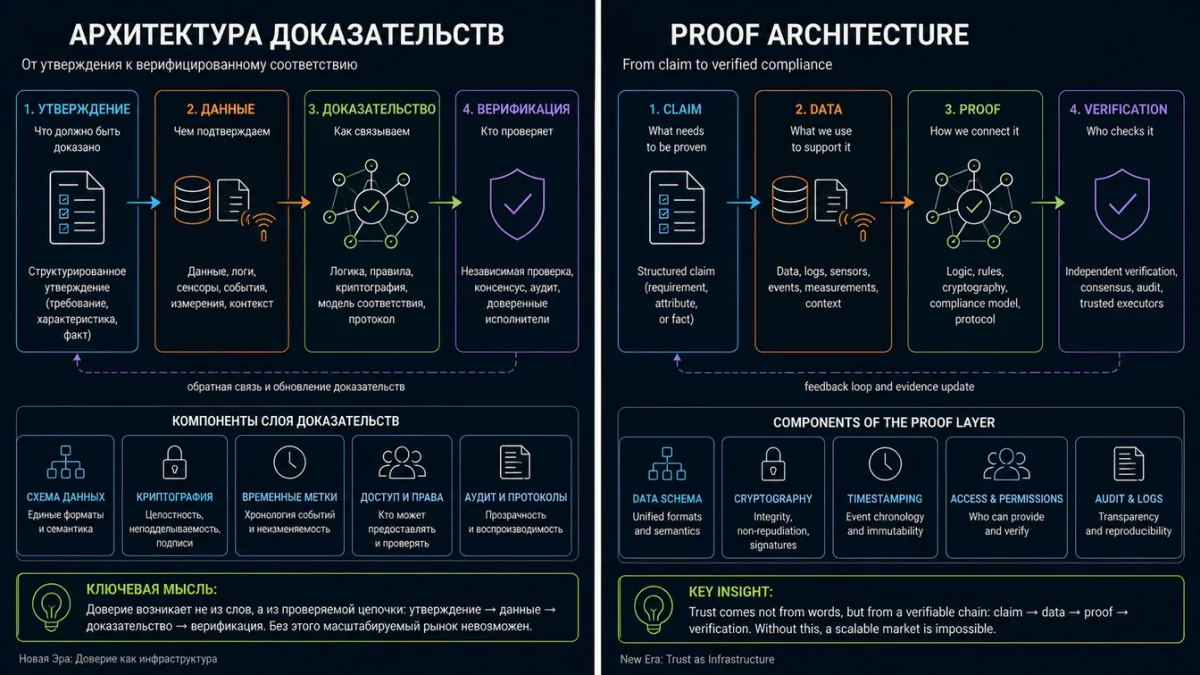
An open capability registry cannot be just a catalog. A catalog is a list. A registry must be a system of proofs. The difference is fundamental.
In a catalog, the producer publishes a claim: we make a quality product. In a proof registry, it publishes a structured object. A capability. A specification. An identity. Provenance. Telemetry. Service level. Verification. Every element is linked to another. Every element is verifiable. Every element has a source.
An agent addressing the registry must be able to ask: who is the claimant? Does it really control the production? Does the claimed capability match the actual characteristics? What is the execution history? Who confirmed this data? Can the telemetry be verified independently? Are the certificates forged, is this node a phantom?
Here an important principle arises: in an open agentic economy, trust must not depend on a single trust center. A producer must not be forced to ask Google, Amazon, Microsoft, or any other platform to say: we confirm that this producer is good. The proof must be portable. Verifiable. Independent of who presents it.
This is not just a technical requirement. It is a political one. Because whoever is the only source of trust is the only source of power. And an open registry is not just a database. It is the constitution of the new economy.
XV. Portable Reputation
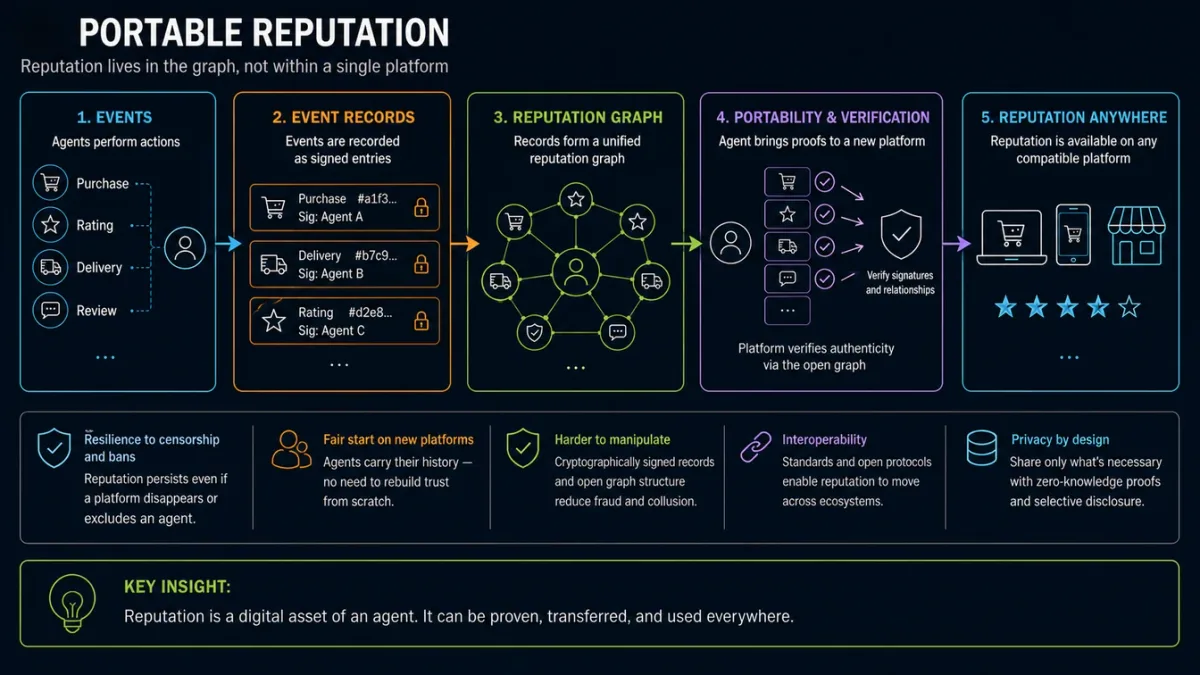
This leads to a more interesting architecture. An architecture in which reputation ceases to be the property of the platform and becomes a property of the economic agent itself.
Every market participant has an identity. Every significant action leaves a signed event. Every delivery has provenance. Every result can be confirmed. Every service level is tied to actual telemetry. Every transaction is recorded as an event in the graph.
And this graph must be portable between platforms. A producer does not start from zero every time it changes venues. Its history, its proofs, its reputation — these are its assets. Not the assets of the platform where it happened to end up.
Then an agent can say: I do not trust your rating. But I trust signed events confirmed by independent network participants. And this is fundamentally different from the modern model. Five stars are an aggregated opinion. Averaged. Subjective. Unverifiable. A verifiable execution history is data for computing trust. Not a verdict. Raw material from which each agent can build its own assessment.
Reputation becomes not a reward handed out by the platform. It becomes a cryptographically portable graph that follows the producer anywhere. Like a passport. Like a credit history that cannot be lost. Like proof of existence that does not depend on who looks at it.
XVI. But the Graph Can Be Attacked
And here we need to stop. Because an open market does not mean a safe market. And if choice happens through the reputation graph, the graph becomes an object of attack. A target. A battlefield.
New forms of economic manipulation emerge, unlike anything from previous experience. Sybil attacks: creating thousands of pseudo-participants that build false reputation. Thousands of phantom agents that "bought", "received", "confirmed" — and created the appearance of a history that does not exist.
Reputation poisoning: injecting false data into the trust chain. Not crude forgery, but subtle distortion. A slight shift in telemetry. A small delay recorded as a failure. A small batch marked as defective even though it was perfect.
Incentive poisoning: creating incentives that make agents choose suboptimal strategies. Not an outright lie, but a distorted reward structure that forces a rational agent to make a decision that benefits the attacker.
Adversarial data: the deliberate distortion of data used by decision-making models. Not hacking an agent and not bribery — just input data shaped cleverly enough that the agent reaches the conclusion the attacker wants on its own.
That is precisely why a single digital signature is not enough. We need to prove not only that the producer really signed the data. We need to prove that this data actually reflects what happened. That the telemetry is not falsified. That the sensor has not been swapped. That the event really took place in the physical world.
Hence the need for independent telemetry, audits, trusted sensors and, for certain classes of claims, cryptographic proofs. In the extreme case, the producer does not say: our service level is ninety-nine point eight percent. It provides a verifiable proof from which the agent can compute that level on its own. Without trusting an intermediary. Without believing the claim. Only mathematics and data.
But even this does not guarantee security. Because in a system where everything is computed, the attack also becomes a computation. And the race between defense and attack does not stop. It simply moves to a new level of abstraction.
We are building a multi-tenant agent system and run into these problems in practice, not on paper. Three examples. Tool verification: an agent must not call an arbitrary function. In our system, tools pass review, are described by a schema — inputs, outputs, constraints, permissions, the verification method — and run in an isolated environment with limits. A tool without a verifiable specification is unavailable. Trusted sources: data from the outside world is marked as untrusted and cannot expand an agent's rights — the rule holds: data affects computation, but not its rights. Protection against fake agents: in a multi-tenant system we have no physical way to tell a real agent from a planted one, so trust is built not on identity, but on behavior — history, reputation, signed events, the price of refusal. What this chapter describes as a hypothesis about the future market is, for us, current engineering reality with the same trade-offs: isolation versus convenience, verification versus speed, trust versus openness.
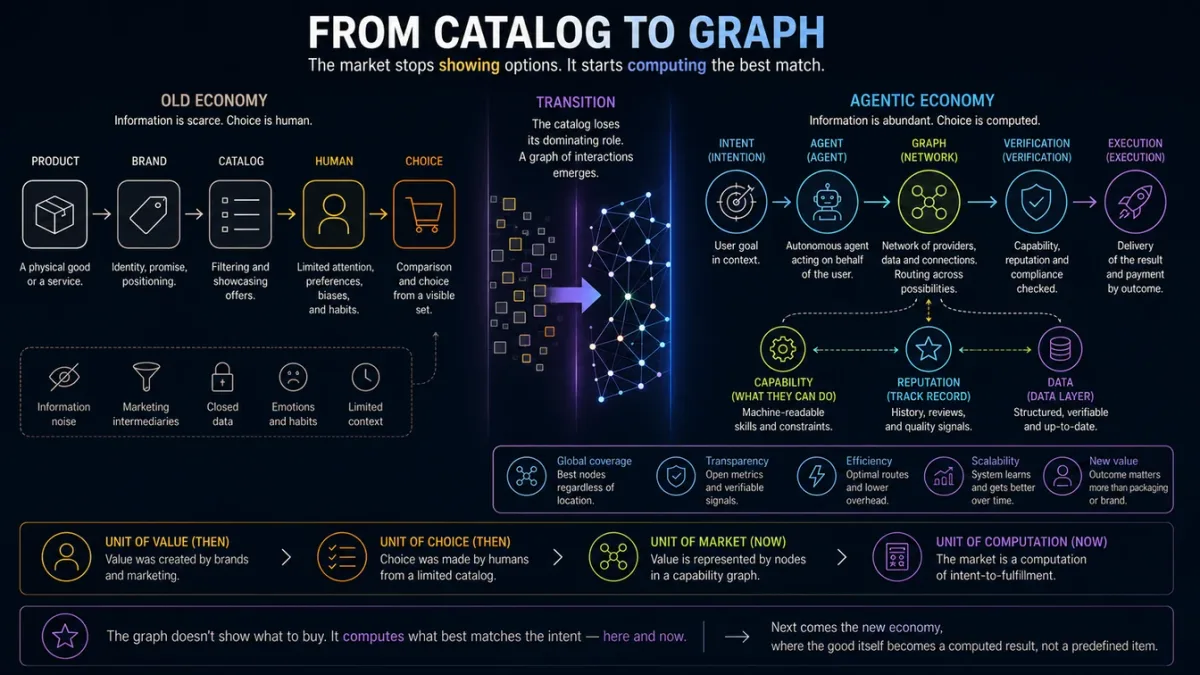
That is the question of the third part.