
The Land of Cash Boxes: How France Pays for Opacity Twice
An analysis of French opacity as a mechanism: record public debt and a record borrowing plan; union funds absent from national statistics; the employers’ organisations' black cash box; African suitcases; strike funds, the most visible of all; energy inflation that makes this an issue for every French person; and the balance sheet of the main cash box, where promises outweigh assets. From the general tax farmers of the Old Regime to autumn 2026 and what can be verified as early as October.
AIERA Frontiers · 15 October 2026 · 40 min
Audio podcast of the article aierafrontiers.com/ru/article/france-land-of-caisses
Key Figures
| Indicator | Value | Comment |
|---|---|---|
| Public debt | 3,595.5 bn € – 119.0% of GDP | Q2 2026, record; largest in the eurozone |
| Deficit 2025 | 152.5 bn € – 5.1% of GDP | General government −128.1; local −15.6; social security −6.7; other −2.2 (INSEE national accounts); third year beyond the EU rule (3%) |
| Debt servicing, 2026 | 62.6 bn € | Treasury estimate (budget forecast was 59.3); 2027 – 72.9; rising with each issuance at a higher rate |
| 10-year OAT yield | ~4.9% (4.90% on 1 October, 4.96% at a given moment) | Highest since 2002 |
| OAT–Bund spread | 133 to nearly 160 bps in early October (139.5 on 12 October) | Highest since 2012 |
| Ratings | Fitch A+/stable; S&P A+ (17.10.2025, unscheduled); Moody's Aa3/negative; DBRS AA/negative | Moody's review – 23.10.2026 |
| Estimated annual resources of the trade union movement | ~4 bn € | Direct and indirect payments; report by Nicolas Perruchot, 2011; rejected on 30.11.2011, not updated |
| UIMM cash box | up to 600 m € | Case was examined by courts in 2014/2015 |
| CFDT cash box | 141 m € | According to BFM data, January 2023 |
| Inflation, September 2026 | +3.0%; energy +21.2%; fresh produce +9.9%; food +1.5% | INSEE preliminary estimate |
| SMIC (from 01.06.2026) | 1,867.02 € gross / ~1,478 € net | Two revaluations in half a year |
| Borrowing 2027 | ~340 bn € | Record plan by the Treasury |
| Net wealth of the state | 690 bn € – 3.5% of national wealth | INSEE, end of 2024 (down 50 bn in a year); according to FIPECO end of 2025 – 750 bn € = 25.1% of GDP |
| Civil service pension liabilities | 1,366 bn € | End of 2025; outside Maastricht debt; Cour des comptes report, 22.09.2026 |
Table 1 – Key indicators of French opacity. Sources: INSEE, Agence France Trésor (the French debt management office), Cour des comptes, Fitch, Moody's, BFM, Bloomberg; details in the list of sources.
0. Two Cash Boxes
In France, the word “cash box” (caisse) stands at every door of the state. The Republic is structured as a system of cash boxes: each collects money, each disburses, and each has its own rules. One cash box is in plain sight, and it is into this one that the reader pays. The other, into which the state pays, is often visible to no one.
The word “cash box” has grown into the French language along with the state itself. Child benefits are paid out by the Caisse d'allocations familiales, sickness benefits are covered by the health insurance cash box, pensions are drawn from pension cash boxes, savings are kept in savings cash boxes, and school lunches are distributed by the school cash box. The state has been structured this way since the time of the Old Regime: a distribution machine in which every monetary stream has its own drawer. Counting the drawers is a national sport; asking who and how they are filled is not.
The first picture is October 2026: a supermarket checkout and an electricity bill. After a quiet 2025, prices went up again, hitting where the family budget is most sensitive: energy prices rose by a fifth. This is already the third payment shock wave in five years, and the first that the state meets without the previous generous shields. The budget has been eaten by debt, and aid is now only targeted, and this is a conscious choice.
The second picture is the accounting of any of the thousands of organisations that live on public money: a joint (parity) fund, an association, a trade union confederation with hundreds of thousands of members. For some, the report is in open access. For others, the balance sheet certified by an independent auditor has never been published: the law does not require it, and where it does, there is no one to check. Between these two pictures lies the entire French arithmetic: the citizen pays into the cash box they see, and into cash boxes no one sees.
The thesis of this article is not about villains: villains are boring and rare. It is about the mechanism. In the country with the densest transparency legislation in Europe (HATVP, the French transparency authority; declarations, registers), the main money flowing between the state and the “social partners” goes through channels that statistics do not count, audits do not cover, and reforms have bypassed for decades. In the autumn of 2026, this mechanism found itself, for the first time in a long time, under dual pressure, market and household-based, and became measurable.
1. The bill for long money
Debt has ceased to be an abstraction of the Treasury: the budget pays 62.6 bn euros in interest a year before it pays for schools and roads. The spread to Germany separates the own from the foreign.
Two terms without which it is impossible to proceed. OAT (obligations assimilables du Trésor) – long-term French government bonds, the reference asset of the entire euro market. The OAT–Bund spread – the difference between the yields of the French and German ten-year bonds; it is read simply: if yields are growing at the same rate, it is a global shock, but if it is specifically the spread that is growing, the market is demanding a premium from France for French-specific risks. This indicator will meet the reader more than once in the article.
First, the numbers. At the end of the second quarter of 2026, the debt stands at 3,595.5 bn euros, or 119.0% of GDP: this is a historical record and the largest absolute figure in the eurozone. The 2025 deficit is 152.5 bn euros, or 5.1% of GDP, the third year in a row significantly above the European threshold of 3%.
Now, on how the bill grows. Debt servicing in 2026 will cost 62.6 bn euros: the Treasury raised its estimate from the 59.3 bn euros built into the budget adopted in February. The estimate for 2027 is 72.9 bn, another 10.3 bn more. The amount grows with each new issuance at a higher rate: interest is fixed at issuance, but borrowing must continue constantly. For 2027, the Treasury plans to borrow about 340 bn euros, which is a record. Due to the autumn sell-off in bonds, it is discussing a shift to short-term papers: the market does not want to take long-term ones.
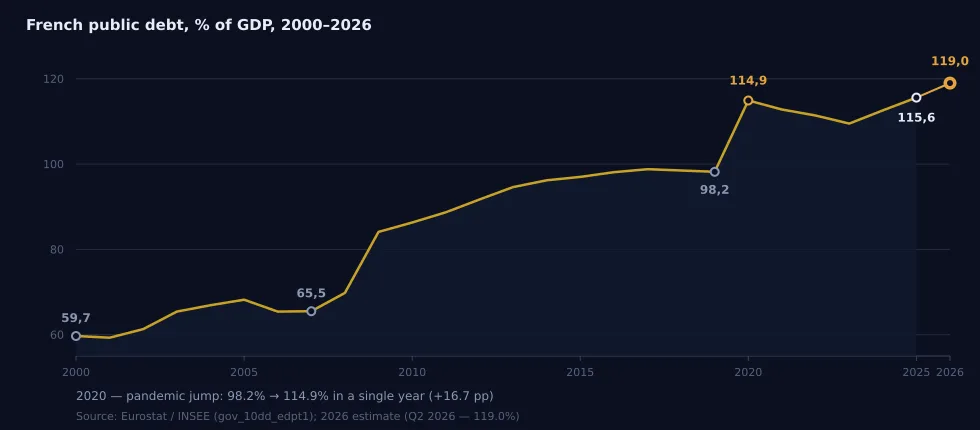
Fig. 1 – French government debt, % of GDP, 2000–2026. Source: INSEE/Eurostat; 2026 – estimate.
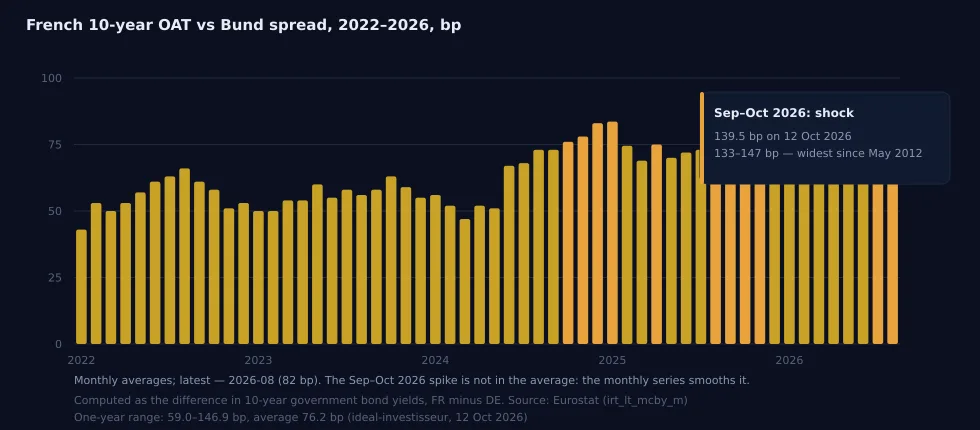
Fig. 2 – 10-year OAT spread to Bunds, 2022–2026, b.p. Source: Trading Economics, EFG International.
The cost of long money is most clearly visible in the chronology of ratings. France lost its AAA top rating with all three agencies in 2012–2013: S&P on 13 January 2012, Moody's in November of the same year, Fitch on 12 July 2013.
In autumn 2025, rating agencies downgraded the outlook at five-week intervals. Fitch downgraded it on 12 September, and S&P followed on 17 October on an unscheduled basis, attributing the decision to political instability. Moody’s maintained Aa3 in late October but changed the outlook to negative. By autumn 2026, the ratings are holding at their minimum levels: Fitch confirmed A+ with a stable outlook, DBRS kept AA with a negative outlook, and Moody’s is scheduled to review the rating on 23 October. If even one agency lowers the rating to A–, this will no longer be a symbolic step: from such levels, a reassessment of all the country’s debt begins, from mortgages to municipal loans.
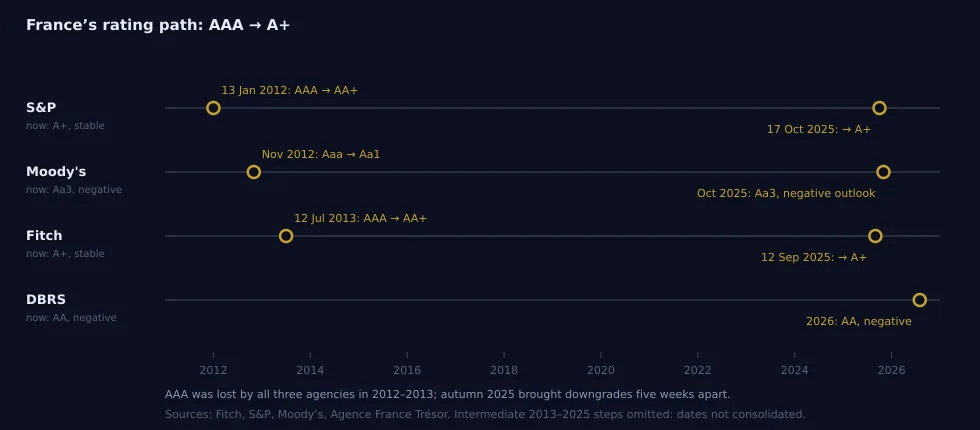
Fig. 3 – France’s rating trajectory: AAA (pre-2012) → A+ (2025–2026). Sources: Fitch, S&P, Moody’s, Agence France Trésor.
The government was unstable in the meantime: between December 2024 and October 2025, three governments fell or resigned, and each tried to take the deficit into account. Section 9 examines what lay behind this. In early October 2026, the spread reached, according to various sources, between 133 and almost 160 basis points, the highest level since 2012. On 1 October, the yield on the 10-year bond reached 4.90% (peaking at 4.96%), the highest level since 2002, but it did not break the 5% mark.
The market is already testing this argument. In October 2026, the yield on French 10-year bonds hovers around 4.9% (4.90% on 1 October and 4.86% on 12 October), the two-year yield stands at 3.61%, and the euro is at a 17-month low against the backdrop of precisely the French budgetary crisis. Morningstar notes that the spread has grown by almost half since the beginning of the year, a rise greater than that seen in southern European countries, which were previously considered risky. The Treasury, discussing a shift to short-term debt, acknowledges the same thing in different words: long money for France has become more expensive for good.
This is not yet a “French collapse”: the economy is holding up, unemployment is moderate, growth is positive, and part of the rise in yields is global, driven by oil and long US rates. But it is the spread that separates one’s own risk from others’, and it is moving precisely during the weeks when Paris cannot pass its budget. The thresholds for this indicator are in section 13.
2. Two Baskets
The basket used to calculate inflation and the basket on which a family lives do not match. In the former, energy accounts for 7.6%. In the latter, housing with utility bills alone takes up to a third of the budget, and for modest households, the entire “pre-committed spending” share reaches 41%.
When French people talk about the consumer basket, they mean two different things. The first is statistical: the basis for the INSEE consumer price index, a list of 263 items whose prices are recorded every month. The weights are known: approximately half goes to services, a quarter to industrial goods, food accounts for 14.8%, energy 7.6%, and tobacco about 1.7%. The second thing is real: the household budget. According to the INSEE “Family Budget” survey, the average cash expenditure of a family is about €2,500 per month; because the survey is not conducted regularly, the figure is rounded. The main item here is housing: approximately a quarter of expenditure, and with utility bills and insurance – up to a third, depending on the year and methodology.
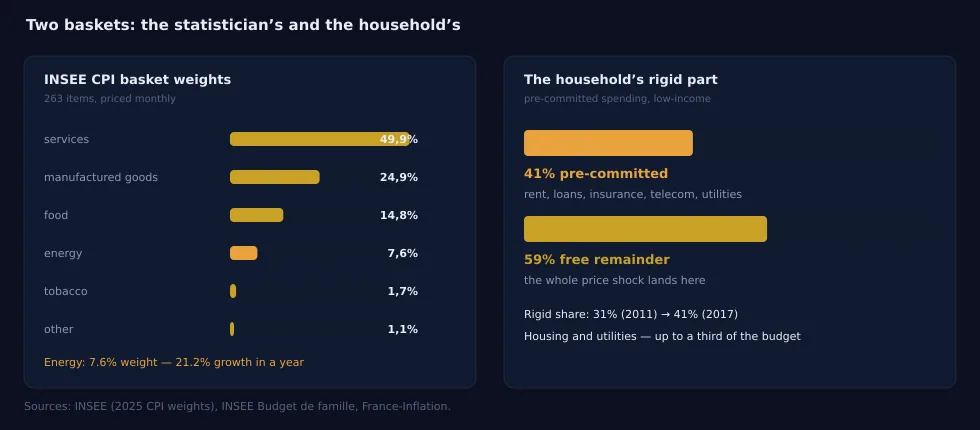
Fig. 4 – Two baskets: weights of INSEE CPI aggregates (left) and the structure of the real budget of an average household (right). Sources: INSEE, France-Inflation, Family Budget survey.
This difference is the source of the famous “felt inflation,” which the French feel but INSEE disputes. While energy prices fall, the difference lies dormant; when energy prices soar, it wakes up and strikes: statistics see a 7.6% weight, while the pocketbook faces the bill for heating, petrol, and electricity, without which one cannot do. The problem has been officially acknowledged: INSEE maintains a public “personal inflation simulator,” where everyone can set their own weights. A state institution proposing to recalculate the state index is a rare form of statistical honesty.
September 2026 put this discrepancy beyond all doubt. Overall inflation reached 3.0% annualised (preliminary estimate; revised data will be released in mid-October). Energy prices rose by 21.2%, and fresh produce by 9.9%: agriculture is paying for diesel and fertilisers, and the energy shock reaches the shelf. Overall food inflation, however, stands at about 1.5%, and there is no contradiction in these figures as long as the weights are kept in view: fresh produce is only a narrow slice of food, the rest of the food basket is rising prices only weakly, and the average figure hides the explosion where people buy every day.
The simple arithmetic here is stronger than any metaphor. Energy accounts for 7.6% of the statistical basket, and a 21.2% price rise contributes around 1.6 percentage points, that is more than half of the total official inflation of 3.0%. No other item in the basket pulls so hard: food, with a weight of 14.8% and a rise of 1.5%, contributes about 0.2 p.p., nearly seven times less than the energy contribution. The state calculates by the weights, the family pays by the invoices, and in the energy shock these two accounts diverge most strongly.
A year earlier the picture was the reverse: in 2025 inflation fell to 0.9%, a multi-year minimum, and the state had had time to get used to the calm.
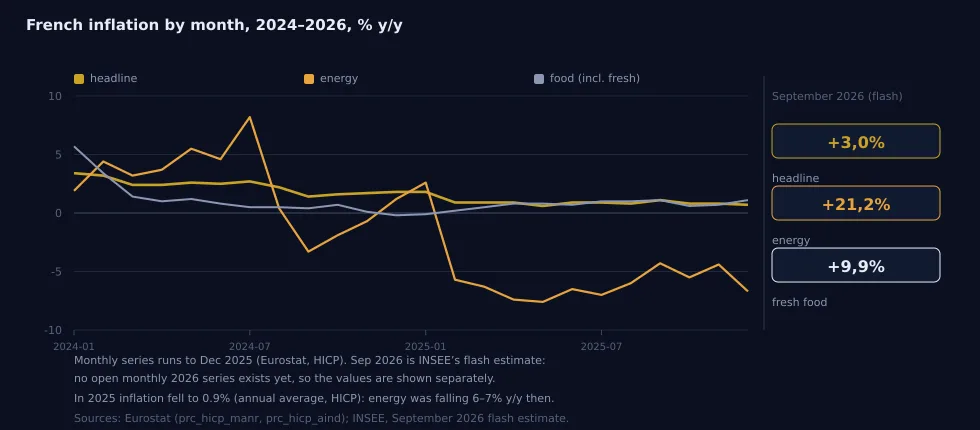
Fig. 5 – Inflation in France monthly, 2024–2026, % annualised: overall index, energy, fresh produce. Source: INSEE; September 2026 – preliminary estimate.
No catastrophe is needed to squeeze a family’s budget; its structure is enough. For modest households, the share of pre-committed spending (dépenses préengagées: rent, loans, insurance, communication, tariffs) has grown from 31% of the budget in 2011 to 41% by 2017, and since then the structure has become even more rigid. As long as these items are unchangeable, the entire price impact falls on the free residual, and it shrinks faster than any averages. Purchasing power has been falling for the second consecutive year.
The family’s response – the arithmetic of survival, and it is measurable. Private label brands (MDD) are roughly a third cheaper than national brands, and their share in the cost of the French basket has reached 35.6%: this is no longer a trick, but a change of habits. The savings rate rose to 17.9% in the first quarter of 2026, but in the second it fell to 17.2%; it seems that some families are spending their savings to maintain their previous level of consumption. SMIC (the French minimum wage) is indexed automatically; over the last six months it was recalculated twice, and since June it stands at 1 867 euros gross. The automation is fair, but it lags: between the tariff spike and the salary recalculation, families live 'until payday' for months.
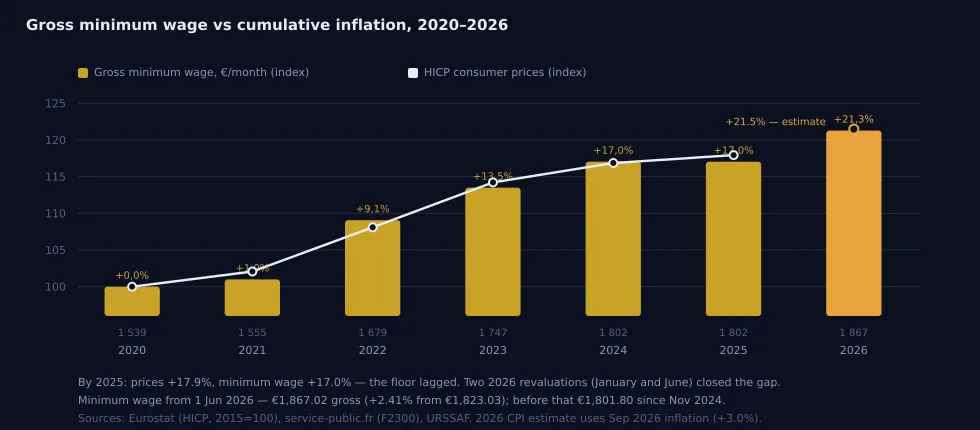
Fig. 6 – SMIC gross against accumulated inflation, 2020–2026. Sources: INSEE, info.gouv; 2026 – calculation based on two revaluations.
The domestic side has a political continuation, which leads to the next section. When the free residual shrinks, demands for wage indexing move from union rhetoric to a mass claim, and pressure on the 'social partners' grows with the price of energy. And the unions have their own cash box, and its arithmetic is far less transparent.
3. Four billion that are not visible
A union in France is a strong negotiating machine with weak membership. The money that feeds this machine flows through channels where the public is interwoven with the private: nine euros out of ten in the end come from employers. The final sum is not officially calculated, and this is a literal fact: such an indicator does not exist in national statistics.
We will begin with the paradox of membership. According to surveys, only about 8% of French wage-earners belong to unions, and this is one of the lowest figures in the developed world. Yet unions retain a monopoly on representation: in negotiations, in labour courts, in administrations, and in dozens of joint (parity) bodies where it is decided how billions are spent. Small membership with great weight is possible for one reason: dues provide only a small part of the funds; the rest is brought in by infrastructure.
The scale of this infrastructure is mentioned just once, and even that was accidental. In 2011, Deputy Nicolas Perruchot (The New Center, Loir-et-Cher) prepared a report on the funding of the trade union movement for the National Assembly. His estimate of annual resources – around €4 billion – was met with a fate that is itself a piece of evidence: on 30 November 2011, the committee rejected it by vote (an extremely rare procedure), and the headline in Le Monde read: “The report has been buried.” The official estimate has not been revised since. Any other figure in this article is updated monthly or annually, but this one has not even seen a new version in fifteen years. In a country where INSEE tracks everything, from pasta sales to the number of notarial deeds, these billions exist outside of the count.
Now let’s break down what makes up the four billion. The formula “the state pays the trade unions four billion a year” is a distortion: at parliamentary hearings, the confederations themselves called it disinformation. Reporters and auditors count direct and indirect resources: subsidies, paid secondment, free premises, transfers to joint (parity) funds, and resources of works councils (CSE). According to the liberal think tank iFRAP, about 90% of this money ultimately comes from employers, primarily public ones, not directly from the state budget. The individual slices were calculated only occasionally: direct subsidies – around €175 million a year, 4–5% of the total; membership fees – about 11%; the rest – secondment, funds, and premises. This is not about “union budgets” or a payroll; it is money without a single account, and arguments about it can go on indefinitely precisely because there is nothing to check.
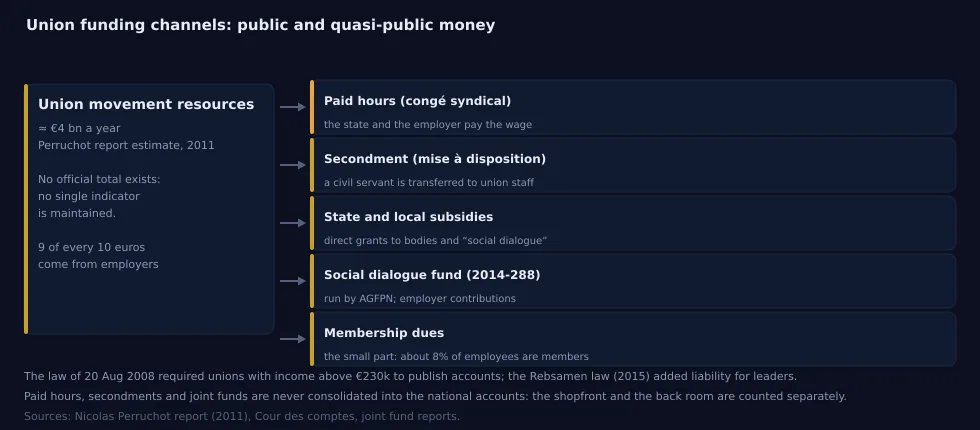
Fig. 7 – Channels of union funding: state and quasi-state money. Scheme; sources: Nicolas Perruchot’s report (2011), Cour des comptes, joint (parity) funds’ reports.
These channels explain why the total is not calculated. The first is paid hours for union work (congé syndical): the state and the employer pay a salary to a person who does not work for them. The second is secondment: a civil servant or agency employee is transferred in full to the union headquarters, while their salary and pension remain attached to them. The third is deductions from social security and pension funds: under “agreements,” the fund directs a portion of its operating budget to union structures. The fourth, the quietest, is the joint (parity) continuous training funds (OPACIF/FONGECIF, Transitions Pro), where decisions are made by “social partners,” and the money is collected from contributions paid by all employers in the country.
Individual slices of this money are visible, and they grow with each passing year. The central example is the Social Dialogue Financing Fund, established by the law of 5 March 2014 (No. 2014-288, on vocational training, employment, and “social democracy”). The fund is managed by the AGFPN, the joint national fund. It collects employer contributions and distributes them directly among the confederations: €133.6 million in 2021, €147.2 million in 2023, and €161.55 million in 2024. The final term in the law’s title, “social democracy” (démocratie sociale), describes precisely this transfer: money moves from employers to unions with the state’s sanction and without intermediate accounts. Each slice is legal and auditable from top to bottom on its own, but none of them is added up to form a grand total. Add them up yourself. The state audit does the same thing, just with a decade’s delay.
The legal framework exists, and it highlights the difference between the shop window and the back office. The law of 20 August 2008 required unions with revenues exceeding 230 thousand euros to publish their accounting reports. The 2015 Rebsamen law added liability for governing bodies. Following the 2014 reform, a partial mirror also appeared: the confederations annually submit public reports to AGFPN, and the fund compiles an annual report for the government and parliament based on them (the 2024 report is available on the AGFPN website). The Cour des comptes (France's state audit court) noted improvements in early 2018, and in May 2024, it specifically audited the fund itself. But the mirror only reflects its own angle: the AGFPN report describes the transfers of one fund and does not consolidate the entire system into a single account. The completeness of publication, deadlines, and depth of audit at the confederations are incomparable with what the law requires of any company of comparable turnover. Let us call the remainder opacity: the money here has not been stolen, but no one is required to consolidate it into a single line item.
The rules, meanwhile, already have teeth – in an unexpected place. On 23 September 2026, the social chamber of the Cour de cassation (France's highest civil court; decision No. 25-17.886, in the Bulletin) confirmed the annulment of the mandate of a union section representative: the section had published its accounts before they were ratified by the general assembly, and the employer challenged the mandate in court. A breach of reporting procedure costs the mandate. And the amounts are still not aggregated by anyone: the requirement circulates through paperwork and never reaches the money.
The French particularity is most clearly visible in comparison with neighbours. In the Scandinavian countries and Iceland, the Ghent model operates: unemployment insurance funds are managed by the unions themselves with state subsidies, meaning public money flows directly through union structures. It is in these countries that the highest membership levels in the OECD are observed: Iceland at around 90%, Denmark at 60–67%, and Sweden and Finland at 65–70%. There, rates, balances, and subsidies are public.
In Germany, unions live almost exclusively on dues, and membership remains around 15%. In Italy, membership is around 30%, and collective agreement coverage is 80%; joint (parity) funds (bilaterali) are financed by employer contributions under public management. It follows that two things are unique in France: membership at around 8% despite public money, and the absence of a consolidated account. The Scandinavian case shows: the state's presence alongside unions is compatible with transparency, provided there is a public account for every payment. The French specificity lies in the absence of an account.
Against this backdrop, the only new rule with a date – decree No. 2026-806 of 21 August 2026 – is modest: from 15 January 2027, organisations with revenue below 230,000 euros will publish accounts only on the DILA website or their own website, rather than through the regional DREETS office. For large organisations, the decree adds no new obligation, as they have been required to publish accounts since the 2008 law; it merely abolishes the DILA fee for publication. This amendment does not create a consolidated account.
4. The employers' organisations' off-the-books cash box
UIMM (the metalworking employers' federation) – the case that explains the whole system in a single evening. An employers' organisation that lived on money from joint (parity) funds (funds run jointly by employers and unions), a cash box up to 600 million in volume – and sixteen and a half million euros in cash that featured in the verdict.
UIMM – the association of metalworking and electronics industries, the "employers' union" of the metals industry, the backbone of MEDEF. It was not the press that exposed the cash box, but the state's anti-money-laundering machine: BNP became suspicious of large cash withdrawals as early as May 2004, Tracfin passed the file to the Paris prosecutor on 24 September 2007, and subsequently, in October, an investigation by Les Échos was published. Inside the organisation, the cash box was called the fonds de soutien, "support fund": a parallel drawer that had been accumulating since the 1970s. According to estimates cited during the proceedings (Challenges), the cash box volume reached around 600m euros. It was fed by a separate EPIM levy – a surcharge of 0.2 per mille on the wage bill in member companies, rising to 0.4 from 2001; approximately 290m euros passed through it. Cash was withdrawn between 2000 and 2007: in court, 16.5m euros in banknotes were cited, with total withdrawals reaching up to 19m.
The formula behind the 2014–2015 verdicts matters more than the figures. They cite breach of trust (abus de confiance) and disguised employment (travail dissimulé) within a structure that collected publicly significant funds and spent them outside public scrutiny. The verdict contains no reference to “bribes” because the final destination of the funds has not yet been established. On 10 February 2014, the court of first instance sentenced Denis Gautier-Sauvagnac to three years, one of which was suspended, and a €375,000 fine; UIMM as a legal entity received a €150,000 fine. The appeal on 1 December 2015 reduced the leader’s sentence to two years suspended and a €100,000 fine. The most instructive development came afterwards: the organisation adopted a “strategy of silence,” and neither the list of beneficiaries nor the purpose of the hundreds of millions was ever fully revealed. The cash box is gone, but the system that gave rise to it remains unchanged: the same conglomerate of joint (parity) funds, the same exactions, the same fog.
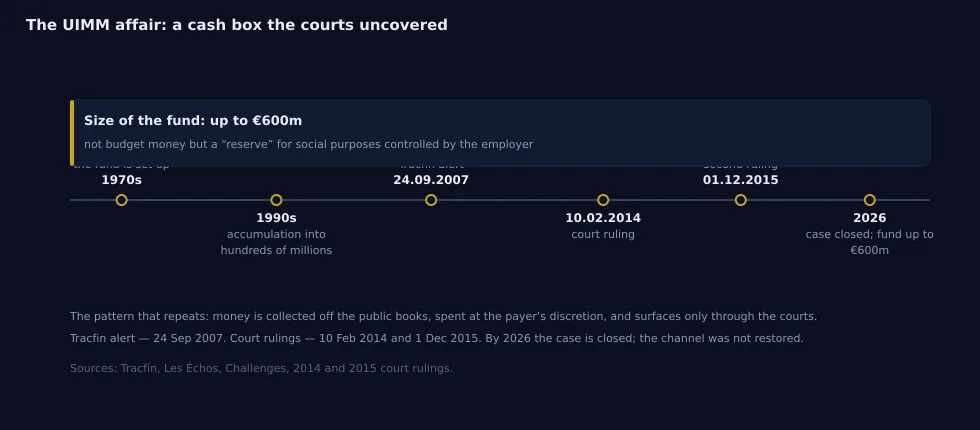
Fig. 8 – UIMM case: timeline 1970s → 2026. Sources: Tracfin (signal 24.09.2007), Les Échos, Challenges, court rulings 10.02.2014 and 01.12.2015.
In terms of scale, the UIMM case is unique in the modern history of the Republic, so it proves nothing about “everyone else”: there is no evidence of theft in most organisations. However, it reveals how the system works: where publicly significant funds flow without public accounting, a cash box grows on its own and then accumulates owners. The amount (up to €600m), the duration (half a century), and the silence (to this day) speak not of a single case, but of the entire system. And the same argument works in reverse: nearly twenty years later, not a single channel from section 3 has been closed, and the loudest report on the system remains the 2011 report.
The link to the everyday dimension is cynical in its simplicity. Workers demand indexation because energy has risen by a fifth. Unions respond with strike funds, employers with support funds. The state sends public money in both directions through funds not included in any account. Every act in this scenario is legal. The total value of the spectacle is unknown to anyone.
5. Strike funds
The most French cash box also proved to be the most visible. CFDT (one of France's largest trade unions) holds €141m in its accounts and disclosed this figure itself; the inter-union federation’s 2023 cash box was openly collected online. National statistics still do not account for them.
A strike costs money to those who strike: a day without work is a day without pay. Compensating participants’ losses is the role of the strike fund (caisse de grève); without it, a mass strike is arithmetically impossible. Therefore, the cash box is the central instrument of union influence: whoever pays the strikers determines how long the conflict will last. In January 2023, during the pension mobilisation, BFM Business broke down CFDT’s treasury: approximately €141m. According to the journalists’ assessment, this amount was enough to cover 86% of the daily SMIC wage for 600,000 members for a week. The inter-union federation’s strike fund for the same wave collected €3.6m on the Leetchi platform (Le Figaro). The CGT (a leading trade union) solidarity fund – another approximately €3m. The confederations themselves announced the figures to journalists upon request; there is no obligation to publish them.
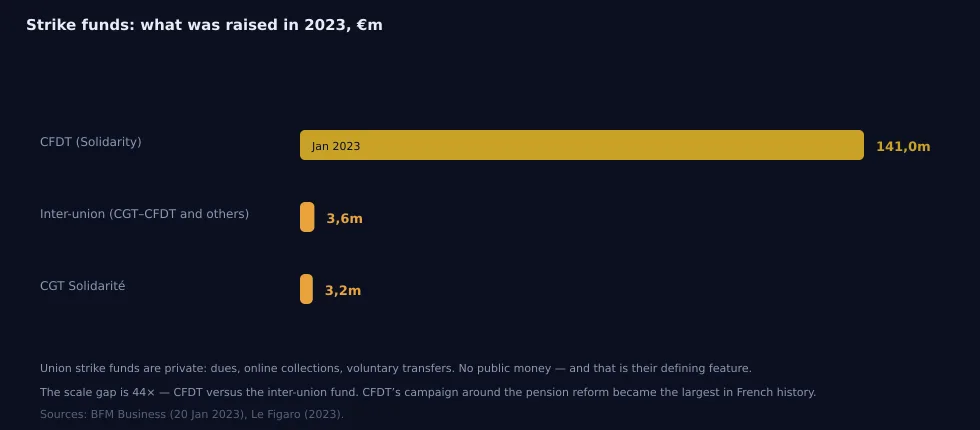
Fig. 9 – Strike funds: CFDT €141m, inter-union federation €3.6m, CGT Solidarité €3.2m. Sources: BFM Business (20.01.2023), Le Figaro (2023).
These cash boxes have a particularity worth examining against the backdrop of sections 3 and 4: they are private. Member contributions, online collections via Leetchi, voluntary transfers. There are no direct sources of public funds within the strike funds themselves. But money is fungible, and the strike fund is a line item in the confederation’s general budget: every euro the confederation saves on union leave (congé syndical) or receives through a joint (parity) fund frees up contributions. There is no direct route from the state budget to the strike fund. An indirect route always exists. And this makes them the most transparent cash boxes in this article: the amounts were voluntarily disclosed by the confederations, the online collection tool shows incoming payments in real time to anyone who wants to see them, including rivals, journalists and the tax authority. Strike funds are a counter-example that confirms the article’s rule: transparency comes with private money and disappears where the state becomes connected to it.
A statistical gap remains: there are no aggregate data on strike funds, whether regarding volume, contributions, or payments to striking workers. The reason is simple: no one is tasked with collecting this information, as the law requires no register or reporting on disbursements. The money exists, but no one is obliged to tally it. The funds themselves are, in fact, the most transparent part of the story.
The chain closes in the following way: an inflationary shock raises workers' demands; the federations either negotiate or pay out of the funds; the federations' funds are replenished in part by public money through the channels described in Section 3; the strike becomes longer and more widespread. But a correction to the 1970s intuition is needed here: the economy today works differently. France has had no general wage indexation since the early 1980s; only the SMIC is indexed automatically, and with it, the salaries of those whose collective agreements tie them to the minimum. Therefore, the "wage-price spiral" is a calculation tested during negotiations, and it materialises only where the shock pushes the employer to its limit. There is no longer any automation in it. No step in this chain violates the law, and none has a counter. That is the essence of it.
6. The Same Model in Three Variations
Opacity in French funding extends beyond trade unions. Associations, political parties, and inter-municipal syndicates – the same scheme: public money, private management, and an account that no one balances.
The first variation is the associations established under the 1901 Law, the circulatory system of French social life: hundreds of thousands of structures, from village sports clubs to operators of hospital services. Estimates of the public money flowing through them diverge by an order of magnitude. Observatoire Hexagone and JDD counted up to €60 bn of “hard-to-track” support in autumn 2026 – subsidies plus state orders plus tax breaks. Direct budgetary subsidies in 2024 amounted to €9.52 bn according to the Senate’s report, while the Cour des comptes had seen €7.43 bn in previous years. Le Figaro delivered a diagnosis in a headline in July 2025: €120 bn escape state control. These figures must be read precisely: the 60 and 120 billion are state expenditures on associations, for services paid and benefits granted. The criticism here concerns the lack of an efficiency account, while the money itself represents ordinary public spending. The Senate, in its report “Who finances the public interest?”, formulated the conclusion more softly than any headline: control exists, but there are no efficiency assessments. The spread in estimates from 7.4 to 120 is a symptom: there are dozens of support routes, and none of them is aggregated with others into a single account.
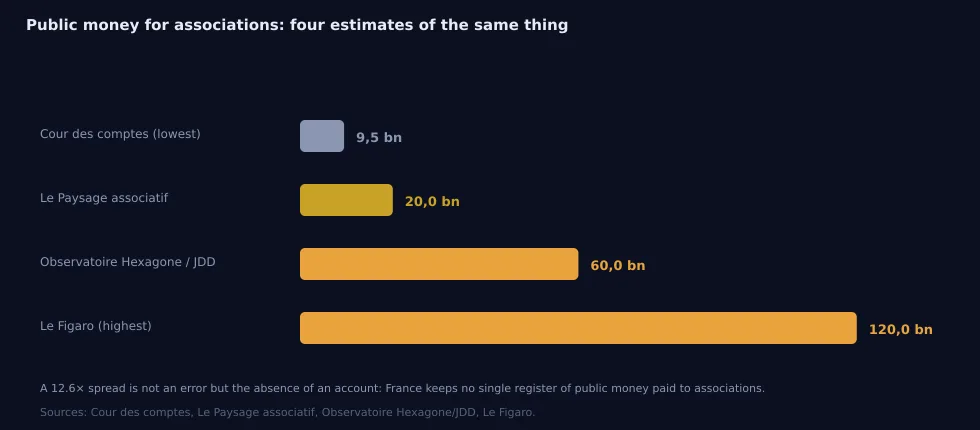
Fig. 10 – Public money for associations: spread of estimates (9.5 -> 20 -> 60 -> 120 bn €). Sources: Cour des comptes, Le Paysage associatif, Observatoire Hexagone/JDD, Le Figaro.
The second variation is political parties: private-law associations around which eleven transparency laws have been built over forty years and the HATVP created, one of Europe’s strictest regulatory bodies. It was established in 2013 following the Cayzac cases. The showcase shines, but the back room is visible in the details. Transparency France, in July 2026, marking “12 years of HATVP”, pointed to proposals to weaken declaratory requirements, meaning rolling back part of what had been done. Petitions in the Assembly demand independent auditing of party accounts, which means a full audit is still absent. There is also a separate layer – associations created to fund parties. The same scheme provides a second key to the same money.
The third variation is technical and the quietest: the syndicats intercommunaux, inter-municipal bodies (the term “syndicate” here has no relation to trade unions: it is a form of inter-municipal cooperation). Their operating revenues grew from €14.4 bn in 2019 to €18 bn in 2024, against debt that the Cour des comptes estimated at €20 bn. Critics call this pyramid of thousands of legal entities “millefeuille” (a thousand layers, like in puff pastry). Each layer has its own budget, its own account, and the ability not to display it beyond the mandatory minimum.
Three variations, one mechanism. This scheme (public financing through structures whose bookkeeping is not aggregated into the national account) survives changes of government because each of its embodiments has its own beneficiaries and its own defenders in parliament. France is not the only country with such devices, but it is rare where such a scheme is declared part of the republican contract, “social dialogue”, and is therefore not reviewed. The next question, of who benefits from what this scheme saves its participants, is already arithmetical. And it has an answer.
7. The Double Cash Box
State debt is someone’s asset. Every cent the budget pays in interest on OAT goes to the bondholder. Who are these holders – and how does the bill for opacity land in their portfolios?
The survey of household wealth, published by INSEE using 2024 data, provides an unadorned distribution. The median household holds €205,000, the mean €374,900. The gap between the mean and the median speaks of asymmetry: the mean is pulled upwards by the top of the distribution.
The threshold for entry into the top 10% is €857,700 per household; the threshold for the top 1% is over €3 million. The top decile holds 47.9% of the country’s total gross wealth – about half; while the entire bottom half of the population is left with about 8%. The dynamics are persistent: according to a series of surveys, the share of the top 1% grew from 16% in 1984 to 24% in 2022. Each crisis after 2008 returned concentration to a new maximum.
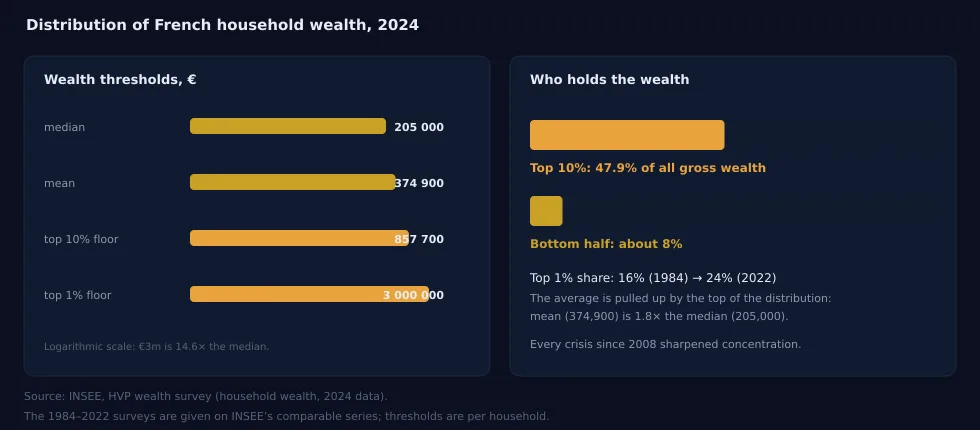
Fig. 11 – Distribution of household wealth in France, 2024: median, mean, D9 and top 1% thresholds, shares of groups. Source: INSEE, HVP survey.
Now let us connect the chapters. The bridge from hidden money to debt requires careful arithmetic, and we begin with scales. Four billion in union money constitutes approximately 2.5% of the 2025 deficit: the fog by itself does not create debt. The sixty billion in association funds is more than an order of magnitude larger than the union figure. They enter the deficit as an ordinary expenditure item, and the question for them is the same: there is no account of efficiency. The systemic effect lies in cumulativity: spending without an account is rarely challenged in the budget, because there is no one to argue about it, and with each new government, it is reproduced.
The key link is interest. 62.6 billion euros a year go to debt holders, primarily non-residents: about 56% of the state’s market debt at the end of 2025 (Bank of France; 50.1% at the end of 2022). Among residents, these are banks, insurers, pension and management funds. Direct investments by French households account for single-digit percentages. Thus, the cycle: spending without an account weakens the budget → the deficit is financed by debt → interest goes to owners of capital, funds, insurers and treasuries of other countries, and within France to portfolios in which capital is concentrated (the top decile holds 47.9% of wealth). We called this the double cash box: one collects from everyone, the second pays the holders of capital, and there is no door between them. The French specificity is that the state here is the largest employer and distributor of “social dialogue”. It is precisely the state that pays for the infrastructure through which uncontrolled sums are spent. The state pays twice: first through subsidies and tax expenditures, then through interest on the debt taken on in exchange. Thus opacity becomes a tariff.
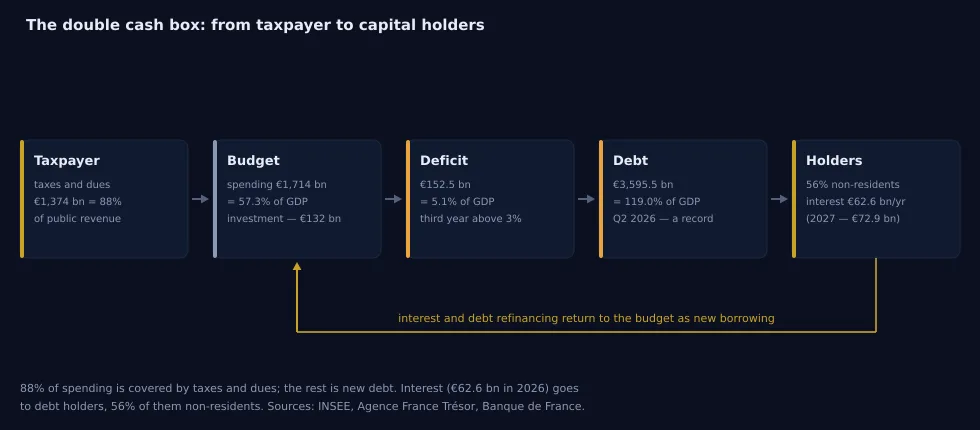
Fig. 12 – The double cash box: the flow of money from the taxpayer through the budget and debt to capital holders (scheme). Sources: INSEE, Agence France Trésor, calculations based on Section 1 data.
It is worth noting the global scale as well: the “spending → debt → interest to owners” cycle is characteristic of any debt economy with an unequal distribution of assets. In the US and the UK, it is stricter. The difference in France is the price: every uncontrolled billion in a country with a deficit above 5% is particularly expensive, because it is paid at the current yield.
8. Suitcases
Consensus was purchased outside the budget – from party phantom posts to African suitcases.
The channels in sections 3–5 – not the entire cash geography. The most documented cash box outside the budget was the party one. On 15 December 2011, the court sentenced Jacques Chirac to two years’ suspended sentence for phantom posts in the Paris city hall: people were on the city payroll, but worked for the mayor’s party. The first former President of the Fifth Republic to be convicted by the French justice system received a sentence for a cash box that was funded by the city budget. The scheme is the same as in the union channels: a public resource is seconded to private political work, and there is no public account.
Beyond this, documentation ends and the suitcases begin. Two sources speak of the cash component of “Fransafrique”, Paris’s informal network with former colonies: the version of a participant and the court. In September 2011, Robert Burgi, a lawyer and “unofficial adviser” to the Elysée on African affairs, heir to the network of Jacques Focara, told Le Monde and JDD that from 1995 to 2005 he personally brought Chirac and Virpoux gym bags and tom-toms stuffed with banknotes – about 20 million dollars from the leaders of Gabon, Congo, Burkina Faso and Ivory Coast. Two months later, the Paris prosecutor’s office dropped the investigation: the evidence was enough for publications, but not for a case.
There was also a court in this story. The Elf case ended in 2003 with convictions of the company’s management: five years for Le Floch-Prizant and Sirven, four years for “Mr. Africa” Tarallo. It proved the mechanics of commissions and sacks itself, but did not name the final beneficiaries in France.
African funds had implicated several presidents in succession. Boko's diamonds cost Jiscard d'Estaing his reputation almost two years before losing the Élysée: Le Canard enchaîné valued the stones at one million francs in October 1979. Mitterrand's son Jean-Christophe, the Élysée's adviser on Africa, spent three weeks in Santé prison on the "Angolagate" case and ended up with suspended sentences.
Of this sequence of cases, only one reached a verdict before the others, the Libyan one, and it is also the most recent. But even here one cannot leap over the wording. Saif al-Islam Gaddafi, in an exclusive Euronews interview on 16 March 2011, demanded that Sarkozy "return the money he took for his campaign": "We financed his campaign." The chronology around the interview is more important than the quote itself: France recognised the Benghazi Transitional Council on 10 March, six days before the interview. On 12 March, the Arab League asked the Security Council for a no-fly zone. On the 17th, Resolution 1973 was adopted, promoted by Paris and London. On the 19th, French fighter jets were the first to strike Libyan armoured vehicles. The intervention was being prepared before the interview, not as a result of it.
The version that the war was also a cleanup of compromising material is a media interpretation; it has not been established by a court. What has been established is this: on 25 September 2025, the Paris court sentenced Sarkozy to five years for criminal conspiracy (association de malfaiteurs) with the aim of financing the 2007 campaign with Gaddafi's money. The court found the actual financing of the campaign unproven. The confirmed fact was the transfer of €6.5 million by Libyan intelligence to intermediaries. The campaign's intermediary Takieddine and Mediapart, which published a note from Libyan intelligence signed with the name of Moussa Koussa, then head of Libyan foreign intelligence, had written about an amount of around €50 million. Koussa himself called the note a forgery back in 2012, and the first-instance court shared that view in its verdict: "probable forgery." The final accounting remained outside the scope of the verdict.
The appeal trial ran from 16 March to 27 May 2026; on 13 May, the Attorney General demanded again seven years and a €300,000 fine for Sarkozy (Geanu – six, Ortheault – two). The verdict is expected on 30 November 2026 – this is the nearest test of the Libyan plot. In autumn 2025, Sarkozy spent exactly twenty days in Santé prison – the first former President of the Republic to be in a prison cell. The cash box without an account outlives its masters and reaches court after eighteen years.
9. Valves and the bill
What could not be bought covertly fell on the budget openly. The valves through which the system released pressure have been closing since 2008; the market presented its bill only in autumn 2026.
We shall expose the weak spot in this arithmetic ourselves. What could not be bought covertly (pensions, healthcare, frozen reforms) fell on the budget openly, in open line items. The 2025 deficit (€152.5 billion, 5.1% of GDP) breaks down into open line items:
| Deficit line item 2025 | Amount | Comment |
|---|---|---|
| State | −€128.1 bn | after −€151.1 in 2024; within this – debt interest, the fastest-growing line item (€62.6 bn for 2026) |
| Local authorities | −€15.6 bn | after −€17.8; improvement of €2.2 bn |
| Social security | −€6.7 bn | first deficit since 2021 (in 2024 it was +€1.1); PLFSS-2026 plan was −€23 bn |
| Other central agencies (ODAC) | −€2.2 bn | after −€1.4 bn |
| Total | −€152.5 bn = 5.1% of GDP | after −€169.1 bn (5.8%) in 2024 |
Table 2 – 2025 deficit by open line items (INSEE national accounts). Sources: INSEE, Insee Première No. 2106 (May 2026; first estimate – Informations rapides of 26.03.2026); Senate, report a25-126 on PLFSS-2026 – PLFSS plans for comparison; economie.gouv.fr – treasury execution (different base).
The table must be read twice. On the first read, it works against the thesis: the cash box without an account is small next to the open one (four billion in union funds represents 2.5% of the deficit, as in Section 7), and almost the entire deficit is collected from lines visible to anyone who opens the budget law. On the second read, it works for the thesis: an open line has an owner; it can be calculated, challenged at elections, and cut. The cash box without an account has not even an address. Opaque money does not sit in the deficit as a separate item. It is dissolved in open lines, and with every raise in stakes its price grows while remaining anonymous. The PLFSS plan promised a social security deficit of 23 billion in the social insurance line: illness –17.2, pensions –6.3. According to national accounts, the entire social insurance block for 2025 yielded –6.7 – the first deficit since 2021 and three times softer than the plan: two ledgers diverge even where every publication is signed. The reform that was supposed to close the deficit has been postponed to negotiations with the "social partners," and the freeze lies in that same open line, just without an end date.
The valves through which the system released pressure were closing one by one. The law of 20 August 2008 obliged large trade unions to publish their accounts. In 2013, HATVP was created. The Rebsamen law of 2015 added accountability for executives. In July 2022, the ECB ended the era of negative rates and raised the deposit rate to 4% by 2023: the cheap money on which both the debt and the compromises had rested was gone.
Meanwhile, France was leaving Africa. From 2022 to July 2025, it wound down its permanent military presence on the continent, from Mali to Chad. On 17 July 2025, the last flag was lowered in Dakar: the end of more than sixty years of presence. Economic links tore apart next: in 2024, Niger revoked Orano's permit for the Imouraren uranium mine and, by December, took operational control over the Somaïr, while in 2025 it nationalised the enterprise. The CFA franc reform of 2019–2020 removed from Paris the requirement to centralise half of the African reserves in the French Treasury. The guarantee of convertibility remained, but what held Franc-Africa together had weakened, and the transition to a single currency awaits the decision of the African countries themselves.
In early October 2026, the spread approached 150 basis points, fourteen months after Dakar. All three valves (transparency, Africa, money) had closed before the market posted the bill. The coincidence of dates is not yet causality: we do not demonstrate a mechanical link of the type "valve closed – spread rose," and no one else has either. The chain can be checked via the political component: if the 2027 budget passes without a vote of no confidence, and the French premium does not shrink, this part of the explanation will be weaker than it is written here.
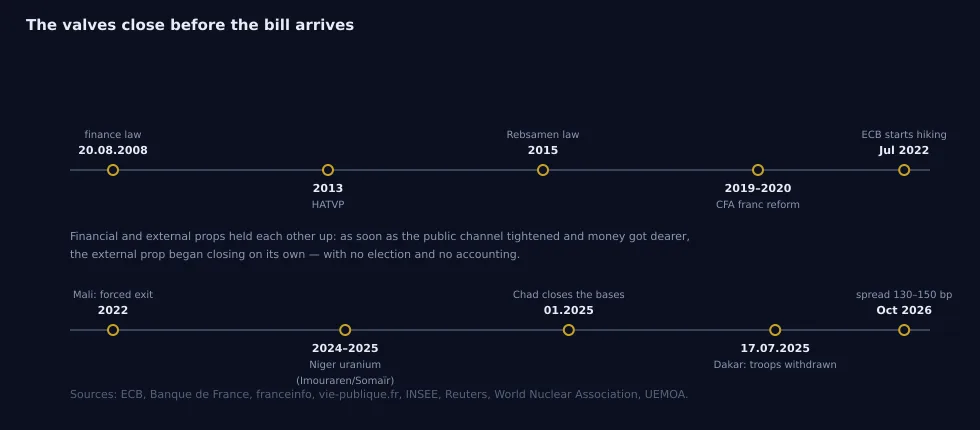
Fig. 13 – Valves close before the bill: law of 20.08.2008 → HATVP (2013) → Rebsamen law (2015) → ECB 07.2022 → CFA reform (2019–2020) → Mali (2022) → Chad (01.2025) → Dakar 17.07.2025 → Niger's uranium: Imouraren/Somaïr (2024–2025) → spread 130–150 b.p. (early October 2026). Sources: ECB, Banque de France, franceinfo, vie-publique.fr, INSEE, Reuters, World Nuclear Association, UEMOA.
While the valves were closing, the conflict moved to where it could no longer be paid for secretly – to parliament. The Barnier government fell in December 2024 – the first vote of no confidence since 1962, raised against a social security budget. The Bayrou government in September 2025 itself put the question of confidence to a vote and lost: 364 votes against 194. The Lecornu government in October 2025 resigned without waiting for a vote. Four days later, Lecornu was appointed again. In ten months, three governments, and every prime minister who tried to reckon with the deficit paid with the post. Twenty years ago, the price of compromise lay in a suitcase. Now it lies in the spread.
The market cost itself consists of two parts. Of the French decennial yield of 4.9%, the share attributable to the Bund is 3.5%: this is the global component, driven by oil prices and long-term US interest rates, and it is borne by all eurozone debtors alike. The roughly 1.4 percentage points on top of that is the French premium. In 2021 it did not exceed 50 basis points; by October 2026, it had grown by a factor of 2.7 to 3.2. The level is the cost of the world. The premium is the cost of the country. The premium has a feedback loop that works against previous practice: the higher the rate, the more expensive it becomes to postpone decisions; and the more expensive it is to postpone decisions, the less room there is for the hidden payment of consensus. What used to be absorbed from invisible cash boxes now has to be discussed openly: in Parliament, in front of cameras, and in front of rating agencies. The timetable for this scrutiny is in section 13.
10. The Undeclared Network
Lobbying in France is declared. Network influence is not. Masonic lodges do not hide their numbers, but they do hide their membership lists; it is in this gap that “social capital” lives, which regulators do not see.
Let us begin with the measurable. There are an estimated 170–200 thousand Freemasons across all obediences, and around four and a half thousand lodges. The largest obedience, the Grand Orient de France, brings together 54,700 members. In 2018, Le Parisien counted 200–250 Masonic deputies and senators in the legislature. The fraternal “Fraternité parlementaire” operates openly, with a statute, just like any other club. Sophie Coignard in Un État dans l'État (2009) described the lodges as a “true counter-power” with fiefdoms in the senior administration, justice system, and education. L'Express confirms: influence in the highest echelons is “still very great.”
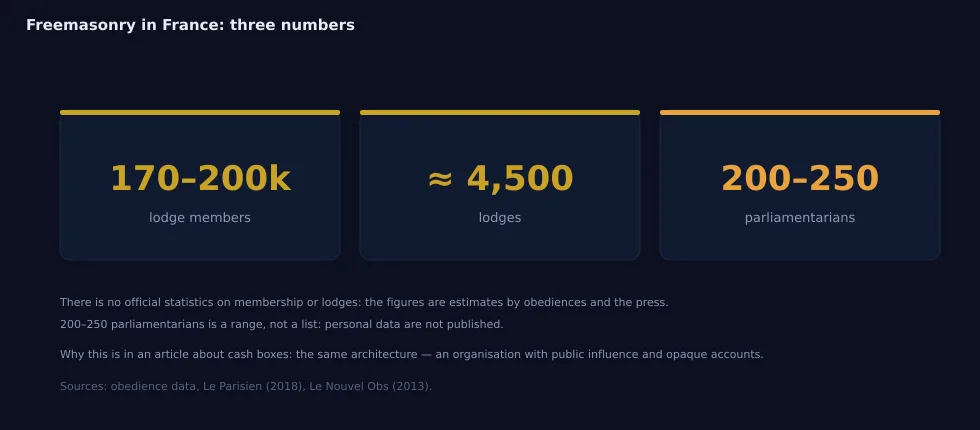
Fig. 14 – Masonic presence in France: 170–200 thousand members, ~4,500 lodges, 200–250 parliamentarians. Sources: Obedience data, Le Parisien (2018), Le Nouvel Obs (2013).
The mechanism of this influence is not lobbying in the legal sense. In its 2024 report, HATVP identifies the gap: contact with a lobbyist is declared, a meeting between “brother and brother” is not. Lodge membership is not included in any mandatory register, and the secrecy of membership is part of the oath. The working formula of network capital is acceleration in place of a bribe, access in place of a decision, and reciprocity in place of an order. A civil servant who recognises a “brother” in an applicant breaches no rule on conflicts of interest. This is precisely why these rules have no effect on the channel.
The weight of the lodges is neither static nor monolithic. France Culture, in an analysis marking the 250th anniversary of the GODF, traces the gradual decline in the brotherhood's influence. The obediences compete with one another. Inside the lodges, the entire political spectrum is represented, from mayoral clubs to ministers. The example of the FNSEA shows that even without any secrecy, the agricultural lobby openly pushed through 783 “keys in hand” amendments. Secrecy, therefore, is only one form of power. From this topic we take one point: the network that is not declared operates by the same rules as the cash box that is not accounted for.
11. Three Centuries of the Cash Box
None of the described mechanisms were invented in the 21st century. French opacity has a history three hundred years long: tax farming as a system, the parliament's black cash box, the network as an appointment machine, and the pyramid under parliamentary protection. Each episode shows the cost of a cash box without an account.
The beginning was set by the general tax farm (Ferme générale) – a company of tax farmers to which the old regime in 1726 entrusted the collection of indirect taxes: excises (the salt monopoly), customs duties, duties, and tobacco. Forty general tax farmers leased the right to collect taxes every six years. Tax farming generated around half of all crown revenues; the general tax farm alone accounted for roughly a third. In terms of accounting, the setup was impeccable. In terms of trust, it was catastrophic: private hands handled public money without public accountability and built the most famous fortunes of the 18th century, and the most famous hatred, on it. The outcome is known: on 8 May 1794, the Revolutionary Tribunal sentenced 28 former general tax farmers to death, including the chemist Lavoisier. The state, having handed over the cash box without transparency, sent the bill through the guillotine.
The second episode – Panama in 1892, the "cash box without an account" of the Third Republic in its pure form. The bankruptcy of the Panama Canal Company (1889) – the largest financial scandal of the nineteenth century: 800,000 French depositors lost more than 1.8bn francs. The case reached the Chamber of Deputies: at least 104 officials received money through intermediaries, Baron de Reinach (died before giving testimony) and Cornelius Herz (fled). The list of recipients was never published in full. The 1893 trial acquitted most of the defendants. The scandal served as fuel for anti-Semitic and anti-Masonic propaganda simultaneously: conspiracy theory always comes first, followed by cross-party harassment. However, the structure of the case can be read independently of the propaganda: a megaproject, private intermediaries, parliamentary payments, books without an account. Three characteristics from this series (intermediaries, payments, books) are also present in the UIMM case. The difference ultimately is: Panama ended with almost complete acquittals, UIMM – with convictions.
The third episode – the "Fiches" affair (affaire des fiches), 1904: a rare case where network patronage was documented by a state investigation itself. The Minister of War, General Louis André, a Freemason, received for years regular reports from the Grand East on the political views of officers and "cleaned up" army appointments based on the lodge dossiers. The system, exposed by the press, cost the minister his post and became one of the premonitions of the 1905 Law on the Separation of Church and State. The Fiches affair showed that a network of trust, to which a state position is added, turns into a distribution machine. This is how an ordinary club works, which is trusted more than the procedure.
The fourth episode – the Stavisky affair, winter 1934. The bonds of Crédit Municipal de Bayonne, issued under the patronage of influential parliamentarians and officials, turned out to be worthless. Alexandre Stavisky, who stood behind the issue, was found dead in Chamonix on 8 January. On 6 February, crowds marched to the Assembly, the police opened fire, 15 people died, the government fell. For millions of French people, the affair became proof: the parliamentary system is fundamentally corrupt. This is what far-right propaganda said, and it was politically convincing precisely because it was supported by real financial fraud.
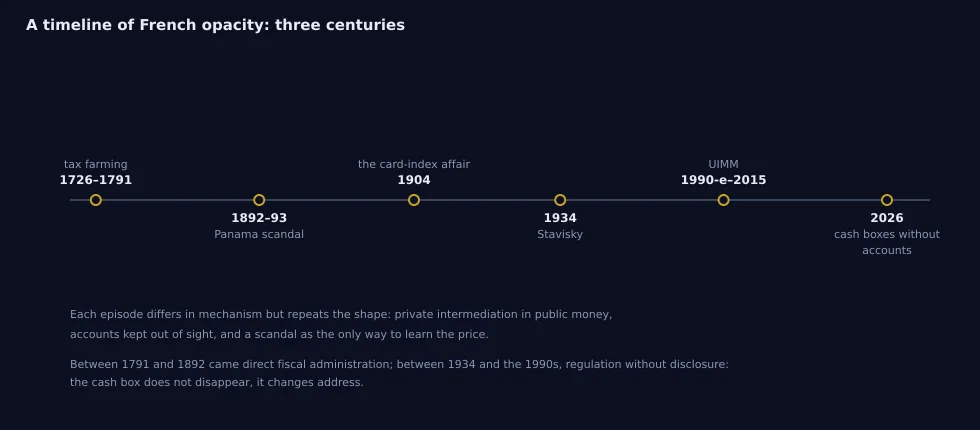
Fig. 15 – Chronology of French opacity: the general farm (1726–1791) -> Panama (1892–93) -> Fiches affair (1904) -> Stavisky (1934) -> UIMM (1990s–2015) -> cash box without an account (2026). Sources: see list of sources.
History says three things. First: an opaque cash box in France regularly grew precisely where public money passed through private or semi-public hands – the farm, the company, the fund, the association. Second: each scandal cost the Republic cabinets, and one – trust for a generation, and that was enough to feed authoritarian temptations. Third: after each crisis, the system added rules (law, regulator, register), but the foundation on which it grows again remained untouched. The fifth episode – UIMM. The sixth is described in sections 3–5 and is not yet finished. It has a chance to end in reform rather than scandal, but there is no date yet for such a reform.
12. Objections
A strong thesis must withstand objections. Below are the five most serious objections and what the material in this article does with them.
The strongest objection is numerical, and it is fair: the €4 billion is a 2011 estimate, unconfirmed by a new survey in the intervening fifteen years. But it primarily strikes at the state: at the habit of counting only what is convenient to count. No institution in fifteen years deemed it necessary to review an estimate in the billions, and this refusal constitutes half of the article’s thesis. The article uses the same order of magnitude and marks the year of the estimate. If a better figure emerges, the article will be outdated, and that is the best possible outcome for it.
Second: opacity is not the same as corruption. The French system cannot be compared to banana republics. The money described in Sections 3–6 goes mostly toward statutory activities: training, representation, social projects. Large-scale criminal cases are isolated incidents. This is true, and that is why the thesis is formulated around the absence of an account, not around theft: one cannot simultaneously assert that this money is clean and deny the taxpayer the right to see its sum. The demand for transparency is a condition for proving innocence, of which the system deprives even the honest.
Third: trade unions are weak, membership is at 8%, their influence is exaggerated, and the entire Section 3 is a giant with clay feet. The weakness of membership is part of the mechanism: an organisation living on dues depends on its members. An organisation living on the congé syndical and joint (parity) funds depends on the infrastructure and reproduces it, rather than a membership base. UIMM shows the same on the employers' side. Headcount does not measure the strength of a funding system. The weakness of membership explains why such a system does not need headcount.
Fourth: the Masons are a sociology, not a conspiracy. The lodges themselves are voluntary clubs. “Un État dans l'État” is a genre of journalistic essay. The objection is correct, and the story in Section 11 confirms it: anti-Masonic conspiracy theory (Panama, Vichy) did more harm than the lodges themselves and poisoned any conversation about the transparency of network capital. Therefore, the material sticks to the measurable: the network is not declared, lobbying is declared. The fact was recorded in the 2024 HATVP report.
Fifth, regarding the market chapter: the rise in yields and the spread is a global process (long-term US rates, oil). To attribute it to French opacity is a stretch. That is precisely why in Section 1 the spread was chosen as the indicator, while the level was mentioned only as background: the level measures the world, the spread measures the country. The decomposition is set out in Section 9. The 200-basis-point threshold has a history: in the twenty-seven years of the euro’s existence, the OAT–Bund spread breached it only once, between November 2011 and mid-2012, at the peak of the European debt crisis, exactly when France was losing its top credit rating (S&P in January 2012, Moody's in November of the same year, Fitch in July 2013). Since then the threshold has not been touched: in October 2026 the spread came within approximately 40–70 points of it. A threshold breached in a crisis that happened is a calibration. A threshold that is never breached is a decoration.
13. What can be verified: two axes, one background, four dates
Thresholds have a history, opacity has a calendar. For the first time in a long while, the French cash box faces measurable tests.
The background is chronic relative impoverishment on the Italian scenario: debt at 119–120% of GDP, growth near zero, a deficit that on the official trajectory is supposed to converge to 3% by 2029, but even the voted target for 2026 of 5.0% does not fit into this trajectory without new amendments, and the revised estimate is already 5.4%. This is a drift in which each new issue at a higher rate costs more than the previous one.
The first axis is fiscal: mimicry or storm. In the mimicry scenario, the 2027 budget is passed, the market believes in the deficit trajectory, the spread returns under 100 b.p., and the country lives like “a large Italy with nuclear weapons.” In the storm scenario, autumn 2026 repeats with less cushion: yields above 5% become the norm, the spread holds above 200 b.p., the Treasury fully moves to short-term debt, and ratings are downgraded to A–. The second axis is political: the 2027 budget and transparency. The government serves out its term until 2027 and passes the budget without a vote of no confidence, or another vote of no confidence or resignation scuttles it. The axes are independent: a storm is possible with a passed budget, and mimicry is possible with a scuttled one.
| Marker | Alert threshold (working calibration, not dogma) | What it means |
|---|---|---|
| OAT–Bund spread | sustainably above 200 b.p. for a quarter | own shock, not a global one |
| Rating | downgrade to A– by at least one agency | revaluation of the cost of the country’s entire debt |
| Moody's review | downgrade Aa3→A1 (23.10.2026) | end of the “soft” phase of pressure |
| Appeal (Libya case) | verdict 30.11.2026 | on 13.05.2026 the prosecutor again sought 7 years; entrenchment or reversal of the “Libya precedent” |
| Annual AGFPN report for 2025 | for 2024 – press release 27.11.2025, €161.55m | if by the end of November 2026 there is no report, the mirror is lagging or silent |
| Cour des comptes topic selection | participation campaign closed 22.06.2026 (1,096 topics); public funding of trade unions makes the list | first chance for an official assessment since 2011; in 2022, of 333 proposals, six were selected |
| INSEE inflation | revised release confirms ≥3.0% for September | persistence of the energy shock |
| 2027 budget | adoption without censure/resignation | stability of the political axis |
Tabl. 3 – Markers and thresholds. Calibration: the spread above 200 b.p. was breached only once – the euro crisis, 2011–2012. Statuses as of 12 October 2026: the threshold has not been breached (early October 130–150 b.p., 12 October 139.5); upcoming tests – Moody's 23 October and the appeal verdict in the Libya case 30 November.
Checks proceed on schedule. The first to come out is the revised INSEE inflation for September, in mid-October: it will become clear whether the 3.0% figure was the lower bound. On 23 October 2026, Moody's reviews the rating. Anyone who finds this article pessimistic will read this date carefully: a downgrade would turn the negative outlook into a fact, while confirming the status with a negative outlook would defer the question by six months. On 30 November – the appeal verdict in the Libya case: it will either entrench the “Sarkozy precedent” or reverse it. In December, the Treasury will publish details of the 2027 borrowing programme, and it will then become clear whether the budget will pass without a vote of no confidence. Two transparency markers remain outside the calendar. The AGFPN annual report in previous years came out by late autumn: for 2024 – the fund’s press release of 27 November 2025, €161.55m. As of mid-October 2026, there is no report for 2025 on the website, and for such a deadline that is still normal. The test is late autumn: a new figure will show whether this mirror is growing or standing still, and the absence of a report by the end of November would already be a signal. And the Cour des comptes will select topics from the 2026 participation campaign: if public funding of trade unions is among them, the four billion euros will for the first time in fifteen years have a chance of an official assessment. But in 2022, of 333 proposals, only six were selected. If none of these markers moves, that too is a result: the cash box will remain a cash box.
None of the scenarios returns France to the cushion of strength of the AAA era. The question is only whether the country will count its cash boxes before the market bills them.
14. Money without an asset
The country’s wealth is €19,559bn, and the state’s share in it is 3.5%. Promises that the main cash box made to its own employees are worth nearly twice all its assets – and they do not enter the national debt.
Until now, the discussion has focused on flows: what passes through the cash boxes, who pays, and to whom. The question of the stock remains: what is the machine itself worth if we open its own books? The first book is the INSEE national accounts, end of 2024. French wealth has been valued at 19,559 bn: households hold 14,953 bn (76.5%), non-financial companies 3,860 bn (19.7%), and the State – 690 bn, or 3.5%. The entire construction described in sections 3–9, all the funds, special accounts, and joint (parity) bodies lives on a balance sheet that weighs just 3.5% of the wealth of the very country that calculates it.
And these 690 bn are not money that can be picked up and spent. Of this amount, 2,821 bn consists of buildings, roads, and land; the financial net position is negative at 2,132 bn: liabilities exceed financial assets. In 2024 alone, the net wealth of the cash box shrank by a further 50 bn. The proportion within the net position is fixed, and FIPECO formulates it sharply: the debt is borne almost entirely by the State, while the assets belong mainly to local authorities – legally autonomous entities that cannot be sold to pay off the center’s debts.
The second book, from FIPECO, measures the same thing against annual GDP – and gives a different answer: 750 bn at the end of 2025, 25.1%. The peak was in 2007, at 62% of GDP; since then, the net value has fallen by 37 points, and this has been entirely driven by the growth of liabilities – which have reached 130.8% of GDP. There is no contradiction between 3.5% and a quarter of GDP: these are two books of the same cash box, both signed by official institutions. The perimeters, bases, and years are different – the answer depends on which book is opened.
The annual flow that must service all of this is known: the spending of all public administrations was 1,714 bn in 2025, 57.2% of GDP, the second-highest in the European Union after Finland; Germany stands at 50.5%, and the eurozone average at 49.8%. Mandatory contributions absorb 43.6% of GDP. Nevertheless, the balance of this flow – that mentioned above – is one with almost no assets.
This is where begins what is absent from both books. Maastricht debt is the only thing the European Union counts as debt: issued bonds. Promises are not bonds. Obligations toward serving and retired civil servants amount to 1,366 bn – almost half of GDP. On top of this lie guarantees – 13% of GDP according to FIPECO. A fair ladder looks like this:
| Step | Volume | Comment |
|---|---|---|
| Official debt (Maastricht) | 119.0% of GDP | Q2 2026; only issued bonds, which the market trades daily |
| Promises of civil servant pensions | +1,366 bn € | Outside Maastricht debt; loi de règlement of 22.04.2026 |
| Guarantees of public administrations | +13% of GDP | FIPECO, end of 2024 |
| Fair ladder | 165–190% of GDP | Against the official 119; not 270 "by international standards" and not ten trillion |
Table 4 – The ladder of obligations behind the official debt. Sources: INSEE (debt Q2 2026), loi de règlement 2025, FIPECO.
How the cash box lives with promises but no assets was revealed in the Cour des comptes report on civil servant pensions dated 22 September 2026. In 2025, the scheme paid 65.1 bn € to two million pensioners – one-seventh of all pension spending in the country and about fifteen percent of the State budget. There were 1.9 m payers – less than one per pensioner. The hole is covered by the employer, that is, the State itself: 85.9% of the income of the civil servant pension cash box comes from the employer’s contribution, 54.9 bn in 2025, at a rate of 78.28% of the salary for civilians and 126.07% for military personnel; apart from the Treasury, operators, local authorities, La Poste, and Orange also pay. The Cour des comptes emphasizes: the figure in the accounts is a bookkeeping convention, not a cash flow movement. Its own prescription: from the report to the 2027 budget, split the lines of the special account, and from 2029 separate the funding contours – without creating a new cash box.
The figure 1,366 itself is also a cash box, only in the accounts. A year earlier, the Treasury showed 1,573 bn: minus 207 bn in one year, and no law is involved here. Obligations are recalculated at the market discount rate; in 2025, it rose to 2.21%, the promises "cheaper" on paper, remaining the same in substance. If rates fall – the figure will grow back: the promise will not disappear.
In the expenditure lines, money is visible; in the stocks – it is not. There is money – but no assets.
15. Degradation
Degradation is not a fall, but habituation. Autumn 2026 measures the country by basis points; beneath them, slow work is taking place – the country is habituating itself to living with figures that cannot be paid for in any budget.
Let us start with a figure that was overlooked amidst the noise of budget crises. In 2025, 645,000 people were born in France, while 651,000 died: natural population increase was minus six thousand, negative for the first time since 1945, the very year when the social cash box was founded, promising to provide for everyone. On 1 January 2026, citizens aged over 65 accounted for 22.2%, while those under 20 accounted for 22.5%: the elderly are nearly on par with children. The Bank of France responds with restraint, as statistics do: growth of 0.4% in 2026, unemployment at 8.4% by year's end. None of these figures is a disaster. The disaster is their direction: all are moving in one direction and no longer reversing course.
Work statistics answer in kind. In 2025, a record 1,165,800 companies were created, and 65% of them are micro-entrepreneurs: people registering their status because nobody will hire them. The record here reads the other way round: the economy is not creating jobs, it is creating statuses. From this arises a corkscrew loop: benefits push towards micro-employment, micro-employment brings minimal contributions, minimal contributions promise a minimal pension, and the minimal pension returns one to benefits. Each turn of the corkscrew is legal, and not one of them leads the cash box to balance.
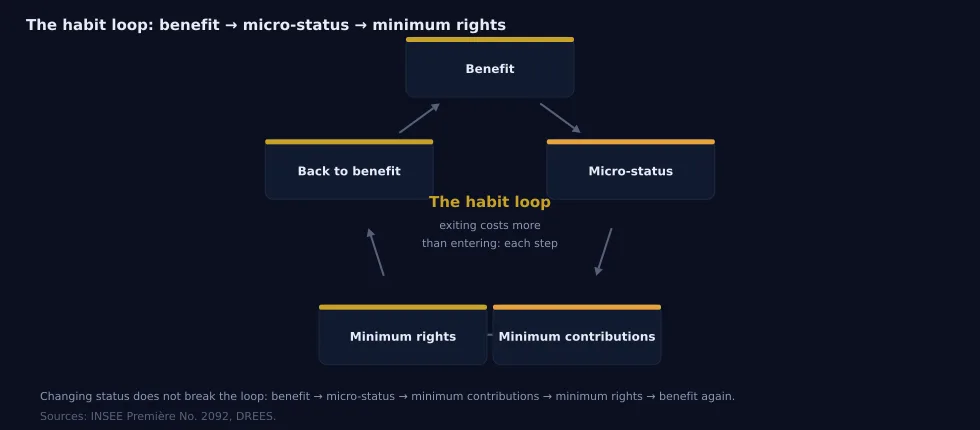
Fig. 16 – The corkscrew of habituation: benefit → micro-status → minimal contributions → minimal entitlements → benefit again. Scheme; sources: INSEE (Première No 2092), DREES.
For the pension cash box, demographics are a single ratio. In 2023, there were 1.77 contributors for every pensioner: 30.4 million workers against 17.2 million pensioners. The ratio does not move: 1.75 in 2021, 1.77 in 2022, 1.77 in 2023; the reform that raised the age to 64 has not yet influenced the ratio. In the sixties, four people worked for every pensioner; today, it is fewer than two. All pension arithmetic happens inside this number: either the promises are recalculated to fit 1.77, or 1.77 will not hold up against the promises.
Promises that have no underlying asset were once converted into debt: how this "temporary" solution looks is shown by CADES – the 1996 fund created to retire the debt of the social cash boxes. A "temporary" tax of half a percentage point was introduced for it. The tax is thirty years old, and the fund's liquidation date has been postponed not once: it is now the end of 2033, and the 2022 rule already allows the fund to survive that date if new debt is transferred to it. The cash box created to close the cash box is not closed.
Habituation is visible even where the cash box meets the individual. Minimum benefits cost €31.6bn a year (2023 data), received by 4.25 million people. RSA is paid to 1.81 million households – one percent fewer than a year earlier; the record in company creation and the outflow from RSA are the same landscape viewed from two angles: people register statuses because there are no contracts, and the benefit is cut under micro-income rules. Above this, the habit is paid for by employers: approximately €75bn a year in contribution exemptions, of which nearly €39bn is on wages up to 1.6 SMIC. This is the price the cash box pays so that someone will hire those whom the market will not take without a discount. None of these figures adds up with the others into a general account – a familiar device.
For forty years, this arithmetic was resolved in one way: it was not resolved. Social security of 1945 was built on the calculation of infinite growth; the "glorious thirty years" were just beginning. In 1983, the retirement age was lowered to sixty – under a demographic reality that no longer existed. Then came the nineties: the Balladur reform of 1993, the Juppé plan of 1995, buried by strikes, the Fillon reform of 2003, and the Woert reform of 2010 – each time the promises were slightly trimmed and slightly postponed, while the cash box was left untouched. The 2023 reform with an age of 64 is the same technique: the promise is shifted, and the cash box without an account remains a cash box.
The fork in the road ahead is not about economics, but about arithmetic. The first path – to recalculate promises openly: to acknowledge that, with a coefficient of 1.77 and a decrease of six thousand in growth, the old cash box does not balance, and to rewrite it in front of the voters. The second path – not to recalculate: to finance the habit with credit, to wait for the return of low rates, and to hope that the recalculation will be done by someone from the outside – the market, rating agencies, Brussels. The first path is politically expensive: the Juppé plan was buried by strikes, and the reforms of Fillon and Vermeulen were only passed in a reduced form. The second path has already been paid for by the spread in Section 1. The choice of October 2026 requires no decision; October will simply show how much credit remains for the habit.
What the cash box shows
The collected data describe a system that is difficult to fit into old categories. The country's aggregate wealth is growing and reaching records. Debt is growing faster, and the state, which pays for all of this, has almost no assets: 3.5% of the country's wealth and a quarter of the annual GDP in net value. Inflation has returned through energy, which accounts for only 7.6% of the statistical basket. Trade unions, associations, and funds, through which the state distributes social peace, live on money that has no consolidated account. History shows that this system has been reproducing itself for the third century.
Was it an accidental layering or a mechanism of elite consensus? No one will say in advance: mechanisms are not acknowledged while they are working. But one thing is visible from the arithmetic: the rules of the game, whereby the treasury pays everyone and does not know exactly whom, require reconsideration in a world where every extra 100 basis points cost the budget billions of euros a year. Understanding the mechanism is half the defence against it. The other half is the account that will either appear or be postponed again.
In the land of cash boxes, the word "opacity" has for centuries meant one thing: the glass through which the taxpayer is shown someone else's account. A small fragment of that glass is already standing: AGFPN sends the government and parliament a report on the public accounts of the confederations every year. The real test will begin when the glass is turned over to show the entire display case: let them show their own.
Sources and materials
- INSEE. Quarterly national accounts: public sector debt, Q2 2026 (€3,595.5bn, 119.0% of GDP; Informations rapides No 239, 29.09.2026); Informations Rapides: In September 2026, consumer prices rose by 3.0% (preliminary estimate); Household saving rate (17.9% in Q1 2026; 17.2% in Q2 2026, published 28.08.2026).
- INSEE. Family Budget Survey (Insee Première No 1771, 2017 survey: €2,530/month; share of housing expenditure: approximately a quarter, up to a third including utilities and insurance; a series of waves ranging from 23.7–31.7%).
- France-Inflation. Understanding the INSEE basket: 263 consumption items; aggregate weights (energy 7.6%; food 14.68%).
- INSEE / service-public.gouv.fr. 2026 SMIC: €12.02/hour, gross €1,823.03 (01.01.2026); €12.31/hour, gross €1,867.02 (01.06.2026).
- Agence France Trésor. France's credit ratings: Moody's Aa3/negative, next review 23.10.2026; Fitch A+/stable (28.08.2026); DBRS AA/negative (18.09.2026).
- Fitch (12.09.2025): France AA– → A+; S&P Global Ratings (17.10.2025, unscheduled): France AA– → A+/A-1; France24 (18.10.2025); WSJ (17.10.2025). Loss of AAA: Washington Post (13.01.2012) – S&P AAA → AA+; Moody's (19.11.2012) – AAA → Aa1; Bloomberg (12.07.2013) – Fitch AAA → AA+.
- AFT / Banque de France; BFM, a French business news channel (16.09.2026). Structure of holders of market debt: non-residents – approximately 56% (end-2025; 50.1% at end-2022); among residents – banks, insurers, pension funds, and asset managers.
- EFG International; Morningstar; Trading Economics; TwentyFour AM; ECB. French debt crisis, October 2026: OAT–Bund spread at 130–150 bps in early October, peaking at nearly 160 (highest since 2012), yield around 4.9% (4.96% at one point), euro at a 17-month low; spread >200 bps – euro crisis, November 2011 – mid-2012.
- Bloomberg via Seeking Alpha; CNBC. Record borrowing of ~€340bn for 2027; debt at 119.3% of GDP (2026 forecast).
- INSEE. Public sector accounts in 2025 (Insee Première No 2106, May 2026; initial estimate – Informations rapides of 26.03.2026): deficit of €152.5bn – 5.1% of GDP (following €169.1bn – 5.8% in 2024); sub-sectors: General government −€128.1bn (following −€151.1bn), Local authorities (APUL) −€15.6bn (following −€17.8bn), Social security (ASSO) −€6.7bn (following +€1.1bn; first deficit since 2021), Other (ODAC) −€2.2bn; economie.gouv.fr: treasury execution of the state budget −€124.7bn (2025, different basis).
- Senate, report a25-126 (PLFSS-2026): planned social security deficit for 2025 – €23bn (healthcare −€17.2bn; old-age pensions −€6.3bn); actual per INSEE national accounts – −€6.7bn; National Assembly, bill No 3211: −€21.8bn (2026); La Tribune: 2027 target – €12.7bn; Cour des comptes (July 2025): deficit of all pension schemes €6.6bn (2025).
- Le Monde (15.12.2011); Radio France. Chirac's verdict: two years suspended, sham positions at the Paris city hall; first convicted former president of the Fifth Republic.
- Le Monde / JDD (11.09.2011; 17.11.2011); Le Figaro, France 24, Le Parisien (16.11.2011); BBC. The Bourgi case: ~20 m $ to Chirac and Villepin during 1995–2005 from leaders of Gabon, Congo, Burkina Faso and Côte d’Ivoire; investigation dropped (classement sans suite).
- Euronews (16.03.2011): interview with Saif al-Islam Gaddafi; Guardian (15.11.2016), Mediapart (2012): estimate of ~50 m €; Mediapart (2012): publication of a memo from Libyan intelligence, signed by the name of Moussa Koussa, then head of Libya’s foreign intelligence; Koussa’s statements regarding the forgery – since 2012; first instance court: “probable forgery” in the verdict (Mediapart, 26.09.2025). TV5Monde/Information, BBC Afrique: funding of the 2007 campaign not established by the court despite a confirmed transfer of 6.5 m €. Reuters, BBC, NYT (25.09.2025): Sarkozy – 5 years for criminal conspiracy (Libya); Le Monde, Libération (10.11.2025): 20 days in Saintes; Le Monde, France 24 (13.05.2026): in the appeal the prosecution demands 7 years and 300 000 € (Gehan – 6, Ortefeux – 2); Transparency France (16.03.2026): communiqué regarding the appeal trial; juspoliticum (01.06.2026): appeal hearing 16.03–27.05.2026; Euronews, BFM (27.05.2026): verdict – 30.11.2026.
- franceinfo; Wikipédia (Intervention militaire de 2011 en Libye). Chronology of the intervention: recognition by France of the NTC in Benghazi – 10.03.2011; Arab League request for a no-fly zone – 12.03.2011; UN Security Council resolution 1973 – 17.03.2011; first strikes – 19.03.2011.
- Reuters (20.06.2025); Al Jazeera; World Nuclear Association; Africa Business Insider. Niger: revocation of the Imouraren licence (June 2024); loss by Orano of operational control over Somair (December 2024); announced nationalisation of Somair (June 2025); revocation of the Arlit concession (2026).
- UEMOA (the West African monetary union), Council of Ministers (Abidjan, 21.12.2019); French Ministry of Economy, communiqué 21.12.2019; Jeune Afrique. The 2019–2020 CFA franc reform: France’s convertibility guarantee retained; the requirement to centralise 50% of foreign exchange reserves in the Treasury’s operational accounts lifted; the transition to the “eco” deferred by decision of the African parties.
- France 24 (10.10.2025); info.gouv.fr (06.10.2025); Wikipédia (Gouvernement Lecornu II). Lecornu’s resignation – 06.10.2025, reappointment – 10.10.2025.
- Le Monde (12.11.2003); Le Temps. The Elf case: convictions of Le Floch-Prigent and Sirven (5 years), Tarallo (4 years); Le Canard enchaîné (10.10.1979): Bokassa’s diamonds (~1 m francs); Wikipédia, Reuters: “Angolagate” – J.-P. Mitterrand in Saintes 21.12.2000–11.01.2001, suspended sentence.
- vie-publique.fr; Euronews; LCP (08.09.2025): Barel’s vote of no confidence – 194 votes in favour, 364 against, 15 abstentions.
- ECB; Banque de France. ECB rates: series of increases from July 2022, deposit rate 4% in 2023. franceinfo; Wikipédia (Retrait militaire français d'Afrique de l'Ouest): military withdrawal 2022–2025, Dakar – 17.07.2025.
- Trading Economics: 10-year Bund 3.48% (07.10.2026); Boursorama (08.10.2026): 3.50%; Reuters (07.10.2026): OAT–Bund spread nearly 160 b.p.; Yahoo Finance: ~140 b.p..
- WSWS (28.02.2012, wsws.org/francais/News/2012/fev2012/perr-f28_prn.shtml): overview of African allegations against the presidents of the Fifth Republic – used as a lead; facts cross-verified against primary sources.
- Assemblée nationale. Commission d'enquête on union funding, rapporteur – Nicolas Perchoire (Nouveau Centre, Loiret), 2011 (~4 bn €/year); rejected by the committee on 30.11.2011, not published; Le Monde (06.12.2011) "Union money: the report buried"; breakdown: direct subsidies ≥175 m € (4–5% of the total) – TF1 (24.06.2016); dues ~11% – iFRAP.
- Cour des comptes: early 2018 – noted improvements in the transparency of union funding; May 2024 – report on AGFPN (S2024-0673); enforcement of the law of 20.08.2008. AGFPN: annual reports of the confederations and annual reports of the fund; data (133.6 → 147.2 → 161.55 m €, 2021/2023/2024).
- Loi n° 2014-288 of 5 March 2014 (vocational training, employment and social democracy) – creation of a social dialogue funding fund; AGFPN (management association, March 2015); Décret No. 2026-806 of 21 August 2026 (procedure for publishing the accounts of organisations with income below 230,000 €, entering into force on 15.01.2027; Légifrance, the French legal database; JORF of 22.08.2026); loi n° 2008-796 of 20.08.2008; loi Rebsamen of 17.08.2015.
- BFM Business (20.01.2023). CFDT treasury: 141 m €; Le Figaro (2023): inter-union cash box 3.6 m € (Leetchi); CGT Solidarité: 3.2 m €.
- Tracfin/Cairn ("Derrière l'affaire UIMM"): referral to the Paris prosecutor on 24.09.2007; BNP alert – May 2004 (Les Échos, 29.10.2007; Mediapart, 05.10.2013); Les Échos (Oct. 2007). Challenges (11.12.2024): 16.5 m € in cash cited in court (withdrawn between 2000–2007); "près de 18" [nearly 18] – Les Échos (26.10.2015); up to 19 m – franceinfo (11.2011). EPIM: 0.2‰ of gross wages, 0.4‰ from 2001, total ~290 m € (Le Monde, 23.10.2007; Challenges; Wikipédia). Verdict of 10.02.2014: 3 years (1 year suspended) + 375,000 € for abuse of trust and concealed employment; UIMM as a legal entity – 150,000 € (Radio France, Ouest-France, l'Opinion, Les Échos, Mediapart); appeal on 01.12.2015: 2 years suspended + 100,000 € (Le Monde, Le Parisien).
- Observatoire Hexagone / JDD (September 2026); Senate, report r25-860 "Who finances the public interest?" (9.52 bn € in direct subsidies in 2024); Le Figaro (02.07.2025): "120 bn € escape oversight".
- Valeurs Actuelles per Cour des comptes. Inter-communal unions: 18 bn € in operating revenue (2024), 20 bn € in debt.
- INSEE. Revenus et patrimoine des ménages (2024 data, gross): median 205,000 €; mean 374,900 €; D9 857,700 €; top 1% >3 m €; top 10% – 47.9% (inegalites.fr per INSEE); vie-publique (15.12.2025): top 10% – "half"; bottom half – around 8% (la finance pour tous, per INSEE, 15.12.2025). Dynamics of the top 1%: 16% (1984) → 24% (2022) – Ouest-France (12.09.2025).
- OECD. Collective bargaining / trade union density: Iceland ~90%, Denmark ~60–67%, Sweden ~66%, Finland ~65%, France ~8%. Ghent system (unemployment insurance funds managed by trade unions under state subsidies): nordics.info; Van Rie & Marx (2002); American Progress. Italy – 30.2% (worker-participation.eu); Germany – ~15%.
- iFRAP (Fondation IFRAP). «Il faut publier le rapport Perruchot sur le financement des syndicats»: around 90% of trade union resources – employer funding, primarily public; «Réformer le syndicalisme»: share of membership fees ~11%.
- Reporterre. FNSEA: 783 amendments submitted by MPs "handed over" since 2024; L'Express: «FNSEA – so strong, so fragile».
- Transparency France. Communiqué of 16.03.2026 regarding the appeal proceedings (Libyan case); position on the 12th anniversary of HATVP (July 2026).
- Le Paysage associatif; Observatoire Hexagone. Estimates of public funds for associations (see Fig. 10).
- Le Parisien (09.03.2018). «Ces francs-maçons de l'Assemblée»: 200–250 parliamentarians; Le Nouvel Obs (2013): 150 parliamentarians; Sophie Coignard. Un État dans l'État (Albin Michel, 2009); L'Express: «the influence of lodges in the highest echelons is still very great»; France Culture: 250 years of GODF.
- HATVP. Rapport sur la transparence de l'influence étrangère, 2024 (lobbying is declared; network influence – no).
- L'Histoire. L'« affaire des fiches », un scandale républicain (1904); History Today; Universalis; Larousse. General farming / Ferme générale (1726–1791; 28 general farmers executed on 08.05.1794, including Lavoisier).
- Britannica; Jewish Currents; Wikipédia. Panama scandals (1892–93): ≥104 bribed, losses >1.8 bn francs, 800k depositors; Stavisky (1934): Crédit municipal de Bayonne, 6 February 1934, 17 killed.
- Circana via Ouest-France. MDD share 35.6%, +3.5 pp over three years; IntoTheMinds; Publidée: MDD 32–35% cheaper than national brands.
- AFT (aft.gouv.fr): France ratings (Fitch A+ stable, 28.08.2026; DBRS AA negative, 18.09.2026; Moody's Aa3 negative, review 23.10.2026); 2027 borrowing programme (339.7 bn €; debt service 62.6 → 72.9 bn €; 29.09.2026).
- INSEE. Bilan démographique 2025 (Insee Première No 2087, 13.01.2026): 645,000 births, 651,000 deaths, natural increase −6,000 – negative for the first time since 1945 (vie-publique, 13.01.2026); as at 01.01.2026: 69.1 m residents, 22.2% – 65 years and older, 22.5% – under 20 (Le Monde, 13.01.2026).
- Banque de France. Projections macroéconomiques intermédiaires (15.09.2026): growth 0.4% in 2026; unemployment 8.4% by year-end.
- INSEE. Les créations d'entreprises in 2025 (Insee Première № 2092, 28.01.2026): a record 1,165,800 creations; 758,600 micro-entrepreneurs (65%).
- INSEE/DREES (the statistics service of the social ministries). Contributors, retirees and dependency ratio across all regimes: 2023 – 30.4m contributors and 17.2m pensioners (1.77); series: 1.75 (2021) → 1.77 (2022) → 1.77 (2023).
- Légifrance. Act settling the 2025 accounts (22.04.2026), general account of the State: liabilities for civilian and military pensions – €1,366bn on 31.12.2025 (approximately 46% of GDP); 2024 – €1,573bn (National Assembly, reply to question no. 17703, 11.08.2026); discount rate of 2.21% in 2025, downward recalculation due to the rise in rates (budget.gouv.fr, 30.09.2026; vie-publique; FIPECO, 20.05.2026). FIPECO: €1,283bn (perimeter excluding La Poste/Orange); Senate (03.04.2023): off-balance sheet at end-2012 – €3,091bn, 152% of GDP (Cour des comptes).
- FIPECO. Off-balance sheet commitments: guarantees of all public administrations – 13% of GDP (end-2024).
- INSEE. Wealth accounts (November 2025, data for end-2024): national economic patrimony €19,559bn – households €14,953bn (76.5%), non-financial corporations €3,860bn (19.7%), financial corporations €56bn, all public administrations €690bn (3.5%; minus €50bn in 2024); net financial position of administrations −€2,132bn; vie-publique (12.11.2025).
- FIPECO. The patrimony of public administrations at the end of 2025 (16.09.2026): net value €750bn = 25.1% of GDP (26.1% at end-2024, minus €16bn for the year); peak of 62% of GDP in 2007, since then −37 p.p. due to liabilities – 130.8% of GDP; financial assets €1,718bn, non-financial assets €2,945bn; debt almost entirely with the State, assets – mainly with legally autonomous local collectivities (summary by FIPECO). Expenditure of public administrations in 2025: €1,714bn = 57.2% of GDP (after €1,672bn and 57.0% in 2024); Germany 50.5%, euro area average 49.8%; PO 43.6% of GDP (INSEE); higher than France in the EU only Finland (57.5%).
- Contribuables associés (23.09.2026) on the report by the Cour des comptes, “Retraites des fonctionnaires de l’État” (Pensions of State civil servants) (22.09.2026): 85.9% of CAS Pensions revenue – contribution of the employer-State, €54.9bn (2025); budget rates 78.28% (civil servants) / 126.07% (military, 2025 – Senate a25-126), calculated by the Cour – 44.1%/51.2%; COR (24.11.2022): besides the State, operators, collectivities, Orange, and La Poste pay into CAS Pensions; €65.1bn of payments in 2025 to two million pensioners – one-seventh of the country’s pension expenditure and approximately 15% of the State budget; 1.9m contributors; Cour recommendations: splitting CAS Pensions line items from the report to PLF-2027, unwinding funding contours from 2029 without creating a cash box (vie-publique, ccomptes.fr, 22.09.2026).
- CADES (cades.fr); ordinance no. 96-50 of 24.01.1996 (CRDS 0.5%); S&P Global (05.2021); decree no. 2022-23: repayment deadline postponed to 2033, further extension permitted.
- DREES. Social minima: €31.6bn (2023); 4.25m recipients (end-2024, +1.3%); RSA – 1.81m households (28.11.2025, −1.1% for the year).
- vie-publique (10.10.2024): employer contribution reliefs ~€75bn; URSSAF: €73bn (2022); FIPECO: €39.1bn on wages up to 1.6 SMIC (2025).
- Cour de cassation, Social Chamber, 23.09.2026, no. 25-17.886 (in the Bulletin): annulment of the mandate of a professional union representative – union accounts published before approval by the general assembly; analyses: courdecassation.fr, UNSA (04.10.2026), CFDT (02.10.2026).
- Reuters/Boursorama (01.10.2026): OAT–Bund spread 133 b.p., maximum since May 2012; 10-year OAT 4.9629% at the moment; 2026 deficit target: voted 5.0%, refined estimate 5.4% (Fitch, 12.10.2026); ideal-investisseur.fr (12.10.2026): spread 139.5 b.p.
- AGFPN (agfpn.fr): report on loans for 2024 (press release 27.11.2025); report for 2025 as at 14.10.2026 not published. Cour des comptes, citizen participation platform: campaign 2026 (11.05–22.06.2026, 1,096 themes – Le Monde, 23.06.2026) and results of campaign 2022 (6 out of 333).