After Marketing: How Agents Are Reshaping the Market
Computation Instead of Catalog
XVII. The Market of Possibilities
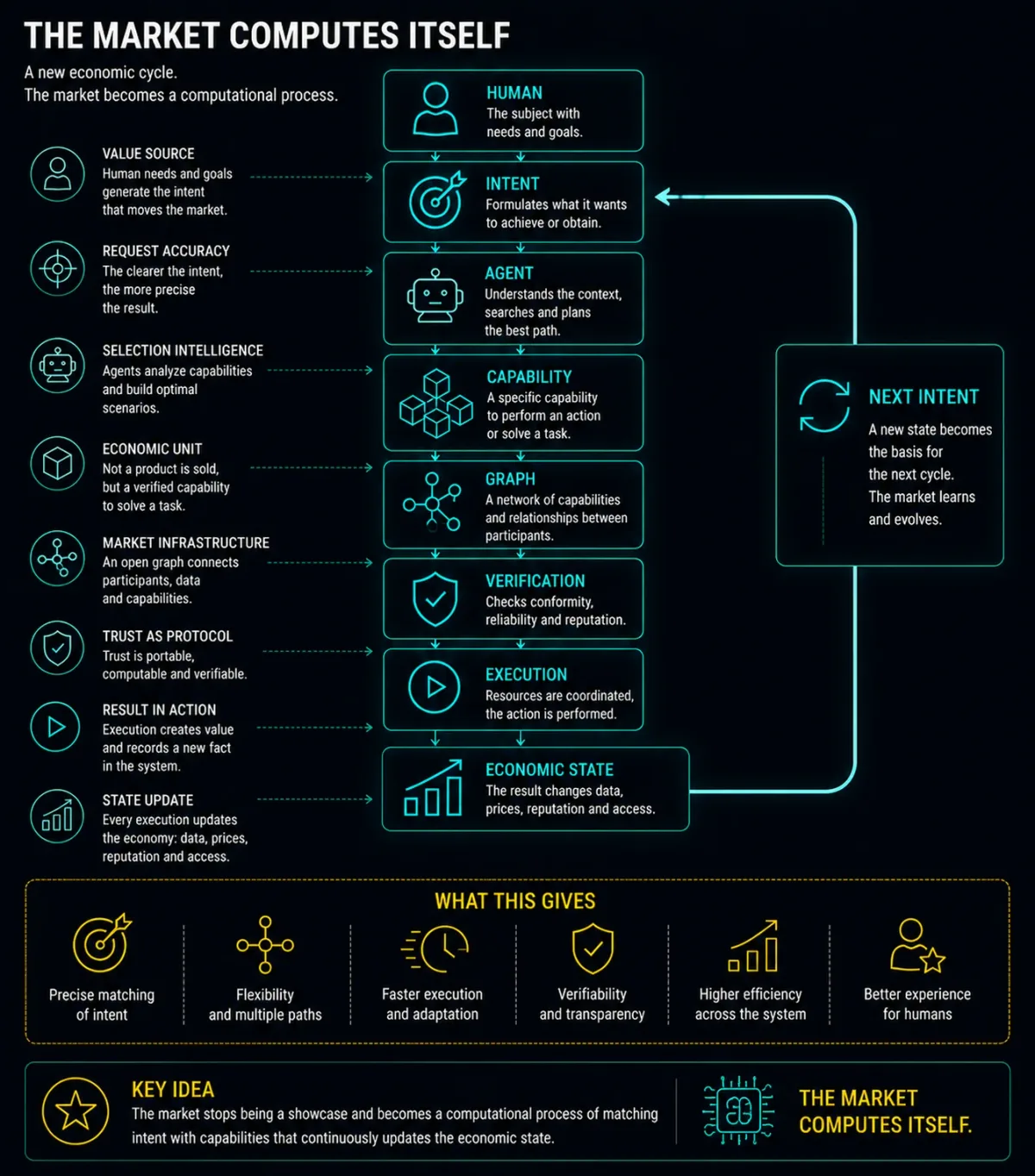
If the architecture described in part two develops far enough, the economic unit itself changes. Not the way of selling. Not the purchase interface. The unit itself.
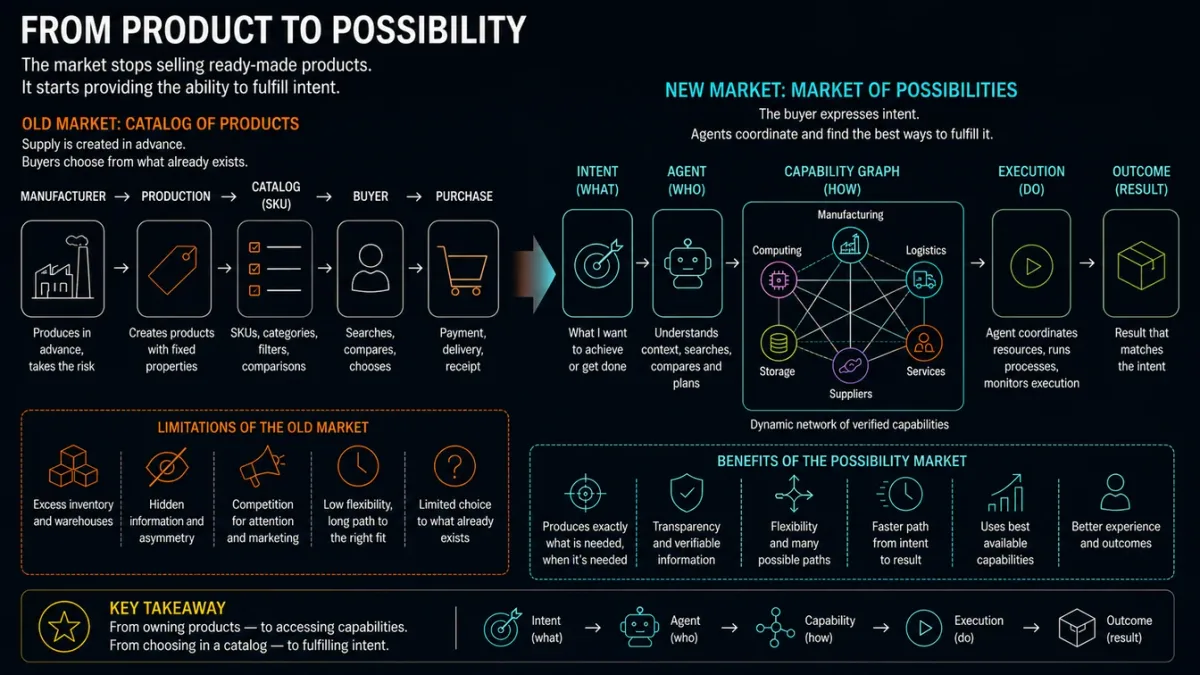
Today the market sells goods, services, and subscriptions. Concrete objects with concrete properties, produced, packaged, and displayed in advance. The buyer chooses from what exists. From what someone decided to create before learning that the buyer exists.
In the agent economy, what is increasingly sold is the capability to perform a certain action. Not an object. A function. Not a thing. A possibility. The producer does not say "here is my product", but "here is a capability I can provide". Produce ten thousand units of a given specification. Process fifty million images. Deliver cargo between two points within twelve hours. Store data with a certain level of reliability. Provide computing power of a certain class.
Then the market becomes closer to a computing system. There is intent. There is capability. There is execution. There is state. And between them there is nothing extra. No shelf. No showcase. No packaging. No slogan. Only the correspondence between what is needed and what can be done.
That is why the architecture of the economy begins to unexpectedly resemble the architecture of software. Not metaphorically. Structurally. Intent, Capability, Execution, State. The same foursome. The same principle: not to choose a pre-created object, but to synthesize a result from the available capabilities of the environment.
Why is this not a metaphor? Because the correspondence is operational, not figurative. Intent in computing is a request to the system; intent in the economy is a request to production. Capability in computing is a verified function; capability in the economy is a verified production ability. Execution corresponds to a transaction, state to the economic position of the participants, verification to the verifiability of data. In both cases the system does not choose a pre-created object, but synthesizes a result from available capabilities; in both cases trust is replaced by verification, and the unit becomes a capability, not a thing. The execution environment and the speed differ — not the principle.
XVIII. The Product as Computation
Here the most radical hypothesis appears. Not a forecast. Not a prediction. A hypothesis to which the logic of the agent economy leads with almost mathematical inevitability.
If a program can be synthesized for a task, why can't a product be synthesized for a task?
Today industry mostly works from production to demand. Factory. Batch. SKU. Catalog. Buyer. The direction is always one: from the one who creates to the one who chooses. The product exists before anyone wanted it. And the entire marketing infrastructure exists to find a buyer for what has already been produced.
But flexible production can gradually reverse the direction. Intent. Specification. Production graph. Product. The user does not choose what exists. They set parameters. And the production system determines whether it can be created, from which components, in what time, and at what price.
This could lead to personalized production, where an individual product becomes not an exception, not a premium service, not "customization for an extra fee", but the normal mode of operation. Not a luxury. The default.
But this does not mean the end of mass production. Mass production will remain where standardization is economically more advantageous. Where millions of people want the same thing. Where plastic injection molding is cheaper than individual milling. Where scale drives cost down to limits personalization will never reach.
Something else will change. Individuality will no longer necessarily require a separate production line. If the factory itself becomes a flexible computational loop, then changing a specification can mean changing the production graph, not launching an entirely new business. Not a new factory. Not a new batch. Not a new brand. Simply a different sequence of operations on the same equipment. A different route in the space of possibilities.
XIX. What Happens to the Brand
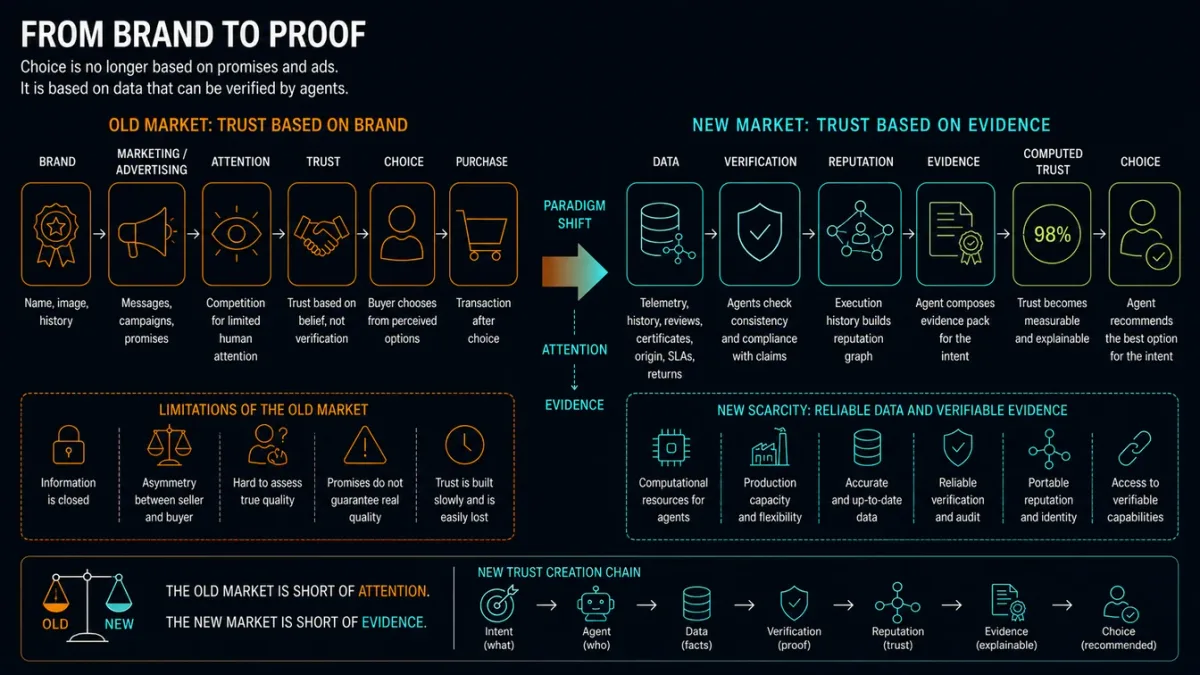
The brand historically solved the problem of trust. If the buyer cannot verify the product — and they cannot verify its chemical composition, failure statistics, or the origin of raw materials — they trust the name. The logo. A reputation accumulated over decades. A brand is a promise that is too expensive to break. It is a deposit the producer leaves in the buyer's mind.
If an agent can verify origin, quality, and execution history directly, the need for the brand as a compressed symbol of trust diminishes. Why trust a name, if you can verify data? Why believe a logo, if telemetry confirms every characteristic? Why remember a brand, if the reputation graph contains two hundred and forty-seven verifiable transactions over the last six months?
But the brand may not disappear. It may turn from an informational certificate into an element of identity. From proof of quality into a cultural marker. From an answer to the question "can this be trusted" into an answer to the question "who am I when I choose this".
"This product is good" may gradually give way to "this product matches my values". The first function is rationalizable — an agent can perform it. The second is cultural — only a human can formulate it. Therefore the agent economy may destroy a huge layer of branding tied to quality, reliability, and social proof — the layer that says "we are better than competitors, and here is why". But leave the layer tied to human identity: "by choosing us, you become part of something". Not part of a shopping basket. Part of a tribe.
XX. Marketing Moves Up a Level
And here a paradox arises that at first seems like a contradiction, but in fact is a logical consequence of all the previous architecture.
If the agent chooses rationally, marketing does not disappear. It moves one level up. Earlier marketing said: buy this product. Then: choose this brand. In the agent economy it may say: want exactly this kind of result.
This is no longer product marketing. Not brand marketing. It is the engineering of human intent. Intent engineering. The architecture of desires.
If a producer cannot force an agent to choose an unfavorable product — and it cannot, because the agent verifies data, compares specifications, and optimizes a function — it may try to change the very formulation of the task. Not "buy our watch", but "do you want to emphasize status?". Not "buy the new car model", but "do you want to feel freedom?". Not "choose this yogurt", but "do you want to feel that you take care of yourself?".
Marketing moves from the space of choice into the space of desire formation. From competition on the shelf to competition over which intent will arise in a person's head. Not over which product will be chosen, but over which request will be formulated.
This is a subtler game. Deeper. And, perhaps, more dangerous. Because if in the old model a person at least saw that they were being manipulated — advertising is obvious, the slogan is visible, the packaging catches the eye — then in the new model manipulation may happen at a level the person does not perceive. At the level of forming the very question they will ask their agent.
XXI. An Economy Without a Catalog
Imagine a market in which the catalog is no longer the main interface. Not a showcase, not a shelf, and not a list of twenty products with photos and reviews.
A person says: I need shoes for daily walking. Not rubbing. Repairable. Light. Produced within a radius of five hundred kilometers. Without certain materials. A service life of at least two years. Color — doesn't matter, but not black.
The agent does not open a catalog. Does not type a query into search and does not flip through pages. It builds a specification. Sends it into the graph. Producers respond with capabilities. Other agents provide operating history. Production agents calculate cost. Logistics agents propose routes. Verifiers check the declared characteristics.
Then the system does not choose the most famous product. Not the one with more advertising, and not the one on the top shelf. It chooses the best match for the intent. The one that answers the given question most precisely. And it may be a producer the person has never heard of. One that does not spend a penny on advertising. One that simply makes good shoes and provides verifiable data.
The catalog becomes a secondary interface. It does not disappear entirely — a person sometimes wants to simply look, browse, wander. But it ceases to be the main decision-making mechanism. The market turns into a computing environment in which intent finds execution by the shortest verifiable path.
XXII. Scarcity Changes Address
In the traditional market, scarcity is human attention. Thousands of brands compete for attention. Billions are paid for attention. Attention is measured, sold, resold, optimized. The entire advertising industry is a machine for extracting and monetizing human attention.
In the agent market, attention ceases to be the main constraint. An agent is capable of analyzing a huge number of offers simultaneously. It does not need to "pay attention". It does not get tired, does not get distracted, does not get hooked by bright packaging, and does not memorize slogans. Therefore other things become scarce.
Computing resources. Reliable data. Verifiability. Production capacity. Reliability. Access to capabilities. Trust in the graph. Verification throughput. Quality of telemetry. Completeness of specifications.
And this is a fundamental economic shift. If earlier a producer needed to be noticeable, now it needs to be machine-verifiable. If earlier the main asset was the brand, now data, capabilities, origin, reputation, verification are gaining ever more value. Not what you say about yourself. What can be proven.
Attention was the currency of the old economy. Evidence is becoming the currency of the new one. The phenomenon that occurs with an excess of receiver throughput can be called signal inflation: signals — brand, rating, advertising — depreciate because they are no longer a scarce good. If attention was the currency and signals were the way to convert it, then removing the scarcity of attention is unbacked emission.
XXIII. Transparency as a Threat
At first glance the agent economy looks almost utopian. The consumer gets more accurate information. Producers compete on real characteristics. Intermediaries disappear. Prices become more transparent. Quality grows, because poor quality is immediately visible. The market becomes more honest, because lying becomes unprofitable.
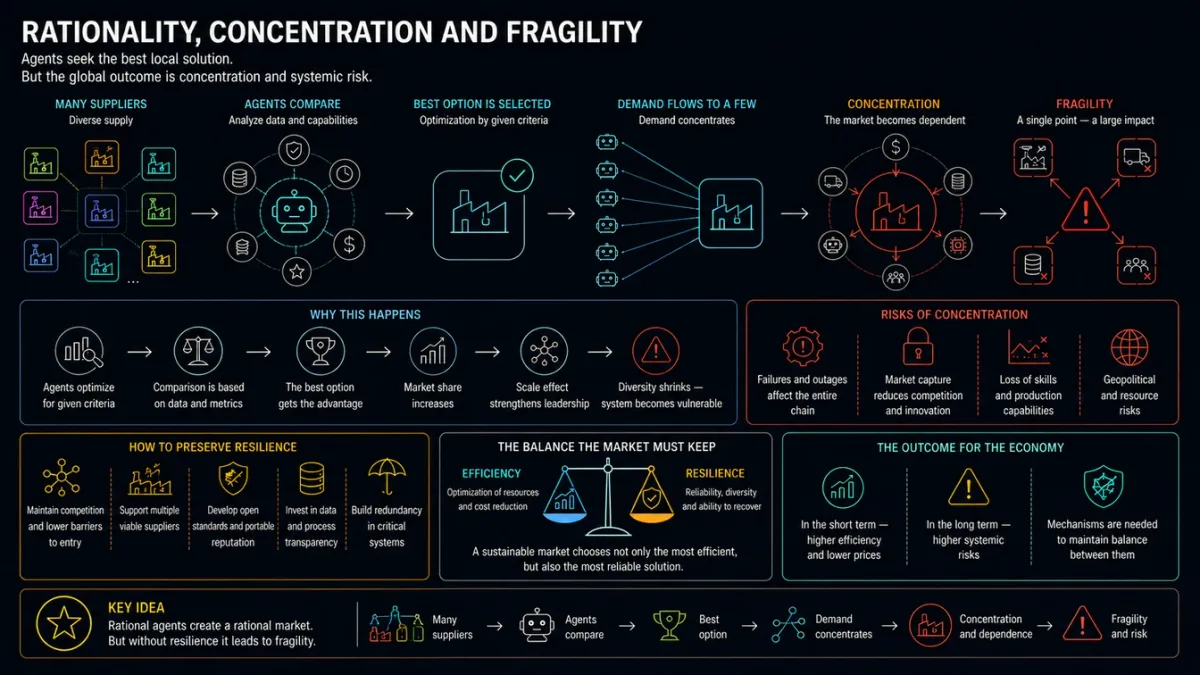
But transparency can strengthen concentration. If the agent system finds one producer that is best on price, quality, and reliability, millions of agents may choose it simultaneously. Not gradually. Not with a delay. Not with human inertia. Simultaneously. In one computing cycle.
The result is a paradox: the more rational the market becomes, the more strongly it may tend toward monopoly. Not because someone builds it or buys out competitors. But because rationality itself is a force of concentration. It does not distribute. It gathers.
Humans create noise. And noise is a source of resilience: it keeps many producers alive, even when one is slightly more efficient than the others, supports local brands out of a sense of community, chooses the worse option out of habit. This irrationality creates redundancy, and redundancy saves the system when the best producer suddenly stops working. Machine optimization removes this noise — and with it the insurance. Therefore the agent economy may have to deliberately preserve economic diversity. Not because it is always efficient. But because it is insurance against systemic failure. Not optimality. Resilience.
XXIV. The Protocol War
And here the main political question arises. Not economic. Not technological. Political.
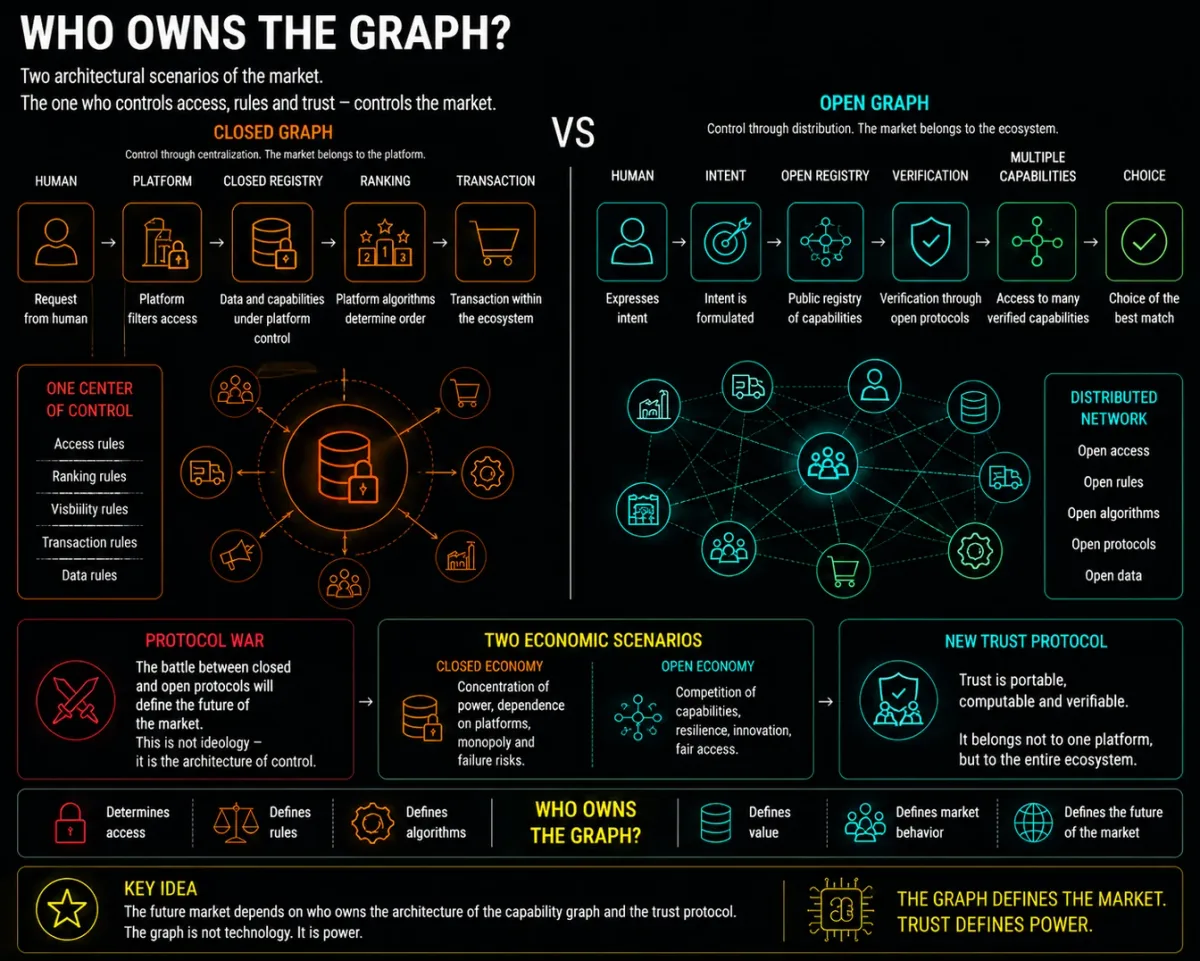
If earlier power belonged to whoever controlled the catalog, the store, advertising, attention, then in the new system power goes to whoever controls intent, capability, reputation, ranking, transaction. That is, the graph of economic interactions. The very fabric from which the market is woven.
As we saw in part two, control over the catalog is control over supply, and control over the graph is control over the very mechanism of forming supply and demand. Not over what is sold, but over how the decision to buy is made.
Therefore the struggle of the future economy may no longer be over brands. Not even over stores. Not over advertising budgets and not over market shares in the usual sense. It may be over the protocol of choice. Over the standard by which agents communicate. Over the format in which capabilities are published. Over the mechanism by which trust is computed.
Whoever writes this protocol will not own the market. They will own something bigger. They will own the rules by which the market exists.
And this fork is no longer hypothetical. Between October 2025 and April 2026, more than ten payment protocols for AI agents were launched almost simultaneously — Coinbase, Stripe, Lightning Labs, Google, Visa, Mastercard, American Express, OpenAI, Alibaba — and none of them is compatible with the others. x402 (a protocol based on HTTP 402, launched in May 2025, now developed under the Linux Foundation together with Visa, Mastercard, Stripe, Google, AWS, and Shopify), MPP, co-authored by Stripe, L402 from Lightning Labs; on top of traditional card networks — Visa TAP and its Intelligent Commerce, Mastercard Agent Pay, Amex ACE, Google AP2; commercial standards Google/Shopify UCP and OpenAI ACP. In parallel, MCP (Model Context Protocol from Anthropic, November 2024) has become the de facto standard for connecting tools to agents — and already determines which capabilities agents see at all. The irony is that our own system stands precisely on this layer: for us MCP is not a hypothesis but a working infrastructure, and we feel its power over the visibility of capabilities every day. The protocol war this chapter speaks of is not in the future: it is happening right now, between specific players, and the stake in it is precisely that fabric of the market through which the economy makes decisions.
XXV. Two Worlds
From here two fundamentally different scenarios arise. Not two variants of technology development. Two variants of how society is organized.
The closed agent economy. A person formulates intent. The platform agent accepts it. A closed registry of capabilities provides options. A producer gets access to the market only through the platform: the platform knows the user's intent, controls capabilities, owns the reputation graph, and determines the order of choice. In such a world marketing indeed becomes unnecessary — but in its place a new intermediary appears, one that does not show ads but decides whether you exist. It does not charge per click, but charges for presence; it does not sell attention, but sells the right to be found.
The open agent economy. A person formulates intent. The intent enters an open graph containing the capabilities of many producers. Verifiers confirm characteristics. The agent chooses between independent sources. Capabilities, reputation, and data are portable and verifiable. A producer can publish its capabilities without the platform's permission.
Only here can we speak of a truly new market architecture: no node is mandatory, trust is distributed, power is not concentrated in a single point.
XXVI. The New Trust Protocol
For the open model, creating one more catalog is not enough. One more database. One more marketplace with a beautiful interface. What is needed is a decentralized registry of capabilities that links several objects into a single verifiable chain.
Identity. Capability. Origin. Evidence. Verification. Reputation. Each element is linked to the previous one. Each element is verifiable. Each element has a source that can be established independently.
And most importantly — these links must be portable. The agent does not ask: what rating does this producer have on your platform? It asks: what verifiable evidence exists about its ability to fulfill this intent? And gets an answer that does not depend on who answers. That can be verified. That is not an opinion. Trust ceases to be a platform's assertion — "we guarantee", "you can believe us". It becomes a computed property of the graph: a function of observable events, a number that can be obtained from data. Not faith. Computation.
XXVII. The End of Meaningless Distinctions
In such a system, sales promotion in the usual sense may lose a significant part of its meaning. Not because there will be nothing to sell. But because the very mechanics of selling will change beyond recognition.
Let's imagine a milk producer. Today it can create ten varieties. For kids. Premium. Farm. Organic. Sports. For coffee. Family. Ultra-premium. Local. Special edition. Ten packages. Ten ad campaigns. Ten positions on the shelf. Ten design budgets.
Then marketing must convince people that each of them is different. That between "for coffee" and "premium" there is a real difference worth paying for. That "farm" is really farm, not just a word on the label.
But if an agent sees the real composition, characteristics, and price, a different question arises. Are ten products really needed? If one product satisfies ninety-five percent of intents, the other nine may turn out to be economically meaningless. Not unnecessary to the market. Meaningless as separate positions. As separate SKUs. As separate objects of marketing.
And then the market begins not to multiply distinctions. It begins to eliminate meaningless distinctions. Not all distinctions. Those that have no computable basis. Those that exist only as a signal. As a reason to take a place on the shelf. As a pretext for advertising.
Diversity does not disappear. But it must receive a computable basis. If a separate characteristic truly satisfies a separate class of intents — it will remain. If it exists only as a marketing signal, as a reason for positioning, as a way to take more space in the buyer's mind — it may disappear. Not because someone banned it. But because the agent sees no meaning in it.
XXVIII. A Temporary Solution
In the limiting case, the product ceases to be a final object. Ceases to be a thing that is bought, put on the shelf, and forgotten. It becomes a solution to a specific task. A temporary execution of a specific intent. A physical embodiment of a computational request.
The user does not so much buy a product as acquire a result. Not boots, but two years of comfortable walking. Not milk, but three percent fat within a radius of three hundred kilometers. Not a car, but mobility with certain parameters of speed, cost, and environmental footprint.
This is very similar to the transition from buying software to computing. In the old model we bought a program. A box. A license. An object that became our property. In the new model we get a computation. A function. A result that exists exactly as long as it is needed.
In the old economy we buy a product. In the potential agent economy we may buy the satisfaction of intent. The product becomes the physical execution of a computational request. A temporary state that exists between the moment intent was formulated and the moment it was executed. And then — the next intent. The next execution. The next state.
XXIX. The Market Does Not Disappear
It is important not to make one more mistake. Not to decide that if agents can optimize transactions, it means the end of the market. The end of trade. The end of the economy. The end of exchange.
On the contrary. The market may become much denser. Much more active. Much more saturated with interactions.
Today a single human transaction requires search, comparison, negotiation, verification, payment, delivery. Each stage takes time. Each stage requires attention. Each stage is limited by human throughput. A person can make three to five conscious purchases a day. Can compare a dozen options. Can spend an hour negotiating.
In the future, most of these operations may happen automatically. Billions of agents will be able to constantly search for the best combinations of price, quality, risk, time, production, logistics. Not once a day. Not once a week. Constantly. In the background. Like a processor that does not stop between tasks, but simply switches.
The number of interactions will grow by orders of magnitude. But human participation in each of them will shrink. The market will cease to be a place a person comes to for shopping. Will cease to be an event. Will cease to be an action that needs to be performed. It will become a background computational process. Like breathing. Like a heartbeat. Like data synchronization that happens by itself while you are doing something else.
The market will not disappear. It will become invisible.
Horizon: Two Bets
Everything said above can be refuted, and that is right: a forecast that cannot be verified is not worth the position it occupies. Therefore let us fix two bets with a verification horizon.
The first bet concerns the purest layer of signal compression — search advertising. By 2028, the cost of customer acquisition through search advertising in categories with verifiable specifications (electronics, batteries, components — goods where the decision is determined by measurable parameters: capacity, speed, compatibility) will fall faster than in identity categories (clothing, cosmetics, where image and cultural signal decide). The logic: an agent capable of verifying a specification does not need an advertising signal; an agent choosing by identity does. The metric is fixed in advance: the share of search advertising in customer acquisition cost across the two groups of categories, according to open reports from eMarketer and Similarweb (digital advertising benchmarks by categories of electronics, components, clothing, and cosmetics). The bet is considered won if by the end of 2028 the gap in dynamics between the groups is at least ten percentage points. Refutation: a gap of less than five points, no gap, or insufficient granularity of public data for verification — in the latter case the bet is recorded as unverified, not won.
The second bet is on a live tracker: by 2028, agent payments via open protocols (x402, MPP) will exceed one percent of online transactions in at least one major region. The baseline already exists: by April 2026 the cumulative volume of x402 was estimated at tens of millions of dollars, and metrics are published by x402 Foundation participants — they can be tracked in real time. Three outcomes are fixed in advance. First: by 2028 open protocols reach one percent in a region — the bet is won. Second: the protocols live, but volumes are below one percent — the bet is refuted. Third: open protocols are displaced by closed payment systems (Apple Pay, Amazon Pay, platform wallets), and the public metric disappears — then the outcome is recorded as "open protocols lost". This in itself is a substantive result: it confirms the risk of the closed model from chapter twenty-five, but the bet in its original formulation is considered not won.
XXX. After Marketing
And here we return to the original question. To the one we started with. What is marketing and why it is needed.
Marketing does not disappear in a day. Brands, stores, catalogs, advertising, packaging, slogans, logos, and billboards do not disappear. But gradually their necessity as a mandatory intermediary between producer and choice disappears. As the only bridge between the one who creates and the one who needs.
Just as in software the necessity of pre-installing an application may disappear, but the computation itself does not disappear. The form changes. The environment remains. The function is preserved. The mechanism changes.
This is the same architectural shift described in chapter seventeen — simply at a different level: in software the attitude to the application changes, in the economy — to the product. Different environments, different speed, one principle.
The old system was built around pre-created objects. Around things that someone invented before learning that the buyer exists. Around catalogs that need to be flipped through. Around shelves you have to walk past. Around signals that need to be noticed and decoded.
The new one begins to be built around intents and the environment's ability to fulfill them. Around the request, not the offer. Around the specification, not the brand. Around evidence, not a promise. Around the graph, not the catalog.
After Choice
The entire history of the mass market can be viewed as an attempt to solve one problem: how to help a person choose in a world too complex for direct comparison. Brand, advertising, rating, catalog, marketplace — all of them are different forms of one mechanism. A compression mechanism that turns the unbearable complexity of the world into a few signals capable of passing through the narrow channel of human perception.
But an agent can work with a much larger volume of information: with full resolution, with raw data, with a graph containing millions of nodes and billions of edges. Therefore the need for the compression mechanism itself gradually disappears, for the very layer that stands between the person and economic reality. The market moves from the model "signal, human, choice" to the model "intent, graph, verification, execution". From compressed to full. From shadow to object. From faith to evidence.
This does not mean that the person disappears from the economy. On the contrary. They become the source of the most important object — intent. The only thing a machine cannot create by itself. The thing that distinguishes a request from a computation. Desire from specification. "I want" from "execute".
And then the machine's work begins. The agent forms requirements. Other agents search for capabilities. Production systems offer options. Verifiers check them. Logistics calculates execution. Financial agents close the deal. And the economic state updates automatically. Quietly. In the background. Without human participation. Without their attention. Without their choice between twenty packages.
An economy emerges in which the market no longer so much shows products to a person, as computes the correspondence between intents and production capabilities. Not a showcase. Computation. Not a shelf. A graph. Not a brand. Evidence.
And here the main question of the next economy appears. It no longer sounds like "how to sell a product to a person". It sounds differently. How to prove to the agent environment that your production capability is truly better than the alternative. Not to convince. To prove. Not to be liked. To match. Not to be remembered. To be verifiable.
But even this is not the last question. Because if billions of agents begin to choose, compare, and bargain through a common graph, an even deeper problem arises. Who controls the very graph through which the economy makes decisions. Who writes the protocol. Who defines the format. Who owns the registry. Who decides what counts as evidence and what does not.
If the graph is closed, marketing will simply be replaced by a new intermediary — more efficient, more invisible, controlling the very space of choice. If the graph is open, portable and verifiable, a truly new market environment may appear: not a new store and not a new platform, but a new fabric of economic interaction — open, distributed, verifiable, not dependent on a single center and not requiring permission to exist.
And then the main economic asset becomes no longer the brand, not the catalog, not advertising, not the promotion budget, and not logo recognition, but the ability to be found, verified, and chosen by the computing environment. The ability to exist in the graph. The ability to prove that you are real, that your data does not lie, that your history is not forged, that your capability is not a promise but a fact.
It is here that the era of the market oriented primarily at human attention ends. The era in which one had to shout louder than everyone. In which one had to be noticeable. In which the winner was the one who occupied more space in the mind.
And a market begins that starts to compute itself.